
face Archives - Page 7 of 8 - Dr. Walter Zamarian Jr.

Categoria: face

  • Deep Plane Facelift Cost Brazil

    Deep Plane Facelift Cost Brazil

    One of the most common questions I receive from international patients is straightforward: “Doctor, how much does a Deep Plane facelift cost in Brazil?” I completely understand. A facelift is a significant investment, and you deserve full transparency before making your decision.

    What I can tell you upfront is that a Deep Plane facelift in Brazil costs roughly 40% to 60% less than the same procedure in the United States or Europe — with equivalent technical quality and safety standards. But the final price depends on several individual factors that I need to evaluate in person. In this article, I’ll walk you through everything that influences the cost, what’s included, and why so many patients from abroad are choosing Brazil for this surgery.

    With over 20 years of experience and more than 8,000 surgeries performed, I can say with confidence that the Deep Plane facelift is the most advanced and long-lasting facial rejuvenation technique available today. And I believe you deserve to understand exactly what you’re paying for.

    Factors That Influence the Cost of a Deep Plane Facelift

    Unlike standardized procedures, a Deep Plane facelift is a highly personalized surgery. Every face has unique anatomy, varying degrees of aging, and different needs. That’s why the price varies from patient to patient. The main factors that influence cost include:

    • Extent of the surgery: A lift addressing only the lower third of the face costs differently than a procedure that includes the neck, temporal region, and eyelids.
    • Combined procedures: Many patients benefit from combining the facelift with facial fat grafting (Regenerative Deep Plane), blepharoplasty, or rhinoplasty. Each combination affects the final cost.
    • Anesthesia and hospital stay: The surgery is performed under general anesthesia, and the length of stay depends on case complexity.
    • Surgical team: I work with a dedicated, experienced team — a specialized anesthesiologist, scrub nurse, and nursing staff trained specifically in facial surgery.
    • Surgeon’s experience and training: The Deep Plane technique demands specific expertise. My training includes the renowned Pitanguy Clinic in Rio de Janeiro and hands-on Deep Plane training with Dr. Tim Marten in the United States, one of the world’s foremost authorities in facelift surgery.

    Price Range: Brazil vs the United States vs Europe

    While I don’t publish specific surgical fees — because every case is individualized and deserves a tailored proposal — I can offer a comparative perspective based on publicly available international market data:

    • United States: A Deep Plane facelift in the US averages between $25,000 and $50,000, and can exceed $70,000 at premium clinics in New York or Beverly Hills.
    • Europe: Prices range from €15,000 to €35,000, depending on the country and surgeon.
    • Brazil: The same procedure performed by qualified surgeons costs 40% to 60% less than in the US, with comparable technical and safety standards.

    This price difference does not reflect lower quality — quite the opposite. Brazil is a global reference in plastic surgery. The lower cost reflects the country’s economic reality, reduced operational expenses, and favorable exchange rates for foreign patients.

    What’s Included in the Price

    When I present a quote to a patient, it’s comprehensive and transparent. No hidden costs. Typically, the value includes:

    • Surgeon’s fees — covering surgical planning, the procedure itself, and all postoperative follow-up
    • Complete surgical team — anesthesiologist, scrub nurse, and nursing staff
    • Hospital and operating room — accredited facility with ICU availability and full equipment
    • Surgical materials and supplies
    • Postoperative consultations — regular follow-ups throughout the entire recovery period
    • Compression garment and other post-surgical items as needed

    For international patients, I also provide logistical support — recommendations for nearby accommodations, transportation arrangements, and remote follow-up after you return home.

    Deep Plane vs SMAS: Why Does the Deep Plane Cost More?

    There’s a fundamental technical difference between the two most common facelift approaches: the traditional SMAS plication or SMASectomy and the Deep Plane technique.

    In the traditional SMAS approach, the surgeon works on the superficial layer of the face, pulling and securing tissues in a more limited fashion. It’s a faster, technically less demanding surgery.

    In the Deep Plane technique, I release the entire deep muscular layer (the SMAS) from the facial retaining ligaments, allowing true repositioning of tissues — without excessive skin tension. This results in:

    • More natural results: No “pulled” or artificial appearance whatsoever
    • Greater longevity: Results lasting 10 to 15 years, compared to 5 to 7 years with traditional SMAS
    • Superior midface rejuvenation: The cheek area and nasolabial folds are addressed far more effectively
    • Surprisingly similar recovery: Despite being a deeper procedure, swelling and bruising with Deep Plane are comparable to SMAS

    The higher cost is justified by the technical complexity, longer operative time, and — most importantly — the superior quality of results. In my exclusive technique — the Regenerative Deep Plane — I add fat grafting with stem cells, which further enhances rejuvenation by improving skin texture, volume, and overall quality.

    Is It Worth Traveling to Brazil for a Facelift?

    I regularly receive patients from the United States, Canada, Europe, the Middle East, and Asia. The short answer is: yes, it’s absolutely worth it. And it’s not just me saying this — it’s the patients themselves who return and refer friends and family.

    The most common reasons patients give for choosing to have surgery with me in Londrina, Brazil:

    • Significant savings: Even including airfare and accommodation, the total cost is typically 30% to 50% less than in the US.
    • World-class technical quality: Brazil trains more plastic surgeons than any other country, and our tradition in facial surgery is internationally recognized.
    • Privacy and peaceful recovery: Londrina is a calm city with excellent medical infrastructure, away from the hustle of major capitals. Many patients appreciate the discretion.
    • Personalized care: My team is fluent in English and supports each patient through every stage — before, during, and after surgery.
    • Surgeon credentials: I’m a member of the SBCP (Brazilian Society of Plastic Surgery), ASPS (American Society of Plastic Surgeons), and AExPI (Pitanguy Alumni Association), with hands-on Deep Plane training in the US.

    “Many patients ask me whether it’s safe to have surgery in Brazil. I can assure you that the hospital infrastructure, safety protocols, and the technical level of professionals here are absolutely comparable to the best centers in the US and Europe.”

    How the Consultation Works

    The first step to knowing exactly how much your Deep Plane facelift will cost is scheduling a consultation. During this appointment, I perform:

    • Complete facial analysis: I evaluate your facial anatomy, degree of laxity, skin quality, and bone structure.
    • Medical history review: I check health conditions, medications, and previous surgeries.
    • Personalized surgical plan: I determine which areas need attention and which complementary procedures could optimize your results.
    • Detailed quote: I present the complete cost with no surprises, listing everything that’s included.
    • Expectation alignment: We discuss realistic expectations and review photos of similar cases to align on the anticipated outcome.

    For international patients, I offer an online consultation as an initial evaluation step, so you can plan your trip with confidence. The in-person consultation fee is R$800 (approximately US$150, first visit) or R$400 (follow-up).

    My clinic is located at Rua Eng. Omar Rupp, 186 — Jardim Londrilar, Londrina, Paraná, Brazil.

    Frequently Asked Questions

    Is a Deep Plane facelift more expensive than a traditional facelift?

    Yes, a Deep Plane facelift generally costs more than a traditional SMAS lift. This is due to the greater technical complexity, longer operative time, and the specialized training required. However, considering that results last significantly longer — 10 to 15 years versus 5 to 7 — the long-term value is actually superior.

    How long do I need to stay in Londrina?

    I recommend a minimum stay of 10 to 14 days. This allows time for the preoperative consultation, the surgery itself, the critical first days of recovery, and at least two follow-up appointments before you travel home. After that period, follow-up can continue remotely via video calls.

    Can I have an online consultation before traveling?

    Absolutely. An online consultation is an excellent first step — it allows me to evaluate your photos and videos, discuss expectations, and provide preliminary guidance. However, an in-person evaluation is essential before surgery, as I need to palpate tissues, assess skin elasticity, and finalize the surgical plan with precision.

    Is it safe to have plastic surgery in Brazil?

    Brazil is one of the world’s leading countries in plastic surgery, with rigorous training programs and hospital accreditation standards. I operate in fully equipped, accredited facilities with ICU availability. My team follows the same safety protocols used at top American and European centers. Patient safety is never compromised.

    Take the Next Step

    If you’re considering a Deep Plane facelift and want to know exactly how much it will cost in your case, the path is simple: schedule your consultation. I look forward to evaluating your face, understanding your goals, and presenting a complete, transparent surgical plan.

    Reach out via WhatsApp or through the contact form on my website. I welcome patients from across Brazil and around the world, with full support in both Portuguese and English.

    Dr. Walter Zamarian Jr.
    CRM-PR 17,388 | RQE 15,688
    Member of SBCP · ASPS · AExPI
    Londrina, Paraná, Brazil
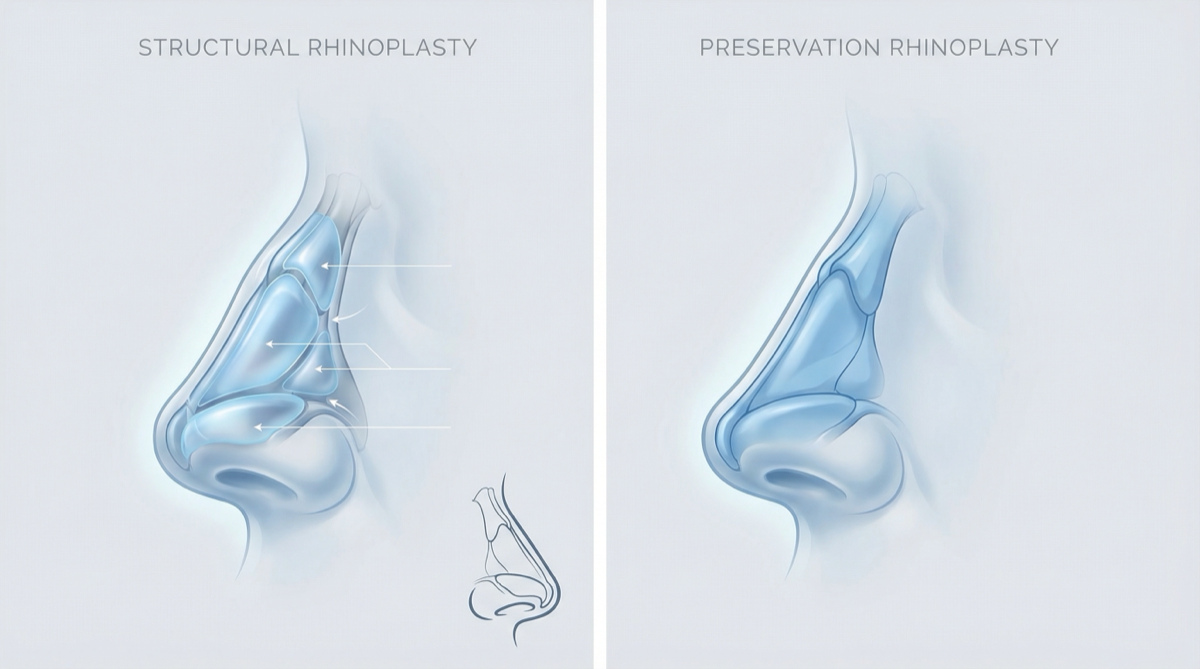
  • Structural vs Preservation Nose

    Structural vs Preservation Nose

    By Dr. Walter Zamarian Jr. — CRM-PR 17,388 | RQE 15,688

    Rhinoplasty has evolved dramatically over recent decades. Today, two surgical philosophies dominate the conversation among specialists: structural rhinoplasty and preservation rhinoplasty. But which is better? The answer, as often in surgery, is: it depends.

    In this article, I’ll explain the differences between these approaches based on my 20+ years of experience in rhinoplasty and thousands of noses operated.

    What Is Structural Rhinoplasty?

    Structural rhinoplasty was introduced in 1989 by Drs. Johnson and Toriumi. The core principle: use cartilage grafts to reconstruct and reinforce the nose’s structure, rather than simply removing tissue.

    In practice, we use the patient’s own cartilage — usually from the nasal septum, and when needed from the ear or rib — to create grafts that provide shape, support, and projection.

    Key features:

    • Usually open approach (columellar incision)
    • Dorsal reduction by rasping or controlled removal
    • Reconstruction with cartilage grafts (spreader grafts, columellar strut, tip grafts)
    • Precise control of nasal tip shape
    • Osteotomies to narrow the nasal bones
    • Predictable, long-term stable results

    This is the technique I use most frequently. It gives me extraordinary control over every detail of the final nasal shape — especially in complex cases like revision rhinoplasty, deviated noses, or ethnic noses.

    What Is Preservation Rhinoplasty?

    Preservation rhinoplasty is a more recent approach that has gained popularity in recent years. Its principle: preserve as much of the natural nasal anatomy as possible, rather than deconstructing and rebuilding.

    Key features:

    • Usually closed approach (no external incision)
    • Dorsal reduction by “push down” or “let down” (lowering without rasping)
    • Preservation of dorsal cartilage in continuity
    • Less tissue dissection
    • May have faster recovery (less edema)
    • Maintains natural dorsal aesthetic lines

    Structural vs Preservation: Comparison

    Feature Structural Preservation
    Philosophy Deconstruct and rebuild Preserve and modify
    Access Open (most common) Closed (most common)
    Dorsum Rasping + grafts Push down / let down
    Graft use Extensive Minimal
    Tip control Precise Conservative modifications
    Post-op swelling Moderate (6-12 months) Less (may resolve faster)
    Complex cases Excellent Limitations in severe cases
    Revision rhinoplasty Gold standard Not always applicable
    Predictability High Good, but less versatile

    When I Choose Structural Rhinoplasty

    In my practice, structural rhinoplasty is the technique of choice for most cases, especially:

    • Significant septal deviations requiring functional and aesthetic correction
    • Poorly defined nasal tips — the technique allows precise sculpting
    • Previously operated noses (revision rhinoplasty) — often need reconstruction
    • Significant asymmetries — grafts enable precise correction
    • Ethnic noses needing augmented projection or definition
    • Patients desiring significant changes in nasal shape

    When Preservation May Be Appropriate

    • The patient has an aesthetically pleasing dorsal shape but wants to reduce a dorsal hump
    • The nasal tip is well-defined and needs minimal changes
    • The case is relatively straightforward and symmetric
    • There is no significant septal deviation

    My Philosophy as a Surgeon

    I’m not dogmatic about techniques. I believe the best surgeon is one who masters multiple approaches and selects the most appropriate for each patient. In most of my cases, structural technique offers greater versatility and predictability — especially in challenging cases.

    What matters is not the technique itself, but the result: a nose that breathes well, looks natural, harmonizes with the patient’s face, and stands the test of time.

    Recent scientific publications, including a 2025 meta-analysis, confirm that both techniques can achieve excellent aesthetic outcomes when properly executed. The choice should be individualized.

    Why Consider Rhinoplasty in Brazil?

    Brazil is the world’s second-largest market for plastic surgery, with rhinoplasty being one of the most performed procedures. My training at the Pitanguy Institute — combined with two decades of experience — allows me to offer international patients world-class structural rhinoplasty at competitive pricing. Londrina has direct flights from São Paulo, and my team assists with all travel logistics.

    Frequently Asked Questions

    Is preservation rhinoplasty better because it’s “more modern”?

    Not necessarily. “Newer” doesn’t automatically mean “better.” Preservation is a valid philosophy with specific indications, but it doesn’t replace structural technique in all cases. Structural rhinoplasty remains the worldwide reference for complex cases.

    Is the open rhinoplasty scar visible?

    In the vast majority of cases, the small columellar incision heals to become virtually invisible within a few months. This incision provides direct visualization that results in greater surgical precision.

    Can rhinoplasty be combined with other procedures?

    Yes. It’s common to combine rhinoplasty with chin augmentation (mentoplasty) to improve the overall facial profile. It can also be combined with blepharoplasty or facelift as appropriate.

    Schedule Your Evaluation

    If you’re considering rhinoplasty, the first step is a detailed evaluation. During the consultation, I analyze your nose, discuss your expectations, and recommend the most suitable technique — whether structural, preservation, or a hybrid approach.

    Schedule your consultation — in-person in Londrina, Brazil, or via telemedicine.

    Dr. Walter Zamarian Jr.
    CRM-PR 17,388 | RQE 15,688
    Member SBCP | ASPS
    Learn about my training and background

  • Rino Estrutural vs Preservação

    Rino Estrutural vs Preservação

    Por Dr. Walter Zamarian Jr. — CRM-PR 17.388 | RQE 15.688

    A rinoplastia evoluiu enormemente nas últimas décadas. Hoje, duas filosofias cirúrgicas dominam o debate entre especialistas: a rinoplastia estrutural e a rinoplastia de preservação. Mas qual é a melhor? A resposta, como frequentemente acontece em cirurgia, é: depende.

    Neste artigo, vou explicar as diferenças entre essas duas abordagens com base na minha experiência de mais de 20 anos em rinoplastia e milhares de narizes operados.

    Rinoplastia Estrutural: o que é?

    A rinoplastia estrutural (ou “structural rhinoplasty”) foi introduzida em 1989 pelos Drs. Johnson e Toriumi. O princípio fundamental é simples: usar enxertos de cartilagem para reconstruir e reforçar a estrutura do nariz, em vez de apenas remover tecido.

    Na prática, isso significa que utilizamos cartilagem do próprio paciente — geralmente do septo nasal, e quando necessário da orelha ou costela — para criar enxertos que dão forma, suporte e projeção ao nariz.

    Principais características:

    • Abordagem geralmente aberta (incisão na columela)
    • Redução do dorso por raspagem ou remoção controlada
    • Reconstrução com enxertos de cartilagem (spreader grafts, columellar strut, tip grafts)
    • Controle preciso da forma da ponta nasal
    • Osteotomias para estreitar os ossos nasais
    • Resultados previsíveis e estáveis a longo prazo

    É a técnica que aprendi e que pratico com mais frequência. Ela me permite um controle extraordinário sobre cada detalhe da forma final do nariz — especialmente em casos complexos como rinoplastias de revisão, narizes desviados ou narizes étnicos.

    Rinoplastia de Preservação: o que é?

    A rinoplastia de preservação (ou “preservation rhinoplasty”) é uma abordagem mais recente que ganhou popularidade nos últimos anos. Seu princípio é: preservar ao máximo as estruturas anatômicas naturais do nariz, em vez de desconstruí-lo e reconstruí-lo.

    Principais características:

    • Abordagem geralmente fechada (sem incisão externa visível)
    • Redução do dorso por “push down” ou “let down” (rebaixamento, sem raspar)
    • Preservação da cartilagem dorsal em continuidade
    • Menor dissecção dos tecidos
    • Pode ter recuperação mais rápida (menos edema)
    • Mantém as linhas estéticas naturais do dorso

    Comparação: Estrutural vs Preservação

    Aspecto Rinoplastia Estrutural Rinoplastia de Preservação
    Filosofia Desconstruir e reconstruir Preservar e modificar
    Acesso Aberto (mais comum) Fechado (mais comum)
    Dorso Raspagem + enxertos Push down / let down
    Uso de enxertos Extensivo Mínimo
    Ponta nasal Controle preciso Modificações conservadoras
    Inchaço pós-op Moderado (6-12 meses) Menor (pode ser mais rápido)
    Casos complexos Excelente Limitações em casos severos
    Rinoplastia de revisão Gold standard Nem sempre aplicável
    Previsibilidade Alta Boa, mas menor versatilidade

    Quando escolho a rinoplastia estrutural?

    Na minha prática, a rinoplastia estrutural é a técnica de escolha para a maioria dos casos, especialmente:

    • Desvios de septo significativos que precisam de correção funcional e estética
    • Narizes com ponta mal definida — a técnica permite esculpir a ponta com precisão
    • Narizes que já foram operados (rinoplastia de revisão) — frequentemente precisam de reconstrução
    • Assimetrias importantes — os enxertos permitem corrigir com precisão
    • Narizes étnicos que precisam de aumento de projeção ou definição
    • Pacientes que desejam mudanças significativas na forma do nariz

    Quando a preservação pode ser adequada?

    A rinoplastia de preservação pode ser uma boa opção quando:

    • O paciente tem um dorso com formato agradável mas deseja apenas reduzir uma giba (corcunda)
    • A ponta nasal está bem definida e precisa de mínimas modificações
    • O caso é relativamente simples e simétrico
    • O paciente não tem desvio de septo significativo

    Minha visão como cirurgião

    Não sou dogmático em relação a técnicas. Acredito que o melhor cirurgião é aquele que domina múltiplas abordagens e escolhe a mais adequada para cada paciente. Na maioria dos meus casos, a técnica estrutural oferece mais versatilidade e previsibilidade — especialmente nos casos mais desafiadores.

    O que importa não é a técnica em si, mas o resultado: um nariz que respira bem, tem aparência natural, combina com o rosto do paciente e resiste ao tempo.

    Um ponto importante: publicações científicas recentes, incluindo uma meta-análise de 2025, mostram que ambas as técnicas podem alcançar resultados estéticos excelentes quando bem executadas. A escolha deve ser individualizada.

    Perguntas frequentes

    A rinoplastia de preservação é melhor por ser “mais moderna”?

    Não necessariamente. “Mais recente” não significa automaticamente “melhor”. A preservação é uma filosofia válida com indicações específicas, mas não substitui a técnica estrutural em todos os casos. A rinoplastia estrutural continua sendo referência mundial para casos complexos.

    A cicatriz da rinoplastia aberta (estrutural) é visível?

    Na grande maioria dos casos, a pequena incisão na columela (entre as narinas) cicatriza de forma praticamente imperceptível após alguns meses. Essa incisão permite uma visualização direta das estruturas que resulta em maior precisão cirúrgica.

    Qual técnica tem menos inchaço?

    A preservação tende a ter menos edema inicial porque envolve menos dissecção. Porém, o inchaço da rinoplastia estrutural também é bem tolerado e resolve progressivamente. O resultado final de ambas as técnicas se estabelece entre 6 e 12 meses.

    Posso combinar rinoplastia com outros procedimentos?

    Sim. É comum combinar a rinoplastia com mentoplastia (implante de queixo) para melhorar o perfil facial como um todo. Também pode ser combinada com blefaroplastia ou lifting facial, conforme a avaliação.

    Como escolher o cirurgião certo para rinoplastia?

    Procure um cirurgião plástico membro da SBCP com experiência documentada em rinoplastia. Peça para ver resultados de casos similares ao seu. Verifique se ele domina tanto a abordagem aberta quanto a fechada — isso garante flexibilidade para escolher a melhor técnica para o seu nariz.

    Agende sua avaliação

    Se você está considerando uma rinoplastia, o primeiro passo é uma avaliação detalhada. Na consulta, analiso seu nariz, discuto suas expectativas e recomendo a técnica mais adequada para o seu caso — seja estrutural, preservação, ou uma combinação de ambas.

    Agende sua consulta — presencial em Londrina ou por telemedicina.

    Dr. Walter Zamarian Jr.
    CRM-PR 17.388 | RQE 15.688
    Membro SBCP | ASPS
    Conheça minha formação e trajetória

  • Lifting Pós-Ozempic: Solução

    Lifting Pós-Ozempic: Solução

    Por Dr. Walter Zamarian Jr. — CRM-PR 17.388 | RQE 15.688

    Os medicamentos GLP-1 como Ozempic (semaglutida) e Wegovy revolucionaram o tratamento da obesidade. Mas muitos pacientes estão descobrindo um efeito colateral inesperado: a perda significativa de volume facial que pode envelhecer a aparência em vários anos — mesmo com o corpo mais saudável do que nunca.

    Esse fenômeno, conhecido como “Ozempic face” (rosto pós-Ozempic), tem gerado uma onda de consultas para rejuvenescimento facial. Como cirurgião especializado em lifting Deep Plane combinado com enxerto de gordura facial, ofereço uma solução completa para esse problema complexo.

    O que é o “Ozempic Face”?

    Quando o paciente perde peso de forma significativa — seja por medicamentos GLP-1, cirurgia bariátrica ou dieta — a face perde volume junto com o corpo. Diferente da gordura corporal, a perda de gordura facial é quase sempre indesejável. Ela causa:

    • Bochechas encovadas e têmporas afundadas
    • Sulcos nasolabiais profundos (linhas do nariz à boca)
    • Pele flácida que perdeu o suporte subjacente
    • Papada visível por perda do coxim gorduroso
    • Aparência envelhecida e cansada apesar do corpo mais magro

    Por que um lifting convencional não basta

    Um lifting facial padrão — mesmo um SMAS bem executado — trata a flacidez e o excesso de pele. Mas não restaura o volume perdido. Esticar tecidos esvaziados sem repor volume pode até piorar a situação, criando uma aparência “puxada” ou esquelética.

    É exatamente por isso que desenvolvi minha abordagem combinando Deep Plane facelift com enxerto de gordura — o que chamo de Deep Plane Regenerativo. Para pacientes pós-Ozempic, essa combinação não é apenas benéfica; é essencial.

    Minha abordagem: Deep Plane Regenerativo

    1. Lifting Deep Plane: restaurando a estrutura

    A técnica Deep Plane reposiciona os tecidos faciais profundos como uma unidade, trabalhando abaixo do SMAS e liberando os ligamentos de retenção. Isso trata a flacidez de forma natural e duradoura (10-15 anos).

    2. Enxerto de gordura: restaurando o volume

    Usando a gordura do próprio paciente (retirada do abdômen ou flancos por lipoaspiração delicada), injeto volumes precisos nas áreas que perderam preenchimento:

    • Maçãs do rosto — restaurando a plenitude jovial
    • Têmporas — corrigindo a aparência oca
    • Sulcos nasolabiais — suavizando vincos profundos
    • Região perioral — tratando linhas de marionete
    • Olheiras — quando combinado com blefaroplastia

    O bônus regenerativo

    Além da reposição volumétrica, a gordura transplantada carrega células-tronco derivadas do tecido adiposo que melhoram ativamente a qualidade da pele. Pacientes pós-Ozempic frequentemente notam melhora na textura, luminosidade e elasticidade — benefícios que preenchimentos com ácido hialurônico não proporcionam.

    Preenchimento vs. enxerto de gordura

    Aspecto Ácido Hialurônico Enxerto de Gordura
    Duração 6-18 meses Anos a permanente
    Volume possível Limitado (2-6 mL) Substancial (20-60 mL)
    Naturalidade Boa, mas material sintético Excelente — tecido próprio
    Melhora da pele Mínima Significativa (células-tronco)
    Custo acumulado Repetições constantes Procedimento único
    Ideal para Perda volumétrica leve Perda significativa (Ozempic face)

    Quando operar?

    Recomendo que o paciente:

    1. Alcance o peso-alvo ou esteja a no máximo 5-10 kg dele
    2. Mantenha peso estável por 3-6 meses antes da cirurgia
    3. Continue ou suspenda o GLP-1 — ambas as opções funcionam, desde que o peso esteja estável
    4. Esteja em boa saúde geral

    Perguntas frequentes

    Posso continuar tomando Ozempic após a cirurgia?

    Sim. Após a cicatrização, você pode manter o GLP-1 para manutenção do peso. O importante é a estabilidade ponderal.

    A gordura enxertada sobrevive se eu uso Ozempic?

    A sobrevivência do enxerto depende primariamente da técnica cirúrgica, não do uso de GLP-1. Utilizo micro-injeção precisa que maximiza a integração da gordura.

    Quanto mais jovem vou parecer?

    A maioria dos pacientes relata aparentar 10-15 anos mais jovem após Deep Plane + lipoenxertia. O resultado específico depende da anatomia individual e do grau de perda de volume.

    Atende pacientes de outros estados?

    Sim. Recebo pacientes de todo o Brasil e do exterior. A primeira consulta pode ser presencial em Londrina ou por telemedicina. Londrina possui aeroporto com voos diretos de São Paulo e Curitiba. A equipe auxilia com hospedagem e logística.

    Agende sua avaliação

    Se o Ozempic ajudou você a atingir suas metas de peso mas deixou o rosto com aparência envelhecida, saiba que você não precisa escolher entre um corpo mais saudável e um rosto jovem. A cirurgia moderna permite ter ambos.

    Agende sua consulta — presencial ou por telemedicina. Avaliarei seu caso específico e criarei um plano cirúrgico personalizado.

    Dr. Walter Zamarian Jr.
    CRM-PR 17.388 | RQE 15.688
    Membro SBCP | ASPS
    Conheça minha trajetória

  • Ozempic Face: Fat Grafting Fix

    Ozempic Face: Fat Grafting Fix

    By Dr. Walter Zamarian Jr. — CRM-PR 17,388 | RQE 15,688

    The rise of GLP-1 medications like Ozempic (semaglutide) and Wegovy has transformed weight loss treatment worldwide. But many patients are discovering an unexpected side effect: significant facial volume loss that can add years to their appearance — even as their body looks better than ever.

    This phenomenon, widely known as “Ozempic face,” has driven a surge in facial rejuvenation consultations. As a plastic surgeon specializing in Deep Plane facelift combined with facial fat grafting, I’m uniquely positioned to address this complex problem. Here’s what you need to know.

    What Is “Ozempic Face”?

    When patients lose significant weight — whether through GLP-1 medications, bariatric surgery, or diet — the face loses fat volume alongside the body. Unlike body fat, facial fat loss is almost always undesirable. It leads to:

    • Hollow cheeks and sunken temples
    • Deepened nasolabial folds (nose-to-mouth lines)
    • Sagging skin that has lost its underlying support
    • Visible jowls as skin drapes over a diminished fat pad
    • A gaunt, aged appearance despite improved body contour

    The irony is cruel: patients who worked hard to improve their health end up looking older. This is where modern facial surgery can make a dramatic difference.

    Why a Traditional Facelift Isn’t Enough

    A standard facelift — even a well-executed SMAS facelift — addresses skin laxity and sagging. But it does nothing to restore lost volume. Tightening deflated tissues without adding volume can actually make the problem worse, creating a “pulled” or skeletal appearance.

    This is precisely why I developed my approach of combining the Deep Plane facelift with fat grafting — what I call Regenerative Deep Plane. For post-Ozempic patients, this combination is not just beneficial; it’s essential.

    The Regenerative Deep Plane Approach for Ozempic Face

    My approach to post-GLP-1 facial rejuvenation involves two simultaneous procedures:

    1. Deep Plane Facelift: Restoring Structure

    The Deep Plane technique lifts and repositions the deep facial tissues — the SMAS, muscles, and fat pads — as a single composite unit. This addresses the sagging and laxity caused by volume loss. By working below the SMAS layer and releasing retaining ligaments, I can achieve a natural repositioning that lasts 10-15 years.

    2. Fat Grafting: Restoring Volume

    Using the patient’s own fat (harvested from the abdomen, flanks, or thighs via gentle liposuction), I carefully inject precise amounts into the areas of volume loss:

    • Cheeks and malar region — restoring youthful fullness
    • Temples — correcting hollowness
    • Nasolabial folds — softening deep creases
    • Perioral area — addressing marionette lines
    • Under-eye hollows — when combined with blepharoplasty

    The Regenerative Bonus

    Beyond volume restoration, transplanted fat carries adipose-derived stem cells that actively improve skin quality. Post-Ozempic patients often notice improved skin texture, luminosity, and elasticity — benefits that fillers simply cannot provide.

    Fillers vs. Fat Grafting for Ozempic Face

    Feature Dermal Fillers Fat Grafting
    Duration 6-18 months Years to permanent
    Volume capacity Limited (2-6 mL typical) Substantial (20-60 mL)
    Natural feel Good but foreign material Excellent — your own tissue
    Skin quality improvement Minimal Significant (stem cells)
    Ongoing cost Repeated treatments needed One procedure
    Risk of complications Migration, Tyndall effect Partial reabsorption (planned for)
    Best for Minor volume loss, maintenance Significant volume loss (Ozempic face)

    For the level of volume loss seen in post-Ozempic patients, fillers are typically insufficient. They would require repeated large-volume injections, accumulating cost and risk over time. Fat grafting provides a definitive solution.

    Timing: When Should You Consider Surgery?

    I recommend patients:

    1. Reach their target weight or be within 5-10 kg of it
    2. Maintain stable weight for at least 3-6 months before surgery
    3. Continue or discontinue GLP-1 — either is fine, as long as weight is stable
    4. Be in good overall health — the weight loss journey itself improves surgical candidacy

    Operating too early — while weight is still dropping — risks the need for revision as further volume loss occurs.

    What International Patients Should Know

    I regularly treat patients from the United States, Europe, and other countries who travel to Brazil for surgery. The combination of:

    • World-class training (Pitanguy Institute + Deep Plane specialization in the US)
    • Extensive experience (+8,000 surgeries over 20+ years)
    • Significant cost savings compared to US and European pricing
    • Excellent medical infrastructure in Londrina, with direct flights from São Paulo

    makes Brazil an attractive destination for this type of comprehensive facial surgery. My team assists with logistics, accommodation, and post-operative care for international patients.

    Frequently Asked Questions

    Can I still take Ozempic after the facelift?

    Yes. Once your weight is stable and you’ve healed from surgery, you can continue GLP-1 medication for weight maintenance. The key is weight stability — not whether you’re on medication.

    Will the fat survive if I’m on Ozempic?

    Fat graft survival is primarily determined by technique, not by GLP-1 use. I use precise micro-injection techniques that maximize graft survival. I typically overcorrect slightly to account for normal reabsorption in the first 3-6 months.

    How much younger will I look?

    Most patients report looking 10-15 years younger after Deep Plane + fat grafting. The specific result depends on individual anatomy, degree of volume loss, and skin quality.

    Is it just for Ozempic patients?

    No. The Regenerative Deep Plane approach is my standard technique for most facelift patients. It’s particularly beneficial for post-Ozempic patients because they tend to have more significant volume loss, but anyone with facial aging and volume loss can benefit.

    Take the First Step

    If Ozempic or other GLP-1 medications have helped you achieve your weight loss goals but left you with unwanted facial aging, you don’t have to choose between a healthier body and a youthful face. Modern surgical techniques can give you both.

    Schedule a consultation — available in-person in Londrina, Brazil, or via telemedicine for international patients. I’ll assess your specific situation and create a personalized surgical plan.

    Dr. Walter Zamarian Jr.
    CRM-PR 17,388 | RQE 15,688
    Member SBCP | ASPS
    Learn about my training and qualifications