rejuvenescimento Archives - Dr. Walter Zamarian Jr.

Tag: rejuvenescimento

  • Fat Grafting vs Fillers: Truth

    Fat Grafting vs Fillers: Truth

    Every week, patients sit across from me and ask the same question: “Doctor, should I get fat grafting or fillers?” After performing over 8,000 surgeries in more than 20 years of practice, I can tell you this — the answer is never one-size-fits-all. Both fat grafting and dermal fillers restore facial volume, but they do so in fundamentally different ways, with different trade-offs that matter enormously depending on your goals, your anatomy, and your stage of life.

    In this article, I’ll share my honest perspective as a surgeon who performs both procedures regularly. No marketing spin — just the clinical reality I see every day in my operating room and office in Londrina, Brazil.

    How Fat Grafting Works

    Fat grafting — also called fat transfer or lipofilling — is a surgical procedure where I harvest fat from one area of your body (usually the abdomen or thighs), process it carefully, and reinject it into the face. The technique I use is part of my Regenerative Deep Plane approach, where fat grafting plays a central role in facial rejuvenation.

    What makes fat grafting unique is that it’s not just a filler — it’s a biological transplant. The transferred fat contains adipose-derived stem cells (ADSCs) that stimulate collagen production, improve skin quality, and promote tissue regeneration. This is why patients often notice their skin looks healthier and more luminous in the months following the procedure, even in areas that weren’t directly injected.

    The fat is processed using centrifugation or decantation to separate viable fat cells from oil, blood, and tumescent fluid. The purified fat is then micro-injected in small parcels across multiple tissue planes, maximizing survival rates. In experienced hands, 60–80% of the transferred fat integrates permanently into the facial tissues.

    Recovery typically involves 7–14 days of noticeable swelling, with final results visible at 3–6 months once the fat has fully integrated.

    How Dermal Fillers Work

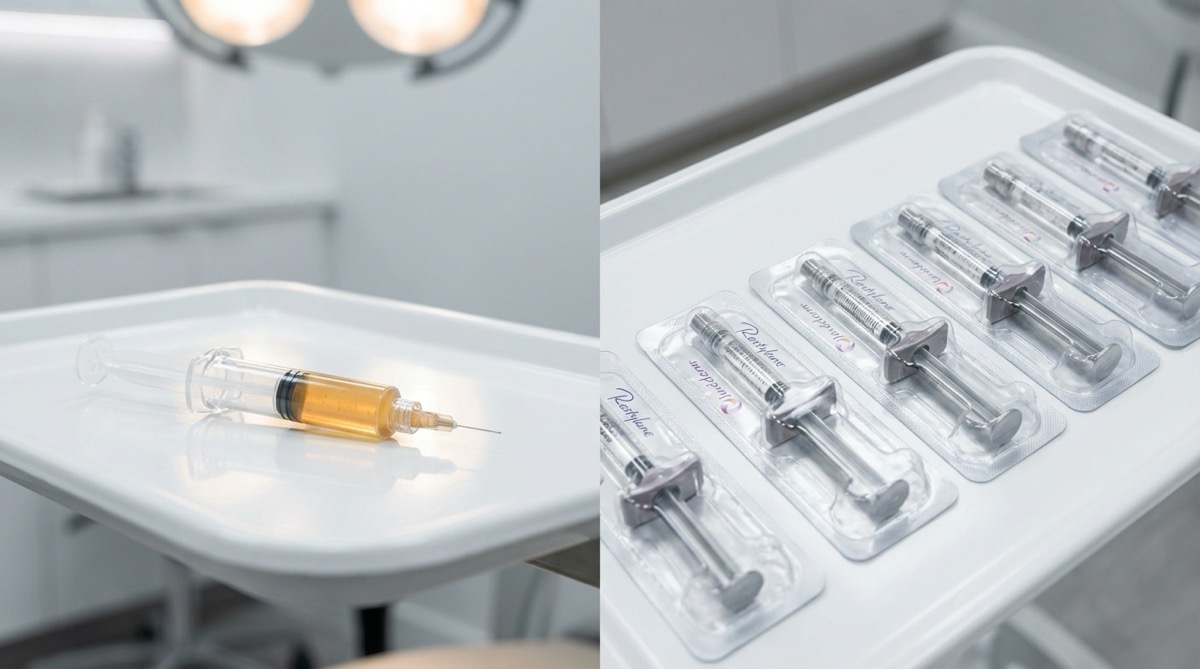
    Dermal fillers — primarily hyaluronic acid (HA) products like Juvederm and Restylane — are gel-like substances injected directly into facial tissues to restore volume, smooth wrinkles, or enhance contours. The procedure takes 15–45 minutes, requires no general anesthesia, and patients can return to normal activities almost immediately.

    Hyaluronic acid is a naturally occurring molecule in your skin that attracts and retains water, creating a plumping effect. Different formulations have varying levels of cross-linking, which determines their thickness, lifting capacity, and longevity. Thicker products work well for cheek augmentation and jawline definition, while thinner ones are better suited for lips and fine lines.

    Results are immediate but temporary, typically lasting 6–18 months depending on the product, the area treated, and your metabolism. The body gradually breaks down the hyaluronic acid, and the effect fades. One significant advantage: HA fillers can be dissolved with hyaluronidase if the result is unsatisfactory or if a complication arises.

    Fat Grafting vs Dermal Fillers: A Detailed Comparison

    Here’s how the two approaches compare across the factors that matter most to my patients:

    Factor Fat Grafting Dermal Fillers
    Longevity Permanent (surviving fat lasts a lifetime) Temporary (6–18 months)
    Naturalness Extremely natural — it’s your own tissue Very good with modern products, but can look “puffy” if overdone
    Cost Over 10 Years Lower (one-time investment, occasional touch-up) Higher (repeated sessions every 6–18 months)
    Recovery 7–14 days of visible swelling 0–3 days of mild swelling
    Anesthesia Local + sedation or general Topical or local only
    Stem Cell Benefit Yes — regenerative effect on skin quality No
    Reversibility Not easily reversible Reversible with hyaluronidase
    Risk of Vascular Occlusion Very low Low but documented, especially near the nose and glabella
    Best Areas Cheeks, temples, periorbital, jawline, full face Lips, nasolabial folds, marionette lines, targeted touch-ups
    Volume Capacity Large volumes (20–60 mL per session) Limited (typically 1–4 mL per session)

    When I Recommend Fat Grafting

    Fat grafting is my first recommendation when patients present with significant facial volume loss — the kind that makes the face look gaunt, hollow, or prematurely aged. Specifically, I recommend it for:

    • Patients over 45 with global volume deflation — sunken cheeks, hollow temples, deep under-eye circles. These patients need substantial volume restoration that fillers simply cannot deliver cost-effectively.
    • Patients combining procedures — if you’re already undergoing a facelift or eyelid surgery, adding fat grafting during the same operative session is highly efficient. One recovery, multiple benefits.
    • Patients who want a permanent solution — those tired of returning every 12 months for filler maintenance.
    • Patients seeking skin quality improvement — the stem cell component of fat grafting genuinely improves skin texture, thickness, and luminosity in ways fillers cannot.
    • Under-eye hollows and tear troughs — in many cases, fat grafting provides a more natural, longer-lasting correction than filler in this delicate area.

    When I Recommend Fillers

    Fillers are the better choice in several specific scenarios:

    • Younger patients (30s–early 40s) with mild volume loss — a syringe or two of filler can restore subtle volume without surgery.
    • Patients who want zero downtime — professionals, public figures, or anyone who simply cannot take time off.
    • Very targeted corrections — lip enhancement, a specific nasolabial fold, a small chin projection adjustment.
    • “Test drive” before surgery — some patients want to see what more volume looks like before committing to a permanent procedure. Fillers serve as an excellent preview.
    • Patients with insufficient body fat — very thin patients may not have enough donor fat for an effective transfer.

    The Hybrid Approach: Combining Fat Grafting and Fillers

    In my practice, I’ve found that the most sophisticated rejuvenation plans often combine both techniques. Here’s a scenario I see frequently:

    A 52-year-old patient undergoes a deep plane facelift with fat grafting for global volume restoration — cheeks, temples, periorbital area, jawline. Six months later, once everything has settled, she returns for a small touch-up with filler: perhaps 1 mL in the lips for definition, or a subtle correction in the nasolabial folds.

    This hybrid approach leverages the permanent, regenerative power of fat for the heavy lifting, while using fillers for precision finishing touches. It’s the best of both worlds.

    The goal is never to choose between fat grafting and fillers — it’s to understand which tool serves which purpose in your specific rejuvenation plan.

    Frequently Asked Questions

    Is fat grafting more painful than fillers?

    Fat grafting is a surgical procedure performed under anesthesia, so you feel nothing during the operation. Post-operative discomfort is mild and manageable with oral medication. Fillers involve needle pricks that can be uncomfortable but are typically well-tolerated with topical anesthetic. Overall, the recovery experience differs more than the pain itself — fat grafting requires downtime, while fillers do not.

    How much does fat grafting cost compared to fillers?

    Fat grafting has a higher upfront cost since it’s a surgical procedure. However, when you calculate the cumulative cost of filler maintenance over 5–10 years (repeated sessions every 6–18 months), fat grafting almost always becomes the more economical option. I always encourage patients to think in terms of total investment over time, not just the initial price tag.

    Can fat grafting go wrong? What if too much fat survives?

    In experienced hands, overcorrection is rare. I use a conservative, multi-layered injection technique and slightly overcorrect initially (by about 20–30%) because some fat is naturally reabsorbed. If the result is slightly fuller than desired, the face typically settles into a natural look within 3–6 months. Unlike fillers, excess fat cannot be “dissolved,” which is precisely why surgical precision and experience matter enormously.

    Are there any risks specific to facial fillers I should know about?

    The most serious risk with facial fillers is vascular occlusion — when filler is inadvertently injected into or compresses a blood vessel. This can lead to skin necrosis or, in extremely rare cases, vision problems. The nose and glabella (between the eyebrows) are particularly high-risk zones. This is why I always emphasize choosing an experienced physician and why I’m selective about which areas I treat with fillers.

    Can I get fat grafting if I’m very thin?

    It depends on how thin. Even slender patients usually have enough fat in the lower abdomen, inner thighs, or flanks for facial fat grafting — we typically need only 30–60 mL of raw fat. However, if you have an extremely low body fat percentage (such as competitive athletes), the harvest may be insufficient. In those cases, fillers or a combination of a small fat harvest plus fillers may be the better approach.

    Ready for an honest assessment? During your consultation, I’ll evaluate your facial anatomy, volume loss pattern, skin quality, and goals to recommend the approach — or combination of approaches — that will give you the most natural, lasting result. Learn more about my Regenerative Deep Plane technique or explore facelift options.


  • Ozempic Face Recovery: Fat Graft

    Ozempic Face Recovery: Fat Graft

    Over the past two years, I’ve seen a dramatic increase in patients walking into my clinic in Londrina, Brazil, with the same concern: “Doctor, I lost weight on Ozempic and my face aged a decade.” The words change, but the frustration is always the same — happiness with a slimmer body, and dismay at a face that looks hollow, gaunt, and far older than before.

    This phenomenon has earned its own name: “Ozempic face.” And it’s very real. The rapid facial fat loss caused by GLP-1 receptor agonists like semaglutide (Ozempic, Wegovy) and tirzepatide (Mounjaro) produces striking changes in facial appearance. Cheeks that were once full become sunken, temples hollow out, deep folds appear, and the skin seems to drape loosely over the facial skeleton.

    With over 20 years of experience and more than 8,000 surgeries performed, I can confidently say that facial fat grafting (lipofilling) is the most effective and natural solution for restoring volume lost to Ozempic face. In this article, I explain why I consider autologous fat superior to dermal fillers and how this procedure can rejuvenate your appearance.

    What is “Ozempic face” and why does it happen

    “Ozempic face” describes the aged, skeletonized facial appearance that develops after rapid weight loss with GLP-1 receptor agonists. While these medications are remarkably effective for weight management, they cannot selectively target which fat deposits to eliminate.

    Our face contains deep and superficial fat compartments that serve as essential pillars of a youthful appearance. When weight loss is accelerated, these compartments — malar, temporal, periorbital, and buccal — deflate rapidly. The visible consequences include:

    • Hollow temples that create deep shadows on the sides of the face
    • Sunken cheeks that accentuate the zygomatic bones
    • Deep nasolabial folds extending from nose to mouth
    • Pronounced under-eye hollows from periorbital fat loss
    • Skin laxity resembling a deflated balloon

    What makes Ozempic face particularly challenging is the speed of volume loss. During natural aging, facial volume diminishes over decades, allowing tissues to gradually adapt. With GLP-1 agonists, this loss occurs over mere months — far too quickly for any tissue accommodation.

    Why facial fat is essential for a youthful appearance

    There’s a fundamental concept in facial surgery that many patients overlook: youthfulness is more about volume than the absence of wrinkles. A young face is a full face, with smooth contours and harmonious transitions between regions.

    Facial fat performs multiple critical functions:

    • Structural support: it acts as a cushion that keeps skin smooth and filled
    • Contour definition: the cheekbones, jawline, and temporal region depend on fat for their shape
    • Smooth transitions: fat creates natural gradients between bone, muscle, and skin
    • Skin quality: adipose tissue nourishes the skin from within, maintaining radiance and vitality

    When I evaluate patients who have used Ozempic for 6 to 12 months, the primary issue is clear: it’s not sagging — it’s deflation. The face has simply lost its padding. And the logical solution? Replace exactly what was lost: fat.

    Facial fat grafting — the ideal solution for Ozempic face

    Facial fat grafting, also known as lipofilling or autologous fat transfer, involves transferring fat from the patient’s own body (abdomen, flanks, or thighs) to the face. In my practice, I consider this technique the most comprehensive treatment for Ozempic face — and here’s why.

    Unlike hyaluronic acid fillers, which are temporary synthetic substances, autologous fat offers unique advantages:

    • 100% natural material: it’s your own tissue, with zero risk of rejection or allergic reaction
    • Permanent results: the fat that successfully integrates (70-80% of the volume) becomes a living part of your face — permanently
    • Regenerative stem cells: adipose tissue is rich in adipose-derived stem cells (ADSCs) that improve skin quality, stimulate collagen production, and promote neovascularization
    • Unlimited volume: I can graft substantial volumes without the limitations of dermal fillers
    • Long-term value: fillers require repeat injections every 12-18 months; fat grafting is a one-time investment

    In practice, the transformation I observe after fat grafting in Ozempic face patients is remarkable: the face regains its fullness, shadows disappear, skin quality improves visibly, and patients feel like themselves again.

    How the procedure works

    Facial fat grafting demands refined technique and extensive experience. Simply injecting fat into the face is insufficient — precision in placement, volume, and layering is essential. Here’s the step-by-step process:

    1. Fat harvesting (liposuction): I perform a mini-liposuction from a donor area — typically the abdomen or flanks. Using fine cannulas and an atraumatic technique, I carefully preserve the viability of the adipose cells.

    2. Processing: The harvested fat undergoes purification (centrifugation or decanting) to separate viable cells from oil, blood, and anesthetic fluid. This step is crucial for maximizing graft survival rates.

    3. Facial grafting: Using 1mm micro-cannulas, I inject the purified fat in multiple layers and tissue planes — subcutaneous, intramuscular, and supraperiosteal. This micro-droplet technique ensures each small parcel of fat is surrounded by vascularized tissue, optimizing graft survival.

    4. Treatment areas: For Ozempic face patients, the regions that benefit most include:

    • Malar region (cheeks) — restores projection and the zygomatic arch
    • Temples — eliminates the hollow, skeletonized look
    • Nasolabial and nasojugal folds — softens deep creases
    • Periorbital region — fills deep under-eye hollows
    • Jawline — redefines the lower face contour

    The procedure takes approximately 2 to 3 hours, is performed under sedation or general anesthesia, and initial recovery lasts about 7 to 10 days. Swelling is expected and resolves progressively over 3 to 4 weeks.

    When to combine fat grafting with a facelift

    Not every Ozempic face patient needs volume restoration alone. In many cases, rapid weight loss also causes significant skin laxity — the skin and soft tissues hang loosely over the facial skeleton. When this occurs, fat grafting alone isn’t enough.

    In these situations, I recommend combining fat grafting with a Deep Plane facelift — what I call the Regenerative Deep Plane approach. This dual strategy addresses both components of post-Ozempic facial aging:

    • The Deep Plane lift repositions deep facial tissues, corrects sagging, and restores structural definition
    • Fat grafting replenishes lost volume, smooths contours, and promotes tissue regeneration

    In my experience, approximately 60% of Ozempic face patients benefit from this combination — particularly those over 45 or who have lost more than 20kg (44 lbs). For younger patients with good skin elasticity and moderate weight loss, fat grafting alone is typically sufficient.

    I’ve written a detailed article about this combined approach: Facelift After Ozempic: Why Fat Grafting Is Essential for Ozempic Face.

    Results and longevity

    One of the most common questions I hear is: “How long do fat grafting results last?” The answer is one of this procedure’s greatest advantages: the results are permanent.

    Here’s why: after the integration period (3 to 6 months), the surviving fat becomes living, vascularized tissue in your face. It behaves like any other facial tissue — aging naturally with you but never disappearing. Unlike hyaluronic acid, which the body absorbs within 12 to 18 months, grafted fat endures.

    Regarding the timeline of results:

    • Week 1: significant swelling — the face appears fuller than the final result
    • Weeks 2-4: swelling progressively subsides
    • 3 months: 80% of the final result is visible
    • 6 months: definitive result — all viable fat is fully integrated

    It’s important to understand that approximately 20-30% of the grafted volume is absorbed by the body during the first few months. I compensate for this during the procedure by grafting slightly more volume than desired. In rare cases, a second session may be needed for refinement — but for most of my patients, a single procedure is sufficient.

    A crucial point: if you’re still actively using Ozempic or another GLP-1 agonist, I recommend stabilizing your weight for at least 3 months before surgery. Operating during active weight loss can compromise results, as the grafted fat may also be metabolized.

    Frequently asked questions

    Does facial fat grafting leave visible scars?

    Virtually none. The incisions for fat harvesting are 3-4mm (usually on the abdomen) and become imperceptible after healing. On the face, the 1mm micro-cannulas enter through tiny access points that leave no visible marks. It’s one of the facial procedures with the least scarring.

    Do I need to stop Ozempic before fat grafting?

    Not necessarily stop it entirely, but I strongly recommend that patients reach their target weight and remain stable for at least 3 months before the procedure. If you’re still actively losing weight, the grafted fat may be partially metabolized, compromising your results. I coordinate with each patient’s endocrinologist to determine the optimal timing.

    What’s the difference between fat grafting and hyaluronic acid fillers?

    They’re fundamentally different approaches. Hyaluronic acid is a synthetic gel injected in-office, with immediate but temporary results (12-18 months). Fat grafting uses your own tissue, requires an operating room, but delivers permanent, natural results with regenerative benefits from stem cells. For Ozempic face, where volume loss is widespread and significant, fat grafting is far superior — you would need prohibitive amounts of hyaluronic acid to achieve comparable correction.

    How much recovery time should I plan for after facial fat grafting?

    Initial recovery takes 7 to 10 days, when swelling and possible bruising are most evident. Most patients return to social and professional activities within 10 to 14 days. Intense physical exercise should be avoided for 3 to 4 weeks. The final result consolidates at 3 to 6 months, once all viable fat has fully integrated.

    Is facial fat grafting suitable for any age?

    Yes, as long as there’s a clinical indication. Younger patients (30-40 years) who lost weight with GLP-1 agonists and have good skin elasticity are excellent candidates for fat grafting alone. Patients over 50 generally benefit more from combining it with a Deep Plane facelift, as they tend to have associated skin laxity. Individual assessment is essential — every face is unique, and the surgical plan must be personalized.

    If you’ve lost weight with Ozempic, Wegovy, or Mounjaro and feel that your face has aged, facial fat grafting may be the ideal solution to restore your appearance. Schedule a consultation at my clinic in Londrina, Brazil — in-person or online — and discover how we can bring back volume, contour, and youthfulness to your face.

  • Rosto Pós-Ozempic: Lipoenxertia

    Rosto Pós-Ozempic: Lipoenxertia

    Nos últimos dois anos, tenho recebido um número crescente de pacientes no meu consultório em Londrina com uma queixa muito específica: “Doutor, emagreci com Ozempic e meu rosto envelheceu dez anos.” A frase varia, mas o sentimento é sempre o mesmo — satisfação com o corpo mais magro e frustração com o rosto que parece ter se esvaziado.

    Esse fenômeno ganhou até nome próprio: “Ozempic face”. E não se trata de exagero. A perda rápida de gordura facial causada por medicamentos como semaglutida e tirzepatida produz mudanças profundas na aparência. Bochechas que antes eram cheias ficam encovadas, as têmporas afundam, os sulcos se aprofundam e a pele parece “sobrar” sobre o esqueleto facial. O resultado, paradoxalmente, é um rosto que aparenta mais idade do que antes do emagrecimento.

    Com mais de 20 anos de experiência e mais de 8.000 cirurgias realizadas, posso afirmar que a lipoenxertia facial é, hoje, a solução mais eficaz e natural para restaurar o volume perdido pelo Ozempic face. Neste artigo, explico por que considero a gordura autóloga superior aos preenchedores e como esse procedimento pode devolver a juventude ao seu rosto.

    O que é “Ozempic face” e por que acontece

    O termo “Ozempic face” descreve a aparência envelhecida e esqueletizada do rosto que surge após emagrecimento rápido com agonistas do receptor GLP-1 — medicamentos como Ozempic (semaglutida), Wegovy e Mounjaro (tirzepatida). Embora esses medicamentos sejam extraordinariamente eficazes para perda de peso, eles não distinguem qual gordura eliminar.

    Nosso rosto possui compartimentos de gordura profundos e superficiais que funcionam como verdadeiros pilares de sustentação da aparência jovem. Quando o emagrecimento é acelerado, esses compartimentos — malar, temporal, periorbital e bucal — deflacionam rapidamente. As consequências são visíveis:

    • Têmporas ocas que criam sombras profundas na lateral do rosto
    • Bochechas encovadas que acentuam os ossos zigomáticos
    • Sulcos nasolabiais aprofundados (os “bigodes chineses”)
    • Olheiras fundas por perda de gordura periorbital
    • Pele com aspecto flácido, como um balão que perdeu ar

    O que torna o Ozempic face especialmente desafiador é a velocidade da perda. Em um envelhecimento natural, o rosto perde volume ao longo de décadas e os tecidos se adaptam gradualmente. Com os GLP-1 agonistas, essa perda acontece em meses, sem tempo para qualquer adaptação tecidual.

    Por que a gordura facial é tão importante para a aparência jovem

    Existe um conceito fundamental em cirurgia facial que muitos pacientes desconhecem: a juventude do rosto está mais relacionada ao volume do que à ausência de rugas. Um rosto jovem é um rosto cheio, com contornos suaves e transições harmônicas entre as regiões.

    A gordura facial desempenha múltiplos papéis:

    • Sustentação estrutural: funciona como um “travesseiro” que mantém a pele preenchida e lisa
    • Definição dos contornos: as maçãs do rosto, o arco mandibular e a região temporal dependem de gordura para ter forma adequada
    • Transições suaves: a gordura cria gradientes naturais entre osso, músculo e pele
    • Qualidade da pele: o tecido adiposo nutre a pele de dentro para fora, mantendo viço e luminosidade

    Quando observo pacientes que usaram Ozempic por 6 a 12 meses, vejo claramente que o problema principal não é flacidez — é deflação. O rosto simplesmente perdeu seu “recheio”. E a solução lógica? Repor exatamente o que foi perdido: gordura.

    Lipoenxertia facial — a solução ideal para o Ozempic face

    A lipoenxertia facial, também conhecida como enxerto de gordura ou fat grafting, consiste em transferir gordura do próprio paciente (abdômen, flancos ou coxas) para o rosto. Na minha prática, considero essa técnica a solução mais completa para o tratamento do Ozempic face — e explico por quê.

    Diferentemente dos preenchedores de ácido hialurônico, que são substâncias sintéticas temporárias, a gordura autóloga oferece vantagens exclusivas:

    • Material 100% natural: é tecido do próprio corpo, sem risco de rejeição ou reação alérgica
    • Resultado permanente: a gordura que pega (70-80% do volume) torna-se parte viva do rosto — para sempre
    • Células-tronco regenerativas: o tecido adiposo é rico em células-tronco mesenquimais (ADSCs) que melhoram a qualidade da pele, estimulam colágeno e promovem neovascularização
    • Volume ilimitado: posso enxertar grandes volumes sem as limitações dos preenchedores
    • Custo-benefício a longo prazo: preenchedores precisam ser reaplicados a cada 12-18 meses; a gordura é definitiva

    Na prática, o que vejo após a lipoenxertia em pacientes com Ozempic face é uma transformação impressionante: o rosto recupera sua plenitude, as sombras desaparecem, a pele ganha viço e o paciente volta a se reconhecer no espelho.

    Como funciona o procedimento

    A lipoenxertia facial é um procedimento que demanda técnica refinada e experiência. Não basta simplesmente injetar gordura no rosto — é preciso saber exatamente onde, quanto e como. Veja as etapas:

    1. Coleta da gordura (lipoaspiração): Realizo uma mini-lipoaspiração em área doadora — geralmente abdômen ou flancos. Utilizo cânulas finas e técnica atraumática para preservar a viabilidade das células adiposas.

    2. Processamento: A gordura coletada passa por um processo de purificação (centrifugação ou decantação) para separar as células viáveis do óleo, sangue e anestésico. Esse passo é fundamental para maximizar a taxa de pega do enxerto.

    3. Enxertia facial: Com microcânulas de 1mm, injeto a gordura purificada em múltiplas camadas e planos — subcutâneo, intramuscular e supraperiosteal. Essa técnica em “micro-partículas” garante que cada pequena porção de gordura fique cercada por tecido vascularizado, otimizando a sobrevivência do enxerto.

    4. Áreas tratadas: No paciente com Ozempic face, as regiões que mais se beneficiam são:

    • Região malar (maçãs do rosto) — restaura a projeção e o arco zigomático
    • Têmporas — elimina o aspecto oco e esqueletizado
    • Sulcos nasolabiais e nasojugais — suaviza as linhas profundas
    • Região periorbital — preenche olheiras profundas
    • Contorno mandibular — redefine a jawline

    O procedimento leva entre 2 e 3 horas, é realizado sob sedação ou anestesia geral, e a recuperação inicial dura cerca de 7 a 10 dias. O inchaço é esperado e resolve progressivamente ao longo de 3 a 4 semanas.

    Quando combinar lipoenxertia com lifting facial

    Nem todo paciente com Ozempic face precisa apenas de volume. Em muitos casos, a perda rápida de peso também causa flacidez significativa — a pele e os tecidos “sobram” sobre o esqueleto facial. Quando isso acontece, a lipoenxertia isolada não é suficiente.

    Nesses casos, indico a combinação de lipoenxertia com lifting facial Deep Plane — o que chamo de Deep Plane Regenerativo. Essa abordagem trata simultaneamente os dois componentes do envelhecimento pós-Ozempic:

    • O lifting Deep Plane reposiciona os tecidos faciais profundos, corrige a flacidez e restaura a definição estrutural do rosto
    • A lipoenxertia repõe o volume perdido, suaviza contornos e promove regeneração tecidual

    Na minha experiência, cerca de 60% dos pacientes com Ozempic face se beneficiam dessa combinação — especialmente aqueles acima dos 45 anos ou que perderam mais de 20kg. Para pacientes mais jovens, com boa elasticidade cutânea e perda moderada de peso, a lipoenxertia isolada costuma ser suficiente.

    Já escrevi um artigo detalhado sobre essa combinação: Lifting Facial Após Ozempic: Por Que o Enxerto de Gordura É Essencial.

    Resultados e duração

    Uma das perguntas que mais ouço é: “Quanto tempo dura o resultado da lipoenxertia?” A resposta é uma das maiores vantagens desse procedimento: o resultado é permanente.

    Explico: após o período de integração (3 a 6 meses), a gordura que sobreviveu torna-se parte viva e vascularizada do seu rosto. Ela se comporta como qualquer outro tecido facial — envelhece naturalmente com você, mas não desaparece. Diferentemente do ácido hialurônico, que o corpo absorve em 12 a 18 meses, a gordura enxertada permanece.

    Em relação à evolução dos resultados:

    • 1ª semana: inchaço significativo — o rosto parece mais cheio do que o resultado final
    • 2 a 4 semanas: inchaço reduz progressivamente
    • 3 meses: 80% do resultado final já é visível
    • 6 meses: resultado definitivo — a gordura está completamente integrada

    É importante entender que cerca de 20-30% do volume enxertado é absorvido pelo organismo nos primeiros meses. Eu já compenso essa perda durante o procedimento, enxertando um volume ligeiramente maior que o desejado. Em casos raros, pode ser necessário um segundo tempo cirúrgico para refinamento — mas na maioria dos meus pacientes, uma única sessão é suficiente.

    Um ponto crucial: se o paciente ainda estiver em uso de Ozempic ou outro GLP-1 agonista, recomendo que estabilize o peso por pelo menos 3 meses antes da cirurgia. Operar durante a fase de emagrecimento ativo pode comprometer o resultado, já que a gordura enxertada também pode ser metabolizada.

    Perguntas frequentes

    A lipoenxertia facial deixa cicatrizes visíveis?

    Praticamente não. As incisões para coleta de gordura são de 3-4mm (geralmente no abdômen) e ficam imperceptíveis após a cicatrização. No rosto, as microcânulas de 1mm entram por pontos de acesso milimétricos que não deixam marcas visíveis. É um dos procedimentos faciais com menor impacto cicatricial.

    Preciso parar o Ozempic antes da lipoenxertia?

    Não necessariamente parar, mas recomendo fortemente que o paciente tenha atingido o peso desejado e esteja estável por pelo menos 3 meses antes do procedimento. Se você ainda está perdendo peso ativamente, a gordura enxertada pode ser parcialmente metabolizada, comprometendo o resultado. Discutimos o plano com o endocrinologista de cada paciente para definir o melhor momento.

    Qual a diferença entre lipoenxertia e preenchedor de ácido hialurônico?

    São abordagens fundamentalmente diferentes. O ácido hialurônico é um gel sintético injetado em consultório, com resultado imediato mas temporário (12-18 meses). A lipoenxertia usa gordura do próprio corpo, requer centro cirúrgico, mas oferece resultado permanente, natural e com benefício regenerativo pelas células-tronco. Para o Ozempic face, onde a perda de volume é generalizada e significativa, a lipoenxertia é muito superior — seria necessário um volume proibitivo de ácido hialurônico para compensar a mesma perda.

    Quanto tempo de recuperação preciso após a lipoenxertia facial?

    A recuperação inicial é de 7 a 10 dias, quando o inchaço e eventuais equimoses (roxos) são mais evidentes. A maioria dos pacientes retorna às atividades sociais e profissionais em 10 a 14 dias. Atividades físicas intensas devem ser evitadas por 3 a 4 semanas. O resultado final se consolida em 3 a 6 meses, quando toda a gordura viável já está integrada.

    A lipoenxertia facial é indicada para qualquer idade?

    Sim, desde que haja indicação clínica. Pacientes mais jovens (30-40 anos) que emagreceram com GLP-1 agonistas e têm boa elasticidade cutânea são excelentes candidatos à lipoenxertia isolada. Pacientes acima de 50 anos geralmente se beneficiam mais da combinação com lifting facial Deep Plane, pois tendem a ter flacidez associada. A avaliação individual é fundamental — cada rosto é único, e o plano cirúrgico deve ser personalizado.

    Se você emagreceu com Ozempic, Wegovy ou Mounjaro e sente que seu rosto envelheceu, a lipoenxertia facial pode ser a solução ideal para restaurar sua aparência. Agende uma consulta na minha clínica em Londrina para uma avaliação personalizada — presencial ou online — e descubra como podemos devolver volume, contorno e juventude ao seu rosto.

  • Facial Fat Grafting: Full Guide

    Facial Fat Grafting: Full Guide

    Over the course of more than 20 years and over 8,000 surgeries, few advances have impressed me as profoundly as facial fat grafting. When I first began incorporating fat transfer into my rejuvenation procedures, I realized I wasn’t merely filling lost volume — I was restoring life to facial tissues. Autologous fat, unlike any synthetic filler, carries mesenchymal stem cells capable of regenerating the skin from within.

    Today, facial fat grafting is the central pillar of my Regenerative Deep Plane technique. Whether performed as a standalone procedure or combined with a facelift, it delivers results that no manufactured filler can replicate: natural volume, rejuvenated texture, and durability measured in years rather than months.

    In this comprehensive guide, I will explain exactly how facial fat transfer works, which areas of the face can be treated, how it compares to hyaluronic acid fillers, and what you can expect from recovery.

    What Is Facial Fat Grafting?

    Facial fat grafting — also known as fat transfer to the face or facial fat injection — is a surgical procedure in which fat from the patient’s own body is harvested from a donor site (typically the abdomen or flanks), processed in a laboratory setting, and strategically re-injected into facial regions that have lost volume or that benefit from the regenerative properties of adipose-derived stem cells.

    Unlike synthetic fillers, fat is a 100% autologous material — it comes from your own body. This eliminates the risk of rejection, allergy, or granuloma formation. When the fat integrates with the recipient tissue (what we call “fat take”), it remains alive and functional, behaving as native facial fat.

    In my practice, I use fat grafting not only as a volumization tool but as a genuine regenerative therapy. The adipose-derived mesenchymal stem cells (ADSCs) promote neovascularization, collagen synthesis, and cellular renewal — effects that go far beyond simple filling.

    How the Procedure Works

    The facial fat grafting procedure is divided into three fundamental steps, each requiring surgical precision and deep anatomical knowledge.

    1. Fat Harvesting (Liposuction)

    The first step involves harvesting fat from a donor area. I prefer the lower abdomen or flanks, which provide excellent quality fat for grafting. The liposuction is performed with fine cannulas and low vacuum pressure, preserving the viability of both adipocytes and — critically — the mesenchymal stem cells.

    This careful harvesting technique is essential: aggressive aspiration damages cells and compromises the graft’s integration rate. I employ an atraumatic aspiration technique that ensures the maximum number of viable cells reach the next stage.

    2. Processing and Purification

    The harvested fat undergoes rigorous purification. I separate viable adipose tissue from anesthetic fluid, blood, oil, and damaged cells. The result is a concentrate rich in healthy adipocytes and mesenchymal stem cells, ready for re-injection.

    3. Strategic Micro-Injection

    The final — and most delicate — step is re-injecting the processed fat into the face. I use fine-gauge microcannulas, injecting small volumes across multiple tissue planes. This micro-injection technique ensures:

    • Natural results — no “overfilled” or puffy appearance
    • High integration rate — each micro-parcel of fat sits close to blood vessels, maximizing survival
    • Facial symmetry — precise volumes in each region, millimeter by millimeter
    • Uniform distribution — no palpable nodules or irregularities

    Facial Areas Treated with Fat Grafting

    The versatility of facial fat grafting is one of its greatest advantages. In my practice, I treat the following regions:

    • Malar region (cheeks) — restores projection and the youthful contour of the midface. One of the areas that benefits most from fat grafting.
    • Nasolabial folds — the creases running from the nose to the mouth. Fat softens these lines without the artificial look that fillers can produce.
    • Periorbital region — addresses deep hollows and under-eye depressions, restoring freshness to the gaze. Requires extremely delicate technique.
    • Temples — temporal volume loss is one of the most aging yet frequently overlooked signs. Fat grafting restores the youthful convexity of this area.
    • Lips — subtle, natural volumization with the advantage of being permanent and regenerating lip skin.
    • Chin — improves projection and jawline contour without the need for an implant.
    • Jawline — defines the jaw and corrects irregularities along the lower facial contour.

    For each region, I adapt the volume and injection depth to the patient’s individual anatomy. There is no one-size-fits-all protocol — every face is a custom project.

    Fat Grafting vs Hyaluronic Acid Fillers

    One of the most common questions I hear from patients is: “Doctor, what’s the difference between fat grafting and hyaluronic acid fillers?” The answer involves fundamental differences every patient should understand.

    Feature Facial Fat Grafting Hyaluronic Acid Fillers
    Material Your own fat (autologous) Manufactured synthetic gel
    Duration Permanent (70-80% integration) Temporary (8-18 months)
    Regenerative effect Yes — stem cells regenerate skin and tissues No — volume only
    Rejection risk None (your own tissue) Low but possible (granulomas, migration)
    Natural feel Looks and feels natural (living tissue) May be detectable by touch
    Procedure Surgical (operating room, sedation) Office-based (local anesthesia)
    Recovery 7-14 days of moderate swelling 1-3 days of mild swelling
    Long-term cost One-time investment (lasting results) Periodic re-treatments (cumulative cost)
    Skin quality Improves texture, luminosity, and elasticity No effect on skin quality

    In my experience, patients seeking long-lasting results and genuine rejuvenation — not just volume — find facial fat grafting to be an incomparably superior solution. Hyaluronic acid fillers have their place for minor touch-ups, but they cannot match the regenerative potential of autologous fat.

    Stem Cells and the Regenerative Effect

    The most fascinating aspect of facial fat grafting — and what sets it apart from every other volumization procedure — is the regenerative effect of mesenchymal stem cells (ADSCs, or Adipose-Derived Stem Cells).

    Adipose tissue is one of the richest sources of adult stem cells in the human body. When I inject processed fat into the face, I’m not merely adding volume: I’m transplanting thousands of stem cells that, once integrated into the recipient tissue, initiate a process of local regeneration.

    The effects documented in scientific literature — and which I observe clinically in my patients — include:

    • Neovascularization — formation of new blood vessels, improving blood supply and tissue nourishment
    • Collagen and elastin synthesis — ADSCs secrete growth factors that stimulate fibroblasts to produce new collagen
    • Improved skin texture — patients report more luminous, hydrated, and youthful-looking skin in treated areas
    • Scar and pigmentation improvement — the trophic effect of stem cells can improve the appearance of scars and hyperpigmentation
    • Ongoing cellular renewal — ADSCs maintain regenerative activity for months after the procedure

    This is precisely why I call my technique Regenerative Deep Plane: combining the Deep Plane facelift with fat grafting transforms the procedure from a simple “tissue repositioning” into a complete facial regeneration.

    Recovery and Post-Operative Care

    Recovery from facial fat grafting is generally well tolerated. Here is what I advise my patients:

    Days 1-7

    • Moderate facial swelling, peaking between days 2 and 3
    • Possible bruising, particularly in the periorbital area
    • Relative rest — avoid physical exertion and sudden movements
    • Sleep with head elevated (2 pillows) to reduce swelling
    • Cold compresses during the first 48 hours

    Days 7-14

    • Swelling progressively resolving
    • Bruising fading (can be concealed with light makeup after day 7)
    • Gradual return to light activities
    • Avoid direct sun exposure

    Days 14-30

    • Partial results already visible
    • Return to normal activities, including light exercise
    • Strict sun protection (SPF 50+)

    Months 1-6

    • Definitive results consolidating as fat integrates with tissue
    • Approximately 70-80% of grafted volume remains — this is accounted for in surgical planning
    • Progressive improvement in skin quality from stem cell effects

    Frequently Asked Questions About Facial Fat Grafting

    Is facial fat grafting painful?

    The procedure is performed under sedation or general anesthesia, so there is no pain during surgery. Post-operative discomfort is mild and well managed with simple analgesic medication. Most of my patients report more discomfort from the donor site (abdomen) than from the face itself.

    How long do fat grafting results last?

    The fat that integrates with the recipient tissue is permanent. In my experience, between 70% and 80% of grafted volume survives and remains indefinitely. I plan a slightly higher volume than the final goal, anticipating partial absorption. The regenerative effects of stem cells also continue benefiting the skin for months after the procedure.

    Can I have fat grafting without a facelift?

    Absolutely. Facial fat grafting can be performed as a standalone procedure in patients who have significant volume loss but do not yet present the degree of skin laxity that warrants a facelift. It is an excellent option for younger patients (ages 35-50) seeking natural rejuvenation without more invasive surgery.

    Is there a risk of looking artificial?

    When performed with proper micro-injection technique across multiple tissue planes, fat grafting produces extremely natural results. The risk of an artificial appearance only arises when excessive volumes are injected inappropriately. In my technique, I prioritize homogeneous distribution of small volumes, ensuring results that look and feel natural.

    What is the ideal age for facial fat grafting?

    There is no single ideal age. I achieve excellent results in patients starting from age 35 (when facial volume loss becomes noticeable) through patients in their 70s. What determines candidacy is not chronological age but rather the degree of volume loss, skin quality, and patient goals. In many cases, I combine fat grafting with the Regenerative Deep Plane technique for comprehensive results.

    If you would like to know whether facial fat grafting is right for you, I invite you to schedule a consultation. During an in-person evaluation, I analyze your facial anatomy, discuss your expectations, and propose the most appropriate surgical plan — always with honesty, clarity, and a commitment to excellence. Contact us via WhatsApp or through the website form to book your appointment.

  • Lipoenxertia Facial: Guia 2026

    Lipoenxertia Facial: Guia 2026

    Ao longo de mais de 20 anos de carreira e mais de 8.000 cirurgias realizadas, poucos avanços me impressionaram tanto quanto a lipoenxertia facial. Quando comecei a incorporar o enxerto de gordura aos meus procedimentos de rejuvenescimento, percebi que não estava apenas preenchendo volumes perdidos — estava devolvendo vida aos tecidos do rosto. A gordura autóloga, diferentemente de qualquer material sintético, carrega consigo células-tronco mesenquimais capazes de regenerar a pele de dentro para fora.

    Hoje, a lipoenxertia facial é o pilar central da minha técnica de Deep Plane Regenerativo. Seja como procedimento isolado ou combinada com o lifting facial, ela permite resultados que nenhum preenchimento industrializado consegue replicar: volume natural, textura rejuvenescida e durabilidade que se mede em anos, não em meses.

    Neste guia completo, vou explicar em detalhes como funciona o enxerto de gordura no rosto, quais áreas podem ser tratadas, como se compara aos preenchimentos com ácido hialurônico e o que você pode esperar da recuperação. Meu objetivo é que, ao final desta leitura, você tenha clareza total sobre esse procedimento que considero revolucionário.

    O Que É Lipoenxertia Facial

    A lipoenxertia facial — também chamada de enxerto de gordura no rosto ou fat grafting facial — é um procedimento cirúrgico no qual gordura do próprio paciente é colhida de uma área doadora (geralmente abdômen ou flancos), processada em laboratório e reinjetada estrategicamente em regiões do rosto que perderam volume ou que se beneficiam do efeito regenerativo das células-tronco presentes no tecido adiposo.

    Diferentemente dos preenchimentos sintéticos, a gordura é um material 100% autólogo — ou seja, vem do seu próprio corpo. Isso elimina riscos de rejeição, alergia ou formação de granulomas. Quando a gordura integra ao tecido receptor (o que chamamos de “pega”), ela permanece viva e funcional, comportando-se como gordura nativa do rosto.

    Na minha prática, utilizo a lipoenxertia não apenas como ferramenta de volumização, mas como uma verdadeira terapia regenerativa. As células-tronco mesenquimais derivadas do tecido adiposo (ADSCs) promovem neovascularização, síntese de colágeno e renovação celular — efeitos que vão muito além do simples preenchimento.

    Como Funciona o Procedimento

    O procedimento de lipoenxertia facial é dividido em três etapas fundamentais, cada uma delas exigindo precisão técnica e conhecimento anatômico profundo.

    1. Coleta da gordura (lipoaspiração)

    A primeira etapa consiste na coleta de gordura de uma área doadora. Na minha técnica, dou preferência ao abdômen inferior ou flancos, regiões que oferecem gordura de excelente qualidade para enxertia. A lipoaspiração é feita com cânulas finas e baixa pressão de vácuo, preservando a viabilidade das células adiposas e, principalmente, das células-tronco mesenquimais.

    Essa coleta cuidadosa é fundamental: uma aspiração agressiva danifica as células e compromete a taxa de integração do enxerto. Utilizo a técnica de aspiração atraumática, que garante que o maior número possível de células chegue viável à etapa seguinte.

    2. Processamento e purificação

    A gordura colhida passa por um processo rigoroso de purificação. Separo o tecido adiposo viável do líquido anestésico, sangue, óleo e células danificadas. O resultado é um concentrado rico em adipócitos saudáveis e células-tronco mesenquimais, pronto para ser reinjetado.

    Esse processamento é uma das etapas que mais diferenciam um resultado mediano de um resultado excepcional. Gordura mal processada tem baixa taxa de pega e pode gerar irregularidades.

    3. Microinjeção estratégica

    A etapa final — e a mais delicada — é a reinjeção da gordura processada no rosto. Utilizo microcânulas de calibre fino, injetando pequenos volumes em múltiplos planos teciduais. Essa técnica de microinjeção é essencial para garantir:

    • Resultado natural — sem aspecto de “rosto inchado” ou cheio demais
    • Alta taxa de integração — cada micropartícula de gordura fica próxima a vasos sanguíneos, aumentando sua sobrevivência
    • Simetria facial — volumes precisos em cada região, milímetro a milímetro
    • Distribuição uniforme — sem nódulos ou irregularidades palpáveis

    Áreas do Rosto Tratadas com Enxerto de Gordura

    A versatilidade da lipoenxertia facial é uma das suas maiores vantagens. Na minha prática, trato as seguintes regiões com enxerto de gordura:

    • Região malar (maçãs do rosto) — restaura a projeção e o contorno jovem do terço médio da face. É uma das áreas que mais se beneficia da lipoenxertia.
    • Sulco nasogeniano — aquele sulco que vai do nariz à boca. A gordura suaviza essa marca sem o aspecto artificial dos preenchimentos.
    • Região periorbital — trata olheiras profundas e a escavação ao redor dos olhos, devolvendo frescor ao olhar. Requer técnica extremamente delicada.
    • Têmporas — a perda de volume temporal é um dos sinais mais envelhecedores e frequentemente ignorados. A lipoenxertia restaura a convexidade juvenil dessa região.
    • Lábios — volumização sutil e natural, com a vantagem de ser permanente e regenerar a pele labial.
    • Mento (queixo) — melhora a projeção e o contorno da linha mandibular sem necessidade de implante.
    • Linha da mandíbula — define o jawline e corrige irregularidades no contorno inferior do rosto.

    Em cada região, adapto o volume e a profundidade de injeção de acordo com a anatomia individual do paciente. Não existe um protocolo único — cada rosto é um projeto personalizado.

    Lipoenxertia vs Preenchimentos com Ácido Hialurônico

    Uma das perguntas que mais recebo no consultório é: “Doutor, qual a diferença entre o enxerto de gordura e o preenchimento com ácido hialurônico?” A resposta envolve diferenças fundamentais que todo paciente deveria conhecer.

    Característica Lipoenxertia Facial Ácido Hialurônico
    Material Gordura própria (autóloga) Gel sintético industrializado
    Duração Permanente (70-80% de integração) Temporário (8-18 meses)
    Efeito regenerativo Sim — células-tronco regeneram pele e tecidos Não — apenas preenche volume
    Risco de rejeição Zero (material do próprio corpo) Baixo, mas possível (granulomas, migração)
    Naturalidade Aspecto e tato naturais (é tecido vivo) Pode ser perceptível ao toque
    Procedimento Cirúrgico (centro cirúrgico, sedação) Ambulatorial (consultório, anestesia local)
    Recuperação 7-14 dias de edema moderado 1-3 dias de edema leve
    Custo a longo prazo Investimento único (resultado duradouro) Reaplicações periódicas (custo acumulado)
    Qualidade da pele Melhora textura, luminosidade e elasticidade Sem efeito na qualidade da pele

    Na minha experiência, pacientes que buscam resultado duradouro e rejuvenescimento real — não apenas volume — encontram na lipoenxertia facial uma solução incomparavelmente superior. O ácido hialurônico tem seu lugar para retoques pontuais, mas não substitui o potencial regenerativo da gordura autóloga.

    As Células-Tronco e o Efeito Regenerativo

    O aspecto mais fascinante da lipoenxertia facial — e o que a diferencia de qualquer outro procedimento de volumização — é o efeito regenerativo proporcionado pelas células-tronco mesenquimais (ADSCs, do inglês Adipose-Derived Stem Cells).

    O tecido adiposo é uma das fontes mais ricas de células-tronco adultas no corpo humano. Quando injeto gordura processada no rosto, não estou apenas adicionando volume: estou transplantando milhares de células-tronco que, uma vez integradas ao tecido receptor, iniciam um processo de regeneração local.

    Os efeitos documentados pela literatura científica — e que observo clinicamente em meus pacientes — incluem:

    • Neovascularização — formação de novos vasos sanguíneos, melhorando a irrigação e nutrição dos tecidos faciais
    • Síntese de colágeno e elastina — as ADSCs secretam fatores de crescimento que estimulam fibroblastos a produzir colágeno novo
    • Melhora da textura da pele — pacientes relatam pele mais luminosa, hidratada e com aspecto mais jovem na região tratada
    • Redução de cicatrizes e manchas — o efeito trófico das células-tronco pode melhorar a aparência de cicatrizes e hiperpigmentação
    • Renovação celular contínua — as ADSCs mantêm atividade regenerativa por meses após o procedimento

    É por isso que chamo minha técnica de Deep Plane Regenerativo: a combinação do lifting Deep Plane com a lipoenxertia transforma o procedimento de um simples “reposicionamento de tecidos” em uma regeneração completa da face.

    Recuperação e Cuidados Pós-Operatórios

    A recuperação da lipoenxertia facial é, em geral, bem tolerada. Aqui está o que oriento aos meus pacientes:

    Primeiros 7 dias

    • Edema (inchaço) moderado no rosto, com pico entre o 2º e 3º dia
    • Equimoses (roxos) possíveis, especialmente na região periorbital
    • Repouso relativo — evitar esforço físico e movimentos bruscos
    • Dormir com a cabeça elevada (2 travesseiros) para reduzir o edema
    • Compressas frias nas primeiras 48 horas
    • Alimentação leve e hidratação abundante

    7 a 14 dias

    • Edema em resolução progressiva
    • Equimoses desaparecendo (podem ser cobertas com maquiagem leve após 7 dias)
    • Retorno gradual às atividades leves
    • Evitar exposição solar direta

    14 a 30 dias

    • Resultado parcial já visível
    • Retorno às atividades normais, incluindo exercícios leves
    • Proteção solar rigorosa (FPS 50+)

    1 a 6 meses

    • Resultado definitivo se consolidando à medida que a gordura integra ao tecido
    • Aproximadamente 70-80% do volume enxertado permanece — isso é considerado na planificação cirúrgica
    • Melhora progressiva da qualidade da pele pelo efeito das células-tronco

    Na área doadora (abdômen/flancos), a recuperação é semelhante a uma lipoaspiração de pequeno porte: uso de cinta compressiva por 2-3 semanas e desconforto leve nos primeiros dias.

    Perguntas Frequentes sobre Lipoenxertia Facial

    A lipoenxertia facial dói?

    O procedimento é realizado sob sedação ou anestesia geral, portanto não há dor durante a cirurgia. No pós-operatório, o desconforto é leve e bem controlado com medicação analgésica simples. A maioria dos meus pacientes descreve mais incômodo na área doadora (abdômen) do que no rosto.

    Quanto tempo dura o resultado do enxerto de gordura?

    A gordura que integra ao tecido receptor é permanente. Na minha experiência, entre 70% e 80% do volume enxertado sobrevive e permanece definitivamente. Por isso, já planifico um volume ligeiramente superior ao desejado, antecipando a absorção parcial. Os efeitos regenerativos das células-tronco também continuam beneficiando a pele por meses após o procedimento.

    Posso fazer lipoenxertia sem lifting facial?

    Sim, absolutamente. A lipoenxertia facial pode ser realizada como procedimento isolado em pacientes que têm perda de volume significativa mas ainda não apresentam flacidez que justifique um lifting facial. É uma excelente opção para pacientes mais jovens (35-50 anos) que buscam rejuvenescimento natural sem procedimentos mais invasivos.

    Existe risco de o rosto ficar com aspecto artificial?

    Quando realizada com técnica adequada de microinjeção em múltiplos planos, a lipoenxertia produz resultados extremamente naturais. O risco de aspecto artificial existe apenas quando volumes excessivos são injetados de forma inadequada. Na minha técnica, priorizo a distribuição homogênea de pequenos volumes, garantindo um resultado que parece natural ao olhar e ao toque.

    Qual é a idade ideal para fazer lipoenxertia facial?

    Não existe uma idade única ideal. Tenho excelentes resultados em pacientes a partir dos 35 anos (quando a perda de volume facial começa a se tornar perceptível) até pacientes na faixa dos 70 anos. O que determina a indicação não é a idade cronológica, mas sim o grau de perda de volume, a qualidade da pele e os objetivos do paciente. Em muitos casos, combino a lipoenxertia com o Deep Plane Regenerativo para resultados completos.

    Se você deseja saber se a lipoenxertia facial é indicada para o seu caso, convido você a agendar uma consulta comigo. Durante a avaliação presencial, analiso sua anatomia facial, discuto suas expectativas e proponho o plano cirúrgico mais adequado — sempre com honestidade, clareza e compromisso com a excelência. Entre em contato pelo WhatsApp ou pelo formulário do site para marcar sua consulta.