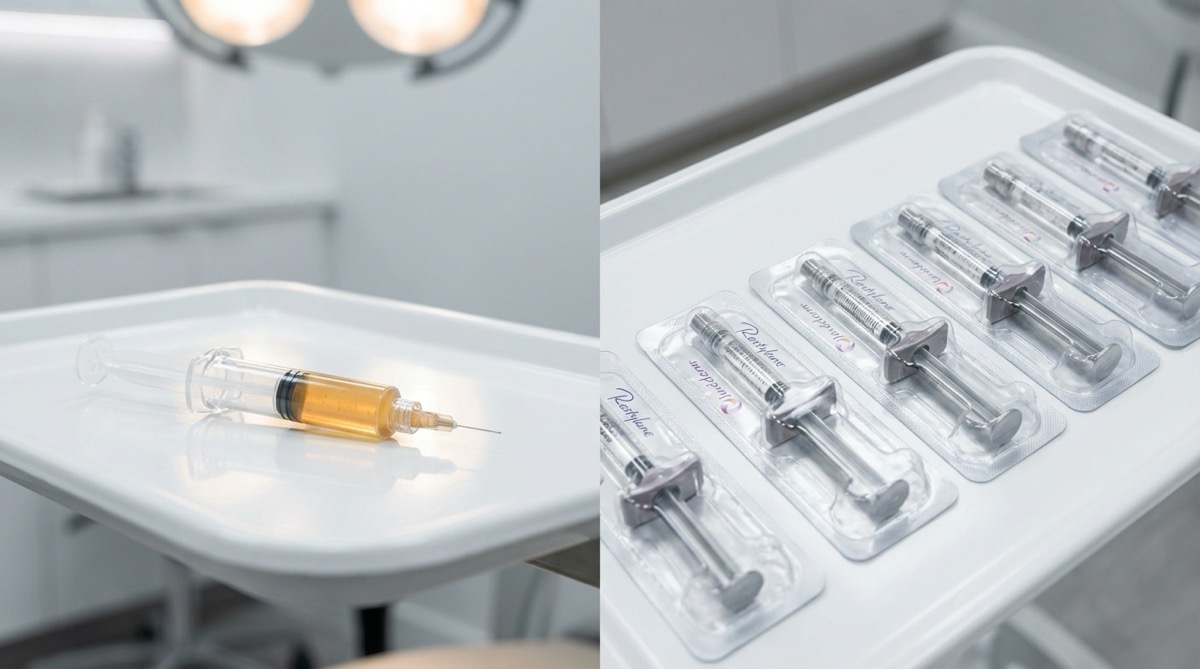
Dermal fillers are usually considered for small, precise and temporary volume corrections, while facial fat grafting is a surgical option for broader volume restoration when a patient needs more structural facial rejuvenation. Neither approach is automatically better. The safer choice depends on anatomy, skin quality, degree of volume loss, tolerance for downtime, medical history, and whether the patient is already planning surgery such as a facelift or blepharoplasty.
I see this question often during consultations in Londrina: “Should I choose fat grafting or fillers?” The honest answer is that both can be useful, but they solve different problems. A syringe of hyaluronic acid filler cannot replace a surgical fat transfer for global facial deflation; fat grafting is not the right answer for every small line, lip detail or minor contour correction.
Medical review
Written and reviewed by Dr. Walter Zamarian Jr., plastic surgeon in Londrina, Brazil. CRM-PR 17.388, RQE 15.688, full member of the Brazilian Society of Plastic Surgery (SBCP) and member of the American Society of Plastic Surgeons (ASPS). More than 8,000 surgeries over two decades of practice; today, by deliberate choice, 2-3 facelifts per week (~100-150 per year). Last reviewed: May 24, 2026.
How facial fat grafting works
Facial fat grafting, also called fat transfer or lipofilling, uses the patient’s own fat as a graft. Fat is harvested from a donor area such as the abdomen, flanks or thighs, processed, and then placed in small parcels into selected facial areas. The goal is not to “inflate” the face, but to restore selected zones of volume loss while respecting facial anatomy.
Because it involves fat harvest, processing and reinjection, fat grafting is a surgical procedure. It may be performed as a standalone treatment in selected patients, but it is often considered during broader facial rejuvenation, such as a facelift, Regenerative Deep Plane facelift, blepharoplasty or neck lift.
Fat grafting is biologically different from a synthetic filler because the transferred tissue contains living fat cells and stromal components from the patient’s own body. That does not mean it should be marketed as a proven stem-cell therapy, and I avoid promising skin regeneration as if it were guaranteed. Some patients notice improvement in texture or softness after fat grafting, but the most reliable goal remains volume restoration with careful placement.
How dermal fillers work
Dermal fillers are injectable medical products used to restore or shape specific areas. Hyaluronic acid fillers are common because they can add volume, hold water and, in many cases, be dissolved with hyaluronidase if a correction or urgent management is needed.
Fillers are often useful for small and targeted changes: mild cheek support, lip definition, a selected fold, chin contour, jawline refinement or touch-ups after surgery. They are temporary, and their duration depends on the product, the area treated, movement, metabolism and the amount injected.
The fact that fillers are nonsurgical does not make them casual beauty treatments. They are medical procedures. Product choice, injection plane, vascular anatomy, dose, antisepsis and emergency preparedness all matter.
Fat grafting vs fillers: the practical differences
| Factor | Facial fat grafting | Dermal fillers |
|---|---|---|
| Procedure type | Surgical fat harvest, processing and transfer | Injectable medical procedure |
| Main role | Broader volume restoration in selected areas | Small, precise and temporary corrections |
| Reversibility | Not easily reversible | Hyaluronic acid fillers can often be dissolved |
| Predictability | Depends on fat survival, technique and healing | More immediately visible and adjustable |
| Recovery | Bruising and swelling in the face and donor area are expected | Usually shorter recovery, but bruising and swelling can still occur |
| Best context | Facial deflation, hollow temples, cheeks, periorbital hollowness, combined surgery | Lips, folds, small contour refinements and surgical touch-ups |
| Main risks | Partial resorption, asymmetry, irregularity, donor-site issues, infection, anesthesia risk | Vascular occlusion, necrosis, visual symptoms, nodules, migration, infection, asymmetry |
When I consider fat grafting
Fat grafting may be appropriate when volume loss is broad enough that repeated filler sessions would be inefficient or aesthetically limited. Common examples include hollow temples, flattened cheeks, periorbital hollowness, facial deflation after weight loss, or a patient undergoing a facelift who also needs volume restoration.
It can be particularly useful when the face looks tired because volume has been lost in several zones at the same time. In those situations, simply tightening skin or adding one small filler bolus may not address the underlying shape change.
However, fat grafting requires realistic expectations. Some transferred fat is absorbed, and it is not easily reversible once tissue has healed. Retention varies by patient, area, technique, vascularity, smoking or nicotine exposure, weight changes and postoperative healing. Touch-up treatment can be necessary. This is why the plan should be conservative and anatomical rather than based on a fixed percentage.
When I consider fillers
Fillers can be the better choice when the change is small, localized and meant to be adjustable. A patient may want lip definition, a small chin refinement, mild cheek support, a fold softened or a limited postoperative touch-up. In those cases, hyaluronic acid filler may offer precision without the recovery of surgery.
Fillers can also be useful when a patient is not ready for surgery or needs a temporary approach. But temporary does not mean unimportant. Repeated filler in the wrong plane or excessive amounts can distort facial proportions, create puffiness, migrate or make later surgical planning more complex.
Risks of dermal fillers
The most serious filler complication is vascular occlusion, when filler enters or compresses a blood vessel. This can reduce blood supply and lead to pain, skin color change, livedo, blisters, necrosis and, rarely, visual symptoms or blindness. Areas such as the nose, glabella and tear trough demand particular caution.
Other possible problems include bruising, swelling, infection, nodules, lumps, Tyndall effect, migration, asymmetry, allergic reaction and dissatisfaction with shape. With hyaluronic acid fillers, hyaluronidase may help in selected situations, but it is not a reason to treat filler casually.
Warning signs after filler include severe or increasing pain, skin blanching, mottled color change, new blisters, worsening swelling, fever, pus, eye pain, blurred vision, loss of vision or neurological symptoms. These symptoms require urgent contact with the treating physician or emergency care.
Risks of facial fat grafting
Fat grafting has a different risk profile because it is surgery. Expected recovery can include facial swelling, bruising, tenderness and donor-site soreness. Possible complications include infection, bleeding, contour irregularity, asymmetry, overcorrection, undercorrection, partial resorption, palpable nodules or oil cysts, donor-site irregularity, anesthesia-related risk and the possibility of revision or touch-up.
The fact that the graft comes from the patient’s own body does not eliminate risk. Technique matters: small parcels, appropriate planes, respect for vascular anatomy, conservative dosing and sterile handling are part of safe planning.
Can fat grafting and fillers be combined?
Yes, but the order and purpose matter. In some patients, fat grafting is used for broader structural volume restoration during surgery, and fillers are reserved later for small refinements once swelling has settled. In others, fillers are enough and surgery would be unnecessary.
The important point is not to choose a favorite product. The goal is to match the tool to the anatomy. Fat grafting, fillers, lifting surgery, eyelid surgery and skin treatments each solve different parts of facial aging.
Frequently asked questions
Is fat grafting better than fillers?
Fat grafting is not universally better than fillers; it is different. It may be more appropriate for broader facial volume loss, while fillers may be more appropriate for small, precise and temporary corrections.
Does facial fat grafting last forever?
Facial fat grafting can be longer-lasting than fillers, but fat retention varies and some of the transferred fat is absorbed. Aging, weight changes, anatomy and healing continue after the procedure, so it should not be discussed as a fixed or guaranteed result.
Are fillers safer because they are nonsurgical?
Fillers avoid surgical recovery, but they are still medical procedures with real risks, including vascular occlusion, necrosis, infection and rare visual complications. Safety depends on indication, anatomy, product, technique and emergency preparedness.
Can fillers be dissolved if I do not like the result?
Many hyaluronic acid fillers can be treated with hyaluronidase, but dissolving is not always perfectly predictable and does not apply to every filler type. Prevention through correct indication and conservative technique remains better than relying on reversal.
How do I know which option fits my face?
The safest way to decide is an in-person consultation that evaluates facial volume, skin quality, eyelids, cheeks, jawline, neck, prior fillers, medical history and expectations. Photos help the discussion, but they do not replace examination and a risk-benefit conversation.
How I approach the decision in consultation
During consultation, I look at the whole face rather than one isolated fold. I assess whether the main issue is volume loss, tissue descent, skin quality, eyelid aging, neck laxity or a combination. Sometimes the right plan is filler only. Sometimes it is fat grafting. Sometimes the better discussion is a facelift, blepharoplasty, neck lift or staged approach.
For deeper reading, see the pages on facial fat grafting, facial fillers, facelift surgery, Regenerative Deep Plane facelift, blepharoplasty and neck lift. The best treatment is not the one with the strongest marketing language; it is the one that fits the patient’s anatomy, goals and safety profile.