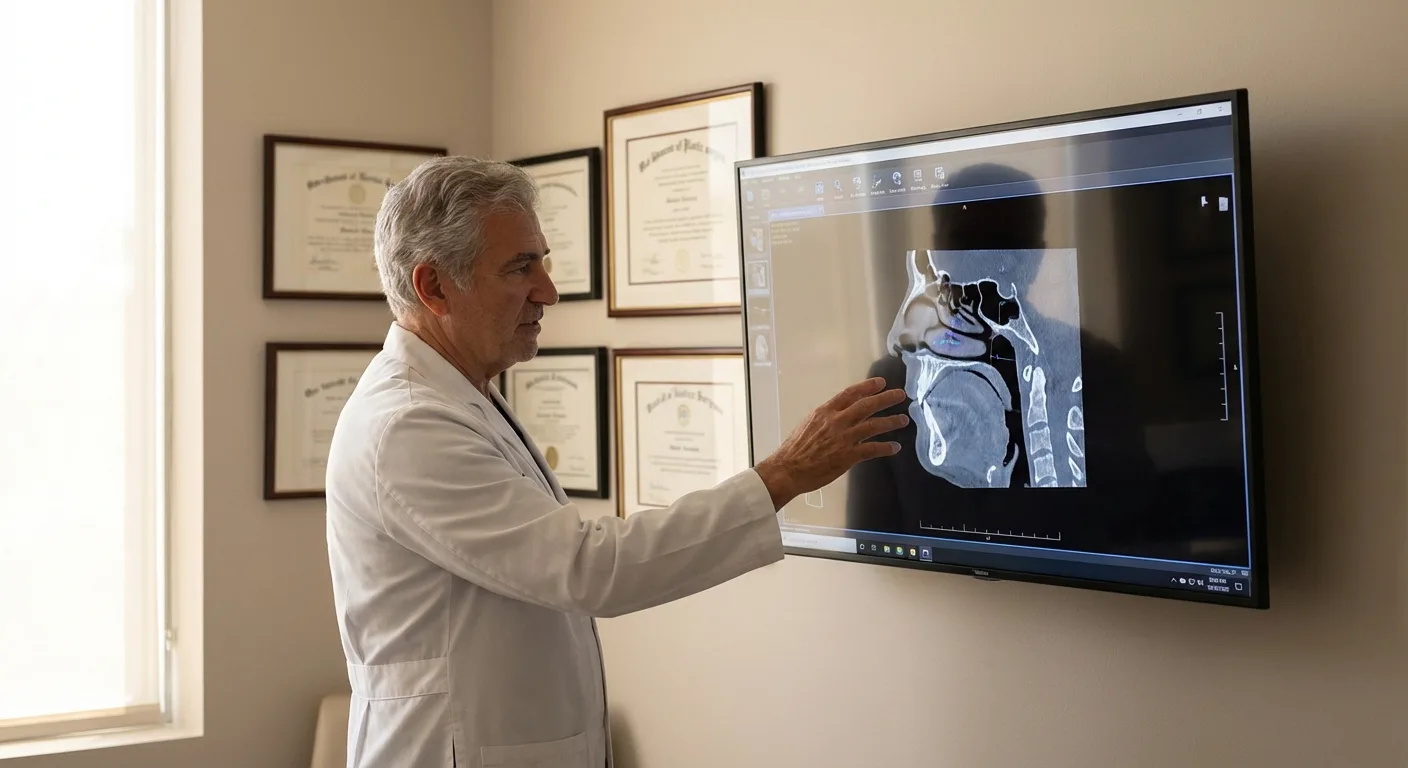
At a glance: Confirm that the surgeon has an active CRM registration, an RQE for the specialty they advertise, and specific experience with rhinoplasty. Ask where the operation will take place, who will provide the anesthesia, how your breathing will be assessed, and how follow-up visits and any revisions are handled. In Brazil, registration should be checked with the CFM and the regional council (CRM); titles, photos, and society memberships do not replace that check. The consultation should explain risks and limits and let you decide without pressure.
Current practice: Dr. Walter Zamarian Jr. no longer performs rhinoplasty, including revision rhinoplasty. This article remains available for educational purposes and is not an offer of the procedure.
I am Dr. Walter Zamarian Jr., a plastic surgeon in Londrina, Brazil (CRM-PR 17.388, RQE 15.688), and a member of the Brazilian Society of Plastic Surgery and the American Society of Plastic Surgeons. Over more than 20 years of practice and more than 8,000 operations, I learned that a good rhinoplasty begins before the operating room: it begins with a careful choice of surgeon and a clear plan. Today, by deliberate choice, more than 90% of my surgeries are deep plane facelifts with fat grafting (fat grafting is not added to every case), and I share what follows as educational guidance.
1. Check CRM and RQE registration before anything else
If you are considering rhinoplasty in Brazil, two registrations matter. The CRM identifies a physician’s medical registration, and the RQE shows the specialty that is formally registered. If a surgeon presents themselves as a plastic surgeon, confirm that they hold an RQE in plastic surgery. Rhinoplasty is also part of the training of otolaryngologists (ENT surgeons), subject to each physician’s own qualifications. In either case, check the qualification being advertised and the surgeon’s specific experience with the procedure.
The CFM/CRM search lets you verify a physician’s professional registration. The SBCP member search helps you confirm the affiliation of anyone who claims to be a member of that society. These are different, complementary checks; neither replaces an evaluation of the surgeon’s experience, the surgical facility, and the quality of the consultation.
2. Being a plastic surgeon is not enough: look at rhinoplasty experience
Rhinoplasty is one of the most delicate operations in facial plastic surgery. It involves skin, bone, cartilage, the septum, the nasal valve, breathing, symmetry, healing, and aesthetic expectations. A surgeon can be excellent in other areas and still not perform rhinoplasty regularly.
During the consultation, ask about specific experience with primary rhinoplasty, revision rhinoplasty, crooked noses, thick skin, reconstruction with cartilage grafts, and functional cases. The quality of the answer matters more than any single number.
3. The consultation must assess both appearance and breathing
Serious planning is not limited to how the nose looks from the outside. The surgeon should examine the nose externally and internally and ask about nasal obstruction, allergies, trauma, previous surgery, snoring, decongestant use, and your breathing history. Breathing function needs to be preserved and, when possible, improved.
If the consultation talks only about making the nose “thinner,” “lifting” it, or “making it pretty,” without discussing the septum, the nasal valve, the cartilage, the skin, and technical limits, that is a warning sign. Modern rhinoplasty has to combine form and function.
4. Be wary of promises and pressure
Surgery works with living tissue. Swelling, healing, pre-existing asymmetry, skin thickness, and individual biological response all affect the result. Promises of perfection, absolute symmetry, or a recovery without individual variation are not responsible medical language.
It is also inappropriate to pressure a patient to decide quickly. A surgical decision should leave room for reflection, a second opinion, and a careful reading of the informed consent. Artificial urgency is a sales tactic, not medical care.
5. Result photos should not be the main criterion
You may want to understand a surgeon’s style, but isolated images have important limitations. They depend on lighting, angle, time since surgery, case selection, consent, and clinical context. Medical advertising is also subject to ethical rules designed to protect patients and avoid promising results.
When results are discussed during a consultation, the goal should be educational: understanding what is possible, what the limits are, and what a natural outcome looks like. The choice of surgeon should rest not on public before-and-after images but on verifiable credentials, technical analysis, honest communication, and safety.
6. Evaluate the hospital and the anesthesia team
Rhinoplasty must be performed in a setting with adequate infrastructure, a trained team, monitoring, safety protocols, and the capacity to manage complications. The anesthesia team is an essential part of this. Ask where the operation will take place, who will provide the anesthesia, which tests will be ordered, and how postoperative follow-up works. To explore this topic further, see my article on anesthesia in rhinoplasty.
This matters even more if you are traveling from another city or country for surgery, or in cases involving combined procedures, secondary rhinoplasty, functional problems, or medical conditions that require additional preparation.
7. Understand risks, revisions, and limits before surgery
A good consultation should explain risks such as bleeding, infection, changes in breathing, asymmetry, internal scarring, irregularities, changes in sensation, the need for revision, and dissatisfaction with aspects of the result. Talking about risk does not weaken trust; it strengthens the decision.
Thick skin, for example, imposes its own limits on definition. Noses that have already been operated on may need cartilage from the ear or rib. Simulations and photographs help the conversation, but they do not replace an anatomical assessment.
8. Ask objective questions during the consultation
A good way to compare surgeons is to ask clear questions and notice whether the answers are technical, patient, and consistent:
- What are your CRM and your RQE in the specialty you advertise?
- Are you a member of the SBCP?
- How will you assess my breathing and my nasal valve?
- What limits do my skin, cartilage, and asymmetries impose?
- Would my surgery require cartilage grafts?
- Where will the operation take place, and who is on the anesthesia team?
- Which risks are most relevant in my case?
- What will follow-up look like during the first year?
- In which situations might a revision be needed?
- Is there any reason for me to postpone surgery or seek an additional evaluation?
9. A second opinion is part of a mature decision
Seeking a second opinion is not disrespectful. It is a legitimate way to think through a permanent decision. A confident surgeon is not offended when a patient wants to compare explanations, understand alternatives, and take time to decide.
This is especially useful in secondary rhinoplasty, cases with breathing complaints, thick skin, a history of trauma, very high emotional expectations, or uncertainty between surgery and nonsurgical alternatives. On that last point, see my article on surgical rhinoplasty versus nasal filler.
Red flags when choosing a surgeon
- not stating CRM and RQE numbers clearly;
- not examining the inside of the nose;
- promising perfection or a nose identical to someone else’s;
- downplaying risks or avoiding the topic of revision;
- pressuring you to decide on the same day;
- relying on social media, celebrities, or follower counts;
- quoting a price that is incompatible with an adequate hospital, anesthesia, and follow-up;
- not explaining recovery, restrictions, warning signs, and follow-up visits.
Frequently asked questions
How can I check whether a Brazilian physician has an RQE?
Search the CFM/CRM database by name or registration number and check the advertised specialty. For a surgeon who presents themselves as a plastic surgeon, look for an RQE in plastic surgery. The SBCP search confirms affiliation with that society.
Is being a plastic surgeon enough to perform rhinoplasty?
No. Beyond checking the advertised qualification, assess the surgeon’s specific experience with rhinoplasty, breathing function, grafts, and revisions. Training in plastic surgery or otolaryngology should be matched by the skills and infrastructure the case requires.
Should I get a second opinion before rhinoplasty?
Yes, whenever you have doubts. A second opinion is a healthy way to compare approaches, confirm the indication, understand the risks, and decide with less pressure. It is especially important in complex cases and revisions.
Are before-and-after photos the main criterion?
No. Results can be discussed ethically and educationally during a consultation, when permitted and with context, but isolated images do not replace credentials, a physical examination, a technical explanation, anesthetic safety, and follow-up.
Does the hospital setting really matter?
Yes. Rhinoplasty is surgery and should take place in an appropriate setting, with a qualified anesthesia team, monitoring, safety protocols, and the capacity to manage complications.
What are red flags in a rhinoplasty consultation?
Pressure to book the operation, promises of perfection, no internal examination, no discussion of breathing, no RQE stated, downplayed risks, or social media presented as the main proof of competence are all red flags.
Conclusion
Choosing a rhinoplasty surgeon is a medical decision, not an impulse purchase. CRM, RQE, SBCP membership, specific experience, the facility, the anesthesia, communication, and safety have to be evaluated together. The right surgeon is not the one who promises the most; it is the one who explains best, examines rigorously, acknowledges limits, and guides the patient responsibly.
In rhinoplasty, prudence is part of the result. Careful planning protects breathing, improves technical predictability, and helps the patient go into surgery with realistic expectations.
Official sources
- SBCP – Find a Surgeon (Encontre um Cirurgião)
- CFM – Specialist title, medical residency, and RQE
- ASPS – Choose a plastic surgeon you can trust
- ASPS – Rhinoplasty risks and safety
- ABORL-CCF – Clarification note on otolaryngologists’ competence in facial surgery
Read Also
This page in other languages: Português (BR)

Dr. Walter Zamarian Jr.
Plastic surgeon in Londrina, Brazil (CRM-PR 17.388 | RQE 15.688), full member of SBCP and ASPS. He has worked in plastic surgery for more than 20 years, with a focus on individualized planning, patient safety, Deep Plane facelift, eyelid surgery, facial fat grafting, and female intimate surgery.
Follow this blog on Google
Want to find more articles from this blog on Google? Add Dr. Walter Zamarian Jr. to your preferred sources.
Leave a comment