lifting-facial Archives - Page 3 of 9 - Dr. Walter Zamarian Jr.

Categoria: lifting-facial

  • Deep Plane Facelift Cost Brazil

    Deep Plane Facelift Cost Brazil

    One of the most common questions I receive from international patients is straightforward: “Doctor, how much does a Deep Plane facelift cost in Brazil?” I completely understand. A facelift is a significant investment, and you deserve full transparency before making your decision.

    What I can tell you upfront is that a Deep Plane facelift in Brazil costs roughly 40% to 60% less than the same procedure in the United States or Europe — with equivalent technical quality and safety standards. But the final price depends on several individual factors that I need to evaluate in person. In this article, I’ll walk you through everything that influences the cost, what’s included, and why so many patients from abroad are choosing Brazil for this surgery.

    With over 20 years of experience and more than 8,000 surgeries performed, I can say with confidence that the Deep Plane facelift is the most advanced and long-lasting facial rejuvenation technique available today. And I believe you deserve to understand exactly what you’re paying for.

    Factors That Influence the Cost of a Deep Plane Facelift

    Unlike standardized procedures, a Deep Plane facelift is a highly personalized surgery. Every face has unique anatomy, varying degrees of aging, and different needs. That’s why the price varies from patient to patient. The main factors that influence cost include:

    • Extent of the surgery: A lift addressing only the lower third of the face costs differently than a procedure that includes the neck, temporal region, and eyelids.
    • Combined procedures: Many patients benefit from combining the facelift with facial fat grafting (Regenerative Deep Plane), blepharoplasty, or rhinoplasty. Each combination affects the final cost.
    • Anesthesia and hospital stay: The surgery is performed under general anesthesia, and the length of stay depends on case complexity.
    • Surgical team: I work with a dedicated, experienced team — a specialized anesthesiologist, scrub nurse, and nursing staff trained specifically in facial surgery.
    • Surgeon’s experience and training: The Deep Plane technique demands specific expertise. My training includes the renowned Pitanguy Clinic in Rio de Janeiro and hands-on Deep Plane training with Dr. Tim Marten in the United States, one of the world’s foremost authorities in facelift surgery.

    Price Range: Brazil vs the United States vs Europe

    While I don’t publish specific surgical fees — because every case is individualized and deserves a tailored proposal — I can offer a comparative perspective based on publicly available international market data:

    • United States: A Deep Plane facelift in the US averages between $25,000 and $50,000, and can exceed $70,000 at premium clinics in New York or Beverly Hills.
    • Europe: Prices range from €15,000 to €35,000, depending on the country and surgeon.
    • Brazil: The same procedure performed by qualified surgeons costs 40% to 60% less than in the US, with comparable technical and safety standards.

    This price difference does not reflect lower quality — quite the opposite. Brazil is a global reference in plastic surgery. The lower cost reflects the country’s economic reality, reduced operational expenses, and favorable exchange rates for foreign patients.

    What’s Included in the Price

    When I present a quote to a patient, it’s comprehensive and transparent. No hidden costs. Typically, the value includes:

    • Surgeon’s fees — covering surgical planning, the procedure itself, and all postoperative follow-up
    • Complete surgical team — anesthesiologist, scrub nurse, and nursing staff
    • Hospital and operating room — accredited facility with ICU availability and full equipment
    • Surgical materials and supplies
    • Postoperative consultations — regular follow-ups throughout the entire recovery period
    • Compression garment and other post-surgical items as needed

    For international patients, I also provide logistical support — recommendations for nearby accommodations, transportation arrangements, and remote follow-up after you return home.

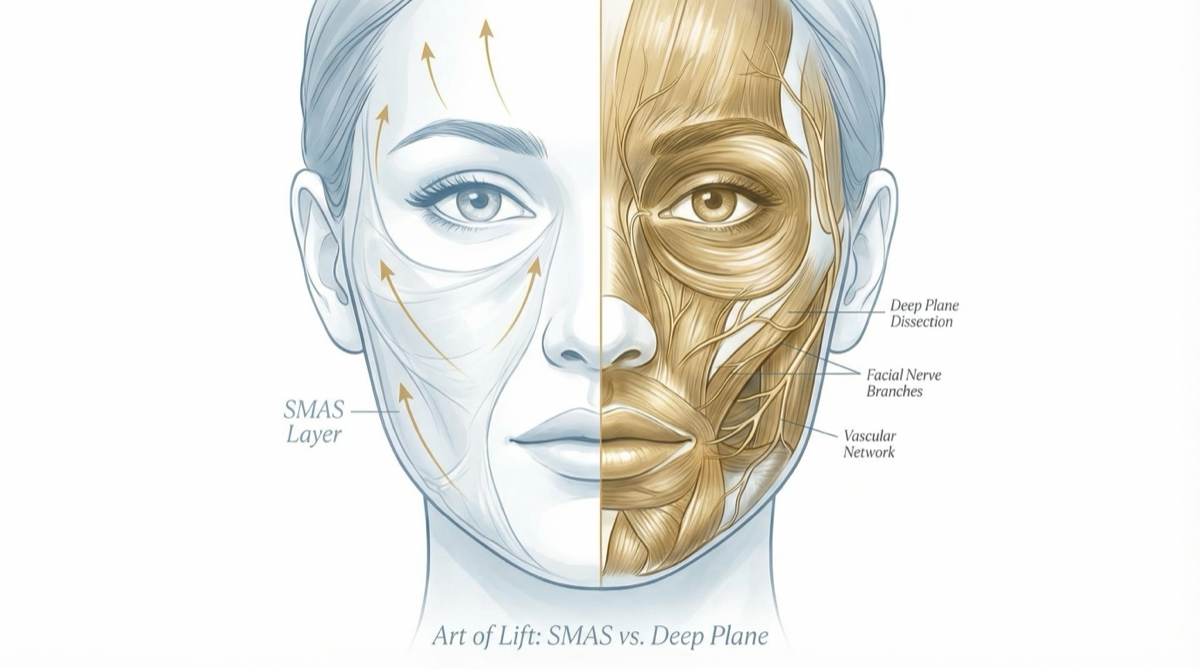
    Deep Plane vs SMAS: Why Does the Deep Plane Cost More?

    There’s a fundamental technical difference between the two most common facelift approaches: the traditional SMAS plication or SMASectomy and the Deep Plane technique.

    In the traditional SMAS approach, the surgeon works on the superficial layer of the face, pulling and securing tissues in a more limited fashion. It’s a faster, technically less demanding surgery.

    In the Deep Plane technique, I release the entire deep muscular layer (the SMAS) from the facial retaining ligaments, allowing true repositioning of tissues — without excessive skin tension. This results in:

    • More natural results: No “pulled” or artificial appearance whatsoever
    • Greater longevity: Results lasting 10 to 15 years, compared to 5 to 7 years with traditional SMAS
    • Superior midface rejuvenation: The cheek area and nasolabial folds are addressed far more effectively
    • Surprisingly similar recovery: Despite being a deeper procedure, swelling and bruising with Deep Plane are comparable to SMAS

    The higher cost is justified by the technical complexity, longer operative time, and — most importantly — the superior quality of results. In my exclusive technique — the Regenerative Deep Plane — I add fat grafting with stem cells, which further enhances rejuvenation by improving skin texture, volume, and overall quality.

    Is It Worth Traveling to Brazil for a Facelift?

    I regularly receive patients from the United States, Canada, Europe, the Middle East, and Asia. The short answer is: yes, it’s absolutely worth it. And it’s not just me saying this — it’s the patients themselves who return and refer friends and family.

    The most common reasons patients give for choosing to have surgery with me in Londrina, Brazil:

    • Significant savings: Even including airfare and accommodation, the total cost is typically 30% to 50% less than in the US.
    • World-class technical quality: Brazil trains more plastic surgeons than any other country, and our tradition in facial surgery is internationally recognized.
    • Privacy and peaceful recovery: Londrina is a calm city with excellent medical infrastructure, away from the hustle of major capitals. Many patients appreciate the discretion.
    • Personalized care: My team is fluent in English and supports each patient through every stage — before, during, and after surgery.
    • Surgeon credentials: I’m a member of the SBCP (Brazilian Society of Plastic Surgery), ASPS (American Society of Plastic Surgeons), and AExPI (Pitanguy Alumni Association), with hands-on Deep Plane training in the US.

    “Many patients ask me whether it’s safe to have surgery in Brazil. I can assure you that the hospital infrastructure, safety protocols, and the technical level of professionals here are absolutely comparable to the best centers in the US and Europe.”

    How the Consultation Works

    The first step to knowing exactly how much your Deep Plane facelift will cost is scheduling a consultation. During this appointment, I perform:

    • Complete facial analysis: I evaluate your facial anatomy, degree of laxity, skin quality, and bone structure.
    • Medical history review: I check health conditions, medications, and previous surgeries.
    • Personalized surgical plan: I determine which areas need attention and which complementary procedures could optimize your results.
    • Detailed quote: I present the complete cost with no surprises, listing everything that’s included.
    • Expectation alignment: We discuss realistic expectations and review photos of similar cases to align on the anticipated outcome.

    For international patients, I offer an online consultation as an initial evaluation step, so you can plan your trip with confidence. The in-person consultation fee is R$800 (approximately US$150, first visit) or R$400 (follow-up).

    My clinic is located at Rua Eng. Omar Rupp, 186 — Jardim Londrilar, Londrina, Paraná, Brazil.

    Frequently Asked Questions

    Is a Deep Plane facelift more expensive than a traditional facelift?

    Yes, a Deep Plane facelift generally costs more than a traditional SMAS lift. This is due to the greater technical complexity, longer operative time, and the specialized training required. However, considering that results last significantly longer — 10 to 15 years versus 5 to 7 — the long-term value is actually superior.

    How long do I need to stay in Londrina?

    I recommend a minimum stay of 10 to 14 days. This allows time for the preoperative consultation, the surgery itself, the critical first days of recovery, and at least two follow-up appointments before you travel home. After that period, follow-up can continue remotely via video calls.

    Can I have an online consultation before traveling?

    Absolutely. An online consultation is an excellent first step — it allows me to evaluate your photos and videos, discuss expectations, and provide preliminary guidance. However, an in-person evaluation is essential before surgery, as I need to palpate tissues, assess skin elasticity, and finalize the surgical plan with precision.

    Is it safe to have plastic surgery in Brazil?

    Brazil is one of the world’s leading countries in plastic surgery, with rigorous training programs and hospital accreditation standards. I operate in fully equipped, accredited facilities with ICU availability. My team follows the same safety protocols used at top American and European centers. Patient safety is never compromised.

    Take the Next Step

    If you’re considering a Deep Plane facelift and want to know exactly how much it will cost in your case, the path is simple: schedule your consultation. I look forward to evaluating your face, understanding your goals, and presenting a complete, transparent surgical plan.

    Reach out via WhatsApp or through the contact form on my website. I welcome patients from across Brazil and around the world, with full support in both Portuguese and English.

    Dr. Walter Zamarian Jr.
    CRM-PR 17,388 | RQE 15,688
    Member of SBCP · ASPS · AExPI
    Londrina, Paraná, Brazil

  • Lifting Pós-Ozempic: Solução

    Lifting Pós-Ozempic: Solução

    Por Dr. Walter Zamarian Jr. — CRM-PR 17.388 | RQE 15.688

    Os medicamentos GLP-1 como Ozempic (semaglutida) e Wegovy revolucionaram o tratamento da obesidade. Mas muitos pacientes estão descobrindo um efeito colateral inesperado: a perda significativa de volume facial que pode envelhecer a aparência em vários anos — mesmo com o corpo mais saudável do que nunca.

    Esse fenômeno, conhecido como “Ozempic face” (rosto pós-Ozempic), tem gerado uma onda de consultas para rejuvenescimento facial. Como cirurgião especializado em lifting Deep Plane combinado com enxerto de gordura facial, ofereço uma solução completa para esse problema complexo.

    O que é o “Ozempic Face”?

    Quando o paciente perde peso de forma significativa — seja por medicamentos GLP-1, cirurgia bariátrica ou dieta — a face perde volume junto com o corpo. Diferente da gordura corporal, a perda de gordura facial é quase sempre indesejável. Ela causa:

    • Bochechas encovadas e têmporas afundadas
    • Sulcos nasolabiais profundos (linhas do nariz à boca)
    • Pele flácida que perdeu o suporte subjacente
    • Papada visível por perda do coxim gorduroso
    • Aparência envelhecida e cansada apesar do corpo mais magro

    Por que um lifting convencional não basta

    Um lifting facial padrão — mesmo um SMAS bem executado — trata a flacidez e o excesso de pele. Mas não restaura o volume perdido. Esticar tecidos esvaziados sem repor volume pode até piorar a situação, criando uma aparência “puxada” ou esquelética.

    É exatamente por isso que desenvolvi minha abordagem combinando Deep Plane facelift com enxerto de gordura — o que chamo de Deep Plane Regenerativo. Para pacientes pós-Ozempic, essa combinação não é apenas benéfica; é essencial.

    Minha abordagem: Deep Plane Regenerativo

    1. Lifting Deep Plane: restaurando a estrutura

    A técnica Deep Plane reposiciona os tecidos faciais profundos como uma unidade, trabalhando abaixo do SMAS e liberando os ligamentos de retenção. Isso trata a flacidez de forma natural e duradoura (10-15 anos).

    2. Enxerto de gordura: restaurando o volume

    Usando a gordura do próprio paciente (retirada do abdômen ou flancos por lipoaspiração delicada), injeto volumes precisos nas áreas que perderam preenchimento:

    • Maçãs do rosto — restaurando a plenitude jovial
    • Têmporas — corrigindo a aparência oca
    • Sulcos nasolabiais — suavizando vincos profundos
    • Região perioral — tratando linhas de marionete
    • Olheiras — quando combinado com blefaroplastia

    O bônus regenerativo

    Além da reposição volumétrica, a gordura transplantada carrega células-tronco derivadas do tecido adiposo que melhoram ativamente a qualidade da pele. Pacientes pós-Ozempic frequentemente notam melhora na textura, luminosidade e elasticidade — benefícios que preenchimentos com ácido hialurônico não proporcionam.

    Preenchimento vs. enxerto de gordura

    Aspecto Ácido Hialurônico Enxerto de Gordura
    Duração 6-18 meses Anos a permanente
    Volume possível Limitado (2-6 mL) Substancial (20-60 mL)
    Naturalidade Boa, mas material sintético Excelente — tecido próprio
    Melhora da pele Mínima Significativa (células-tronco)
    Custo acumulado Repetições constantes Procedimento único
    Ideal para Perda volumétrica leve Perda significativa (Ozempic face)

    Quando operar?

    Recomendo que o paciente:

    1. Alcance o peso-alvo ou esteja a no máximo 5-10 kg dele
    2. Mantenha peso estável por 3-6 meses antes da cirurgia
    3. Continue ou suspenda o GLP-1 — ambas as opções funcionam, desde que o peso esteja estável
    4. Esteja em boa saúde geral

    Perguntas frequentes

    Posso continuar tomando Ozempic após a cirurgia?

    Sim. Após a cicatrização, você pode manter o GLP-1 para manutenção do peso. O importante é a estabilidade ponderal.

    A gordura enxertada sobrevive se eu uso Ozempic?

    A sobrevivência do enxerto depende primariamente da técnica cirúrgica, não do uso de GLP-1. Utilizo micro-injeção precisa que maximiza a integração da gordura.

    Quanto mais jovem vou parecer?

    A maioria dos pacientes relata aparentar 10-15 anos mais jovem após Deep Plane + lipoenxertia. O resultado específico depende da anatomia individual e do grau de perda de volume.

    Atende pacientes de outros estados?

    Sim. Recebo pacientes de todo o Brasil e do exterior. A primeira consulta pode ser presencial em Londrina ou por telemedicina. Londrina possui aeroporto com voos diretos de São Paulo e Curitiba. A equipe auxilia com hospedagem e logística.

    Agende sua avaliação

    Se o Ozempic ajudou você a atingir suas metas de peso mas deixou o rosto com aparência envelhecida, saiba que você não precisa escolher entre um corpo mais saudável e um rosto jovem. A cirurgia moderna permite ter ambos.

    Agende sua consulta — presencial ou por telemedicina. Avaliarei seu caso específico e criarei um plano cirúrgico personalizado.

    Dr. Walter Zamarian Jr.
    CRM-PR 17.388 | RQE 15.688
    Membro SBCP | ASPS
    Conheça minha trajetória

  • Ozempic Face: Fat Grafting Fix

    Ozempic Face: Fat Grafting Fix

    By Dr. Walter Zamarian Jr. — CRM-PR 17,388 | RQE 15,688

    The rise of GLP-1 medications like Ozempic (semaglutide) and Wegovy has transformed weight loss treatment worldwide. But many patients are discovering an unexpected side effect: significant facial volume loss that can add years to their appearance — even as their body looks better than ever.

    This phenomenon, widely known as “Ozempic face,” has driven a surge in facial rejuvenation consultations. As a plastic surgeon specializing in Deep Plane facelift combined with facial fat grafting, I’m uniquely positioned to address this complex problem. Here’s what you need to know.

    What Is “Ozempic Face”?

    When patients lose significant weight — whether through GLP-1 medications, bariatric surgery, or diet — the face loses fat volume alongside the body. Unlike body fat, facial fat loss is almost always undesirable. It leads to:

    • Hollow cheeks and sunken temples
    • Deepened nasolabial folds (nose-to-mouth lines)
    • Sagging skin that has lost its underlying support
    • Visible jowls as skin drapes over a diminished fat pad
    • A gaunt, aged appearance despite improved body contour

    The irony is cruel: patients who worked hard to improve their health end up looking older. This is where modern facial surgery can make a dramatic difference.

    Why a Traditional Facelift Isn’t Enough

    A standard facelift — even a well-executed SMAS facelift — addresses skin laxity and sagging. But it does nothing to restore lost volume. Tightening deflated tissues without adding volume can actually make the problem worse, creating a “pulled” or skeletal appearance.

    This is precisely why I developed my approach of combining the Deep Plane facelift with fat grafting — what I call Regenerative Deep Plane. For post-Ozempic patients, this combination is not just beneficial; it’s essential.

    The Regenerative Deep Plane Approach for Ozempic Face

    My approach to post-GLP-1 facial rejuvenation involves two simultaneous procedures:

    1. Deep Plane Facelift: Restoring Structure

    The Deep Plane technique lifts and repositions the deep facial tissues — the SMAS, muscles, and fat pads — as a single composite unit. This addresses the sagging and laxity caused by volume loss. By working below the SMAS layer and releasing retaining ligaments, I can achieve a natural repositioning that lasts 10-15 years.

    2. Fat Grafting: Restoring Volume

    Using the patient’s own fat (harvested from the abdomen, flanks, or thighs via gentle liposuction), I carefully inject precise amounts into the areas of volume loss:

    • Cheeks and malar region — restoring youthful fullness
    • Temples — correcting hollowness
    • Nasolabial folds — softening deep creases
    • Perioral area — addressing marionette lines
    • Under-eye hollows — when combined with blepharoplasty

    The Regenerative Bonus

    Beyond volume restoration, transplanted fat carries adipose-derived stem cells that actively improve skin quality. Post-Ozempic patients often notice improved skin texture, luminosity, and elasticity — benefits that fillers simply cannot provide.

    Fillers vs. Fat Grafting for Ozempic Face

    Feature Dermal Fillers Fat Grafting
    Duration 6-18 months Years to permanent
    Volume capacity Limited (2-6 mL typical) Substantial (20-60 mL)
    Natural feel Good but foreign material Excellent — your own tissue
    Skin quality improvement Minimal Significant (stem cells)
    Ongoing cost Repeated treatments needed One procedure
    Risk of complications Migration, Tyndall effect Partial reabsorption (planned for)
    Best for Minor volume loss, maintenance Significant volume loss (Ozempic face)

    For the level of volume loss seen in post-Ozempic patients, fillers are typically insufficient. They would require repeated large-volume injections, accumulating cost and risk over time. Fat grafting provides a definitive solution.

    Timing: When Should You Consider Surgery?

    I recommend patients:

    1. Reach their target weight or be within 5-10 kg of it
    2. Maintain stable weight for at least 3-6 months before surgery
    3. Continue or discontinue GLP-1 — either is fine, as long as weight is stable
    4. Be in good overall health — the weight loss journey itself improves surgical candidacy

    Operating too early — while weight is still dropping — risks the need for revision as further volume loss occurs.

    What International Patients Should Know

    I regularly treat patients from the United States, Europe, and other countries who travel to Brazil for surgery. The combination of:

    • World-class training (Pitanguy Institute + Deep Plane specialization in the US)
    • Extensive experience (+8,000 surgeries over 20+ years)
    • Significant cost savings compared to US and European pricing
    • Excellent medical infrastructure in Londrina, with direct flights from São Paulo

    makes Brazil an attractive destination for this type of comprehensive facial surgery. My team assists with logistics, accommodation, and post-operative care for international patients.

    Frequently Asked Questions

    Can I still take Ozempic after the facelift?

    Yes. Once your weight is stable and you’ve healed from surgery, you can continue GLP-1 medication for weight maintenance. The key is weight stability — not whether you’re on medication.

    Will the fat survive if I’m on Ozempic?

    Fat graft survival is primarily determined by technique, not by GLP-1 use. I use precise micro-injection techniques that maximize graft survival. I typically overcorrect slightly to account for normal reabsorption in the first 3-6 months.

    How much younger will I look?

    Most patients report looking 10-15 years younger after Deep Plane + fat grafting. The specific result depends on individual anatomy, degree of volume loss, and skin quality.

    Is it just for Ozempic patients?

    No. The Regenerative Deep Plane approach is my standard technique for most facelift patients. It’s particularly beneficial for post-Ozempic patients because they tend to have more significant volume loss, but anyone with facial aging and volume loss can benefit.

    Take the First Step

    If Ozempic or other GLP-1 medications have helped you achieve your weight loss goals but left you with unwanted facial aging, you don’t have to choose between a healthier body and a youthful face. Modern surgical techniques can give you both.

    Schedule a consultation — available in-person in Londrina, Brazil, or via telemedicine for international patients. I’ll assess your specific situation and create a personalized surgical plan.

    Dr. Walter Zamarian Jr.
    CRM-PR 17,388 | RQE 15,688
    Member SBCP | ASPS
    Learn about my training and qualifications

  • Recuperação do Lifting Deep Plane: Semana a Semana, do Dia 1 ao Resultado Final

    Recuperação do Lifting Deep Plane: Semana a Semana, do Dia 1 ao Resultado Final

    Por Dr. Walter Zamarian Jr. — CRM-PR 17.388 | RQE 15.688

    A recuperação é, sem dúvida, a maior preocupação dos pacientes que consideram um lifting facial Deep Plane. Perguntas como “Quanto tempo vou ficar inchado?”, “Quando posso voltar ao trabalho?” e “Dói muito?” são praticamente universais no meu consultório.

    Quer saber se esse procedimento é indicado para você?
    Agende sua consulta ou fale pelo WhatsApp.

    Neste artigo, vou detalhar exatamente o que esperar em cada fase da recuperação, com base na minha experiência de mais de 20 anos e milhares de liftings realizados. Meu objetivo é eliminar a ansiedade e ajudar você a se preparar da melhor forma possível.

    Antes da cirurgia: preparação

    Uma boa recuperação começa antes da sala de cirurgia. Na consulta pré-operatória, oriento meus pacientes a:

    • Suspender medicamentos anticoagulantes (aspirina, anti-inflamatórios) 10-14 dias antes, conforme orientação médica
    • Parar de fumar pelo menos 4 semanas antes (o cigarro compromete seriamente a cicatrização)
    • Organizar a casa: deixar tudo acessível — travesseiro elevado, compressas frias, medicações, alimentos leves
    • Ter um acompanhante nas primeiras 48 horas
    • Preparar-se emocionalmente: os primeiros dias envolvem inchaço e equimoses — é normal e temporário

    Dia 0: O dia da cirurgia

    A cirurgia de Deep Plane Regenerativo (lifting + enxerto de gordura) dura em média 4-5 horas sob anestesia geral. Ao final, você receberá um curativo compressivo e a rede hemostática de Auersvald — uma técnica que aprendi e incorporei à minha prática, que reduz significativamente hematomas e edema pós-operatório.

    Você vai para casa no mesmo dia ou fica uma noite no hospital, dependendo do caso. A dor é surpreendentemente leve — a maioria dos pacientes classifica entre 2-3 numa escala de 0 a 10. Prescrevo analgésicos e anti-inflamatórios que controlam muito bem o desconforto.

    Dias 1-2: As primeiras 48 horas

    O que esperar:

    • Inchaço moderado, principalmente nas bochechas e região do pescoço
    • Equimoses (roxos) que podem se estender ao pescoço e peito — perfeitamente normal
    • Sensação de tensão e “aperto” na face — é o curativo fazendo seu trabalho
    • Dormência parcial na região operada — temporária

    O que fazer:

    • Manter a cabeça elevada (30-45 graus), inclusive para dormir
    • Aplicar compressas frias conforme orientado
    • Tomar a medicação nos horários prescritos
    • Alimentar-se com dieta pastosa e fria
    • Descansar — é seu principal “trabalho” nestes dias

    Dia 2-3: Remoção da rede hemostática

    No retorno ao consultório (48 horas), removemos a rede hemostática de Auersvald. O procedimento é simples e praticamente indolor. Neste momento, você vai se ver no espelho pela primeira vez — e é comum sentir um susto.

    Importante: o que você vê neste momento NÃO é o resultado final. É o pico do inchaço. A partir daqui, cada dia é melhor que o anterior.

    Dias 3-7: Primeira semana

    O que esperar:

    • O inchaço atinge seu pico entre os dias 2-3 e começa a diminuir
    • Equimoses mudam de cor (roxo → verde → amarelo) — sinal de resolução
    • Você já consegue tomar banho normalmente (cuidado com o rosto)
    • A dor é mínima — muitos pacientes deixam de usar analgésicos no dia 4-5
    • Pode haver sensação de rigidez ao mover a boca ou pescoço

    O que fazer:

    • Caminhar levemente pela casa (estimula circulação)
    • Evitar abaixar a cabeça
    • Não fazer esforço físico
    • Dormir de barriga para cima

    Dias 7-14: Segunda semana

    Esta é a semana da transformação. A maioria dos pontos é removida ou absorvida. O inchaço diminui significativamente — entre 60-70% já resolvido. Equimoses residuais podem ser cobertas com maquiagem.

    Marco importante: a maioria dos meus pacientes se sente confortável para sair de casa e retomar atividades leves por volta do dia 10-14. Para quem trabalha em escritório ou remotamente, este é geralmente o ponto de retorno.

    Semanas 2-4: Primeiro mês

    O que esperar:

    • Inchaço residual (80-90% resolvido)
    • A pele pode parecer “diferente” ao toque — dormência parcial é normal
    • O resultado já é visível e agradável, mas ainda vai melhorar
    • Cicatrizes em processo de amadurecimento

    O que fazer:

    • Retomar atividades normais gradualmente
    • Evitar exercícios intensos (academia, corrida) até liberação médica
    • Usar protetor solar SPF50+ diariamente
    • Evitar exposição solar direta nas cicatrizes

    Meses 2-6: Refinamento

    Esta é a fase em que o resultado realmente se revela. O inchaço residual — aquele que só você nota — vai cedendo gradualmente. Os tecidos se acomodam em suas novas posições. As cicatrizes amadurecem e ficam cada vez mais discretas.

    É nesta fase que os elogios começam a aparecer. As pessoas notam que você parece mais jovem e descansado(a), mas não conseguem identificar exatamente o que mudou. Esse é o sinal de um Deep Plane bem executado.

    Meses 6-12: Resultado definitivo

    O resultado completo do lifting Deep Plane se estabelece entre 6 e 12 meses. Neste ponto:

    • O inchaço residual desapareceu completamente
    • As cicatrizes estão praticamente invisíveis (escondidas no contorno da orelha e no couro cabeludo)
    • A pele, especialmente se combinada com enxerto de gordura, apresenta textura e luminosidade melhoradas
    • O resultado durará 10-15 anos, com envelhecimento natural

    Dicas que fazem diferença na recuperação

    1. Não fume. Nada compromete mais a cicatrização do que o cigarro.
    2. Durma elevado nas primeiras 2 semanas — reduz inchaço significativamente.
    3. Siga a medicação exatamente como prescrita, mesmo que esteja se sentindo bem.
    4. Tenha paciência. O resultado final leva meses para se revelar completamente.
    5. Compareça a todos os retornos. Cada consulta é uma oportunidade de avaliar sua evolução e ajustar orientações.
    6. Protetor solar é obrigatório — proteger as cicatrizes do sol é fundamental para um resultado estético perfeito.

    Perguntas frequentes sobre a recuperação

    Dói muito?

    A maioria dos pacientes se surpreende positivamente. A dor é leve a moderada nos primeiros 2-3 dias e facilmente controlada com medicação. A partir do dia 4-5, muitos pacientes já não precisam de analgésicos.

    Quando posso voltar ao trabalho?

    Para trabalho de escritório ou remoto: 10-14 dias. Para atividades que envolvem esforço físico: 4-6 semanas. Para exercícios intensos: 6-8 semanas, com liberação médica.

    Quando posso fazer exercícios?

    Caminhadas leves: após 1 semana. Exercícios moderados (academia leve, yoga): 4 semanas. Exercícios intensos (corrida, musculação pesada): 6-8 semanas.

    As cicatrizes ficam visíveis?

    Não. As incisões são posicionadas no contorno natural da orelha e, quando necessário, no couro cabeludo. Com a técnica adequada e os cuidados pós-operatórios corretos, ficam praticamente imperceptíveis.

    E se eu tiver complicações?

    Complicações sérias são raras em mãos experientes. Equipe médica e enfermagem estão disponíveis 24 horas nos primeiros dias. Qualquer dúvida ou preocupação deve ser comunicada imediatamente — atendo meus pacientes pessoalmente em todas as fases.

    Pronto para dar o próximo passo?

    Se você está considerando um lifting facial e quer saber como seria a recuperação no seu caso específico, agende uma consulta. Na avaliação, explico detalhadamente o que esperar do procedimento, da anestesia e de cada fase da recuperação — personalizado para as suas características e necessidades.

    Dr. Walter Zamarian Jr.
    CRM-PR 17.388 | RQE 15.688
    Membro SBCP | ASPS
    Conheça minha trajetória e formação

  • Deep Plane vs SMAS Facelift: Understanding the Differences Between Techniques

    Deep Plane vs SMAS Facelift: Understanding the Differences Between Techniques

    By Dr. Walter Zamarian Jr. — CRM-PR 17,388 | RQE 15,688

    One of the most common questions I receive from patients — both in my office in Londrina, Brazil, and from international patients reaching out online — is: “What’s the difference between a Deep Plane facelift and a SMAS facelift?” It’s an important question, because the surgical technique directly impacts the naturalness, longevity, and overall quality of your facial rejuvenation.

    In this article, I’ll explain the technical differences between these two approaches clearly, drawing from my experience of over 20 years and more than 8,000 surgeries, including hands-on Deep Plane training in the United States.

    What is SMAS?

    SMAS — Superficial Musculoaponeurotic System — is a layer of fibrous tissue located between the skin and the deeper facial muscles. Discovered in the 1970s, it revolutionized facelift surgery because it allowed surgeons to do more than just “pull the skin.”

    In a traditional SMAS facelift, the surgeon plicates (folds) or implicates (removes a strip of) this layer, tightening it to reposition sagging facial tissues. The skin is then redraped over the repositioned SMAS.

    It’s a safe and effective technique practiced by the majority of plastic surgeons worldwide. However, it has important limitations.

    What is a Deep Plane Facelift?

    The Deep Plane facelift goes beyond the SMAS. In this technique, the surgeon enters a deeper plane — below the SMAS — and releases the facial retaining ligaments (such as the zygomatic and masseteric ligaments). This allows the entire soft tissue structure to be repositioned as a single unit, without excessive tension on the skin.

    I learned this technique directly from Dr. Tim Marten in San Francisco, widely regarded as the world’s foremost expert in Deep Plane facelift, and from Dr. Andrew Jacono in New York. This training enables me to deliver results that very few surgeons in Brazil can achieve.

    Deep Plane vs SMAS: Side-by-Side Comparison

    Feature Traditional SMAS Deep Plane
    Surgical plane Superficial to SMAS Below SMAS (sub-SMAS)
    Retaining ligaments Not released Released (zygomatic, masseteric)
    Skin tension Moderate to high Minimal (tension on deep tissues)
    Natural appearance Good, but can look “pulled” Excellent — natural result
    Result longevity 5-7 years average 10-15 years
    Midface rejuvenation Limited Significant (nasolabial fold)
    Surgery duration 2-3 hours 3-5 hours
    Technical complexity Moderate High (requires specific training)
    Recovery 10-14 days 10-14 days (similar)

    Why Does the Deep Plane Last Longer?

    The primary reason Deep Plane results last significantly longer than traditional SMAS is where the tension is applied. In SMAS, some tension falls on the skin, which stretches over time, causing the result to fade. In Deep Plane, all tension is placed on the deep tissues — which are far more resilient — while the skin is simply redraped without traction.

    Published studies confirm that Deep Plane patients maintain superior long-term results, with satisfaction rates exceeding 92%.

    The Midface: Where Deep Plane Truly Excels

    One of the greatest limitations of traditional SMAS is its inability to effectively treat the midface — the cheek area and nasolabial fold (the crease running from the nose to the corner of the mouth). SMAS primarily addresses the neck and jawline.

    Deep Plane, by releasing the zygomatic ligaments, allows the midface to be elevated as a complete unit, smoothing the nasolabial fold and restoring cheek volume naturally. This is why my patients often hear: “You look rested,” rather than “Did you have something done?”

    Regenerative Deep Plane: My Evolution of the Technique

    In my practice, I go beyond traditional Deep Plane. I combine the facelift with facial fat grafting (lipofilling), creating what I call Regenerative Deep Plane. The transplanted fat not only restores volume but carries stem cells that actively regenerate skin quality, improving texture, luminosity, and elasticity.

    This combination delivers rejuvenation that no single technique can achieve alone.

    Who Is a Good Candidate for Deep Plane?

    • Moderate to severe facial and neck laxity
    • Pronounced nasolabial folds
    • Loss of jawline definition (jowls)
    • Midface descent
    • Desire for natural, long-lasting results
    • Generally ages 45-70 (but indication is individualized)

    For patients with early signs of aging, a mini-facelift may be more appropriate. An in-person evaluation is essential to determine the best approach.

    Is Recovery Different?

    Many patients assume that because Deep Plane goes deeper, recovery must be harder. In practice, recovery is very similar to traditional SMAS. Swelling peaks between days 2-3 and subsides quickly. Most patients are presentable for social activities within 10-14 days.

    An interesting detail: because Deep Plane doesn’t pull on the skin, healing tends to be even better, with more discrete scars. I detail the full recovery process on my Deep Plane facelift page.

    Frequently Asked Questions

    Is SMAS a bad technique?

    Not at all. SMAS is a proven technique and remains the right choice for many patients. The difference is that Deep Plane offers specific advantages — especially for patients with moderate to severe laxity who seek longer-lasting results.

    Can every surgeon perform Deep Plane?

    Legally, any board-certified plastic surgeon can perform it. However, Deep Plane requires specific hands-on training, ideally with surgeons who have mastered the technique. The learning curve is significant. Ask your surgeon where they trained in this technique and how many they’ve performed.

    Does Deep Plane cost more than SMAS?

    Generally yes, because it’s a longer and more technically complex procedure. Pricing is discussed after an in-person evaluation, as it depends on the extent of the procedure and combinations with other surgeries (such as blepharoplasty or fat grafting).

    Why choose a surgeon in Brazil for Deep Plane?

    Brazil is the world’s second-largest market for plastic surgery, with surgeons who train intensively for years. My training at the Pitanguy Institute — one of the most prestigious plastic surgery schools in history — combined with Deep Plane specialization in the US, offers international patients world-class results at a fraction of US pricing. Learn more about my qualifications and background.

    My Recommendation

    After over 20 years of operating and having trained in both SMAS and Deep Plane with the best in the world, I can say with confidence: for most patients seeking comprehensive facial rejuvenation, Deep Plane is the best option available today. The naturalness, longevity, and ability to treat the midface are differentiators that make a real difference in my patients’ lives.

    If you’re considering a facelift and want to understand which technique is right for you, schedule a consultation. In-person or telemedicine evaluation is the first step toward a personalized plan.

    Dr. Walter Zamarian Jr.
    CRM-PR 17,388 | RQE 15,688
    Member SBCP | ASPS
    Learn more about my training and background