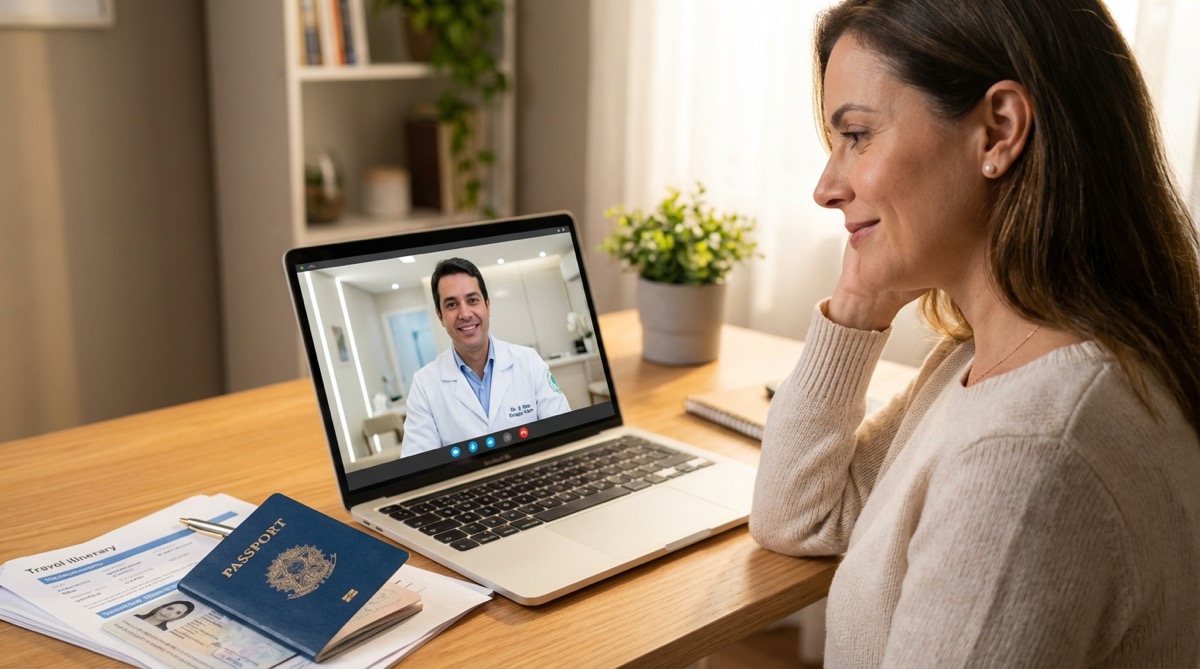
Short answer: start with an online consultation, verify the surgeon’s CRM and specialist RQE, and plan the required in-person assessment in Londrina. Before buying flights, agree on local recovery support, follow-up and access to care after you return home. The CDC’s medical travel guidance recommends obtaining your medical records and planning for complications. Your stay and return flight need individual medical clearance; a standard package or another patient’s timetable cannot determine them.
Medical review: Dr. Walter Zamarian Jr., plastic surgeon in Londrina, Brazil, CRM-PR 17.388, RQE 15.688, titular member of the Brazilian Society of Plastic Surgery (SBCP) and member of the American Society of Plastic Surgeons (ASPS). Last reviewed: May 23, 2026.
Dr. Zamarian has performed more than 8,000 surgeries over two decades (today, by deliberate choice, 3 facelifts per week, ~150 per year), with a practice focused on Deep Plane facelift, blepharoplasty, female intimate surgery and care for patients who travel from other countries.
Planning plastic surgery in Brazil can be a reasonable option for selected international patients, but the decision should begin with medical safety. Before discussing dates or costs, a patient needs a clear surgical indication, medical-history review, medication review, anaesthesia planning, travel documents, insurance, a realistic stay in Londrina and a follow-up plan after returning home.
This guide is written for English-speaking patients considering medical travel to Brazil for aesthetic or reconstructive plastic surgery. It does not replace an individual medical consultation and should not be used to decide on surgery by yourself.
Step 1 — Start with an online consultation
The online consultation prepares the case; it does not replace the final physical examination. It allows a structured review of your goals, medical history, medications, nicotine exposure, allergies, previous surgeries, standardised photos and general feasibility.
For international patients, this step helps avoid travelling without medical orientation. It also helps define whether the plan involves one procedure or a possible combination, such as a facelift, blepharoplasty or female intimate surgery.
The final surgical decision must always be confirmed in Londrina during an in-person consultation, with physical examination, test review, risk discussion and informed consent.
Step 2 — Documents, visa, eVisa and insurance
Before buying tickets, check your passport, Brazilian entry rules, travel insurance and your ability to stay longer if recovery requires it. Visa rules can change, so they should be confirmed with official sources, the appropriate Brazilian consulate and your airline before travelling.
Brazil restored visa requirements for nationals of the United States, Canada and Australia on April 10, 2025, according to the Brazilian Ministry of Foreign Affairs. Requirements differ for dual Brazilian nationals. Ask the Brazilian consulate which documentation and visa category apply to your nationality, passport, reason for travel and planned stay.
Prepare before the trip:
- valid passport and a secure digital copy;
- visa, eVisa or visa-exemption status checked through an official source;
- travel insurance and, when possible, medical coverage compatible with surgery abroad;
- complete list of medications, allergies, illnesses, previous surgeries and recent tests;
- emergency contact, companion and accommodation address in Londrina;
- extra time in case the return flight must be postponed for medical reasons.
Step 3 — Arrival in Londrina and in-person consultation
Londrina, in the state of Paraná, is where Dr. Walter Zamarian Jr.’s clinic is located. After arrival, the in-person consultation is essential to confirm the indication, examine skin and tissues, review photos, verify tests, discuss anaesthesia and refine the surgical plan.
This step can change the initial plan. A surgery discussed remotely may be adjusted, simplified, postponed or even discouraged if the examination shows that risk is higher than the expected benefit. In aesthetic medicine, a good plan protects the patient; it does not automatically confirm a request.
Patients should also schedule a calm period before surgery: sleep, hydration, appropriate nutrition, stopping nicotine when instructed, avoiding self-medication and avoiding intense tourism immediately before the procedure.
Step 4 — Surgery day and the first 48 hours
Surgery should take place in an appropriate setting, with a qualified anaesthesia team and postoperative monitoring. The first 48 hours require rest, a companion, correct medication use, limited exertion and easy communication with the medical team.
Recovery varies by procedure. A Deep Plane facelift, blepharoplasty or intimate surgery does not involve the same operating time, dressings, discomfort or restrictions.
Do not plan sightseeing, social events, swimming, sun exposure, alcohol or long transfers immediately after surgery. The early period is medical: it is used to monitor pain, bleeding, hematoma, infection, blood pressure, swelling and wound healing.
Step 5 — Postoperative stay and return flight
The length of stay depends on the procedure, overall health, flight duration and recovery. Agree on a provisional timetable before booking and allow flexibility if medical clearance is delayed. The CDC notes that travel after surgery adds risk; several days or two weeks should not be treated as a universal safe interval.
The return flight should be medically cleared. Long-distance travel after surgery can increase the risk of deep vein thrombosis and pulmonary embolism, especially in patients with immobility, a history of clots, tobacco or nicotine use, hormonal contraception, obesity, cancer, dehydration or extensive recent surgery.
A responsible travel plan includes hydration, permitted walking, compression stockings when indicated, movement breaks during travel, accessible medical documents and clear instructions about symptoms that require urgent evaluation.
Follow-up after returning home
A remote follow-up plan can help monitor normal recovery, but it does not always replace an in-person medical examination. After returning home, the patient should know which local physician or emergency service to contact if a symptom cannot be assessed safely by photo or video.
Shortness of breath or chest pain requires emergency care where you are; do not wait for a message from the clinic. New one-sided leg pain or swelling requires urgent assessment. Seek prompt local medical review and notify the surgical team for fever, increasing wound pain, marked malaise, bleeding, expanding swelling, pus-like drainage, progressive redness, skin-colour change or wound opening. The NHS explains the clot-related warning signs.
Continuity of care is especially important for patients who live far away. It should be discussed before surgery, not only after the return flight.
Travelling to Londrina: accommodation, transport and personal support
We can begin with an online consultation before you arrange your trip to Londrina. An in-person preoperative consultation is still required; when the first consultation was online, that preoperative visit has no additional consultation fee.
My team provides accommodation guidance in Londrina, including hotel or Airbnb options. Accommodation is booked and paid for separately. We can recommend a trusted driver and a companion or caregiver. The driver and companion/caregiver are available to hire separately, at an additional cost.
During your stay in Londrina, you have support with dressing care and frequent in-person follow-up appointments with me. After you return home, we continue online follow-up until one year after your surgery.
Before booking, confirm the accommodation location, transport to appointments and companion requirements with my team. Your length of stay and clearance to travel depend on an in-person assessment and your individual recovery.
Costs and estimate
I provide an individual surgical quote after assessing you and the proposed treatment plan. Associated procedures, included items and payment terms are discussed during consultation. I do not publish surgical prices or price ranges.
The estimate for plastic surgery in an international patient must be individualised. It may depend on the procedure, operating time, surgical facility, anaesthesia, tests, follow-up, associated procedures and the length of stay needed in Londrina.
A serious estimate should explain what is included and what remains the patient’s responsibility, but it should not turn a medical decision into an impulse purchase. Flights, hotel, companion, insurance, medications, meals, transfers and contingency time are part of the overall plan.
The central question is not “how much can I save?”, but “is this plan medically indicated, safe, understandable and properly followed before and after travel?”.
Procedures often requested by international patients
International patients often ask about facial and body surgery. These procedure pages explain each indication in more detail:
- facelift and facial rejuvenation;
- Regenerative Deep Plane for selected facial laxity cases;
- blepharoplasty when the eyelids are part of the concern;
- female intimate surgery with careful indication and respect for individual anatomy.
Combining procedures may be possible in selected cases, but it is not automatically better. Surgical time, recovery, risks and travel must be considered together.
Frequently asked questions
Is it safe to travel to Brazil for plastic surgery?
Plastic surgery in Brazil can be organised responsibly for a well-selected patient, with a qualified surgeon, appropriate facility, professional anaesthesia, preoperative tests and structured follow-up. Travel adds logistical and medical variables that must be planned before surgery.
How long should I stay in Londrina?
The stay in Londrina depends on the procedure and postoperative course, but an international patient should allow enough time for the in-person consultation, surgery, early follow-up visits and medical clearance before the return flight.
Is the online consultation enough to confirm surgery?
No. The online consultation prepares the case and assesses feasibility, but final confirmation requires an in-person consultation, physical examination, test review and informed consent before surgery.
Do I need a visa or eVisa to enter Brazil?
Requirements depend on your nationality, passport, purpose and length of stay. Brazil restored visa requirements for US, Canadian and Australian nationals in April 2025, with separate rules for dual Brazilian nationals. Confirm your case with the Brazilian consulate before booking.
What should I do if a problem appears after I return home?
For shortness of breath or chest pain, seek local emergency care immediately without waiting for WhatsApp. New one-sided leg pain or swelling needs urgent assessment. For wound problems, fever, bleeding or worsening symptoms, seek prompt local medical review and inform the surgical team.
Next step
If you are considering plastic surgery in Brazil, start with an online consultation with photos, medical history, goals, medications, travel constraints and possible dates. The goal is to build a realistic medical plan before any travel decision.
To explore the main English pages, start with the Dr. Walter Zamarian Jr. English homepage and then review the procedure page related to your case.