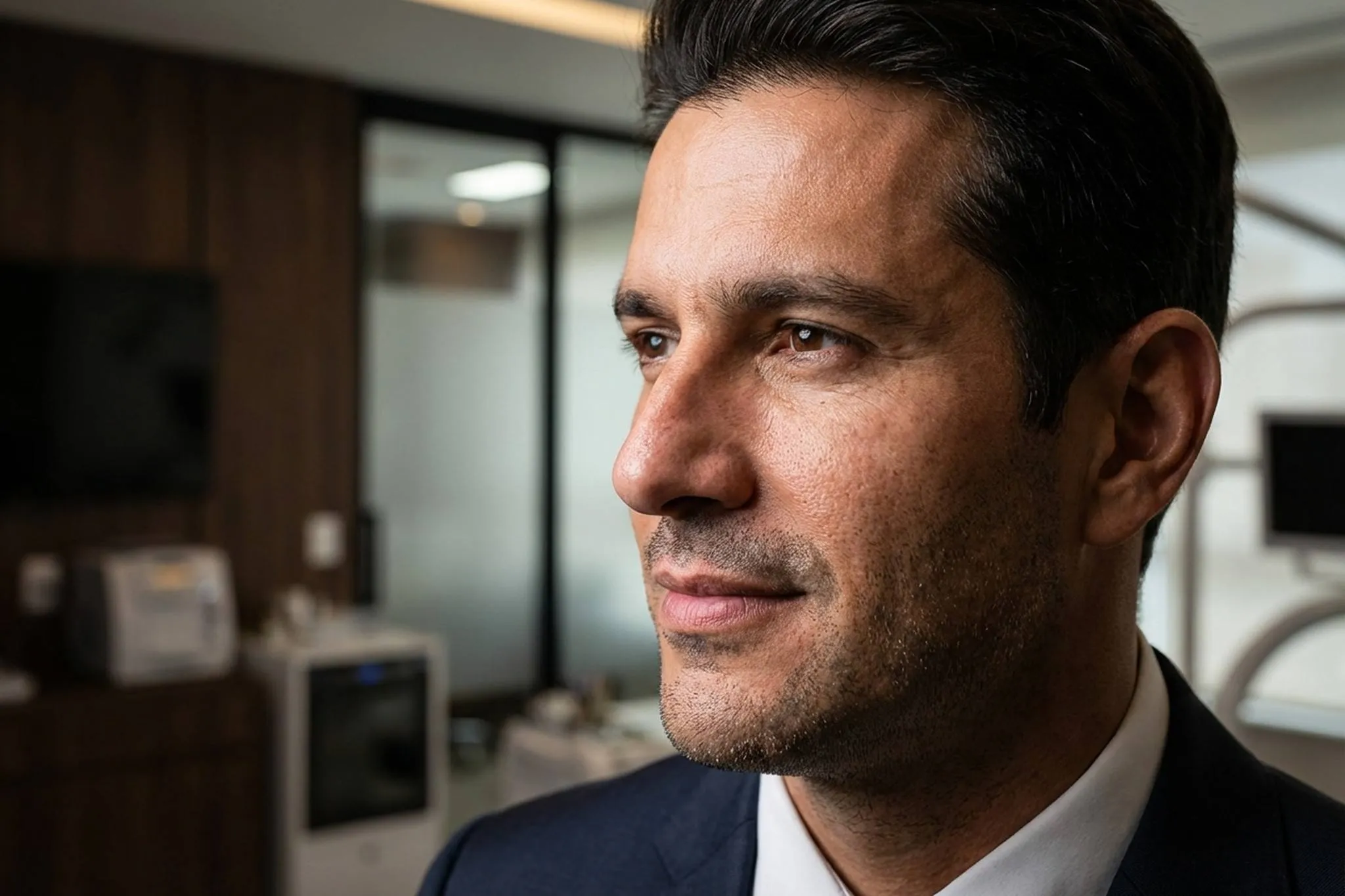
Male Rhinoplasty in Brazil: natural result that preserves masculine identity
Male rhinoplasty is not simply a rhinoplasty performed on a man. It is a surgery with philosophy, planning, and execution that are completely different from female rhinoplasty. Over more than twenty years of operating on noses, I have realised that this distinction is the factor that separates an exceptional result from one that leaves the patient uncomfortable — even when technically well executed.
The biggest mistake a surgeon can make in male rhinoplasty is applying the same aesthetic parameters as in female surgery. The result? A nose that looks good in isolation but feminises the man's face. A concave dorsum, an upturned tip, an overly open nasolabial angle — any of these characteristics, no matter how small they may seem, can transform a strong masculine face into something that simply does not suit the patient.
My approach to male rhinoplasty at my clinic in Londrina, Brazil, is governed by a fundamental principle: preserve the masculine character of the face. This means maintaining a straight or subtly convex dorsum, a tip with adequate projection without excessive rotation, and a nasolabial angle close to ninety degrees. The goal is not to create a "pretty" nose in the classical feminine sense, but rather a balanced nose that integrates naturally with the man's face. Men from the United Kingdom seeking a nose job Brazil with a specialist plastic surgeon Brazil will find that my structured approach, refined at the Ivo Pitanguy Institute, delivers natural results that respect masculine nasal aesthetics.
Male anatomy: why the male nose is different
To understand why male rhinoplasty requires a specific approach, it is essential to know the fundamental anatomical differences between the male and female nose. These differences are not subtle — they directly influence surgical planning, the technique used, and the recovery time.
Thicker and oilier skin
The skin of the male nose is significantly thicker than that of the female, especially in the tip area. This thicker skin has more sebaceous glands, more subcutaneous tissue, and less ability to retract over a new cartilaginous structure. In practice, this means that delicate refinements at the tip may simply not show — the skin does not follow the changes made in the cartilage with the same fidelity as thin female skin.
This characteristic requires patience from both the surgeon and the patient. The definitive result of male rhinoplasty can take twelve to eighteen months to fully define, while in women with thin skin this period is usually six to nine months. It is an investment in time, but the final result is worth it.
Wider and denser nasal bones
The bony structure of the male nose is more robust. The nasal bones are wider, thicker, and more resistant to remodelling. This requires more precise osteotomy techniques and, in many cases, the use of ultrasonic rhinoplasty with piezoelectric scalpel, which allows for millimetric cuts in the bones without irregular fractures or damage to adjacent soft tissues.
Stiffer and more resistant cartilages
The alar and upper lateral cartilages of the male nose are thicker and less malleable. Refinement sutures that work perfectly on delicate female cartilages may not have the same effect on robust male cartilages. It is necessary to use suturing techniques with greater tension or combine sutures with structural grafts to achieve the desired result.
More closed nasolabial angle
This is perhaps the most important parameter of male rhinoplasty. The nasolabial angle — formed between the columella and the upper lip — should be maintained at around ninety degrees in men, varying from eighty-five to ninety-five degrees. In females, this angle is typically more open, between one hundred and one hundred and five degrees. This difference of fifteen degrees may seem insignificant on paper, but on the face, it makes all the difference between a masculine appearance and a feminised one.
More projected nasal dorsum
The dorsum of the male nose tends to be higher and wider. The profile line should be straight or with a gentle elevation, never concave. A dorsum with a "scooped" appearance is one of the most common concerns from men dissatisfied with rhinoplasties performed without this understanding of masculine aesthetics.
The aesthetic parameters of male rhinoplasty
When I plan a male rhinoplasty, I work with specific aesthetic parameters that are fundamentally different from the female ones. Every detail matters, and it is the sum of these details that produces a natural and balanced result.
Dorsum: straight, never concave
The ideal male nasal dorsum presents a straight line or with subtle convexity. I never perform a dorsum reduction that results in concavity. When there is a bony or cartilaginous hump that needs to be reduced, I do so conservatively, preserving a line that conveys strength and presence. In some cases, I use cartilage grafts to ensure that the final profile maintains this straight standard.
Tip: projected, with minimal rotation
The tip of the male nose should have adequate projection but with minimal rotation. Unlike female rhinoplasty, where a slight elevation of the tip is desirable, in men the tip should point almost straight ahead or with very discreet cephalic rotation. An upturned tip is one of the most evident signs of feminisation and is absolutely unacceptable in male rhinoplasty.
Width: proportional to the face
The male nose is naturally wider than the female. Narrowing a man's nose too much creates an immediate disproportion with the other facial structures — jaw, brow, cheekbone. The width of the alar base should respect the proportion with the intercanthal distance and the overall width of the face. In cases of bulbous nose, the reduction should be measured and proportional.
Balance with the rest of the face
The nose does not exist in isolation. It relates to the forehead, eyes, cheekbones, chin, and jaw. In male rhinoplasty, I carefully assess the projection of the chin — a retracted chin can make the nose appear larger than it actually is. In these cases, the combination with chin surgery can produce a much more balanced facial result than rhinoplasty alone.
Surgical techniques in male rhinoplasty
The choice of surgical technique depends on the specific needs of each patient. In male rhinoplasty, some techniques gain special relevance due to the more robust anatomy we need to work with.
Open versus closed rhinoplasty
In most of my male patients, I use the open technique (open rhinoplasty with transcolumellar incision). This approach allows direct visualisation of all structures, which is particularly important when working with thick cartilages and dense bones. The scar on the columella is practically imperceptible after a few weeks.
In simpler cases — a small isolated dorsal hump, for example — the closed technique may be sufficient. But when there is a need for structural work on the tip, grafts, or significant bony remodelling, the open approach is superior.
Ultrasonic rhinoplasty: precision in dense bones
Ultrasonic rhinoplasty is an extraordinary ally in male rhinoplasty. The piezoelectric scalpel uses ultrasonic waves to cut bone without damaging soft tissues. In denser and wider male nasal bones, this means more precise osteotomies, less swelling, fewer periorbital bruises, and faster recovery.
Structural grafts
I frequently use cartilage grafts in male rhinoplasty. Cartilage from the nasal septum, the ear, or, in cases of revision, costal cartilage. These grafts serve to maintain or increase the projection of the dorsum, reinforce the tip, improve columellar support, or correct asymmetries. In male rhinoplasty, grafts are used more robustly than in female rhinoplasty, precisely to maintain the appearance of strength.
Associated septoplasty
A large number of men seeking rhinoplasty also present with a deviated septum, either due to trauma (nasal fractures are more common in men) or asymmetric development. The correction of the septum — septorhinoplasty — is performed at the same surgical time, addressing both the aesthetic and respiratory functional issues.
Male versus female rhinoplasty: the essential differences
To help you understand exactly what differentiates my approach, I will compare point by point the parameters I use in male rhinoplasty versus female rhinoplasty:
- Nasolabial angle: male ~90° versus female ~100-105°.
- Dorsal profile: male straight or slightly convex versus female straight or slightly concave.
- Tip rotation: male minimal versus female moderate upwards.
- Dorsal width: male wider, proportional to the face versus female narrower.
- Tip projection: male maintained strong versus female refined and delicate.
- Alar base: male naturally wider, conservative reduction versus female allows more aggressive narrowing.
- Tip definition: male moderate (thick skin limits) versus female greater possible refinement.
- Final result time: male 12-18 months versus female 6-9 months.
These differences may seem subtle when described in text, but on the patient's face, they are absolutely perceptible. A nasolabial angle fifteen degrees more open than it should be completely transforms a man's facial expression.
Who seeks male rhinoplasty
In recent years, there has been a significant increase in the number of men seeking rhinoplasty. This is no coincidence — society has evolved, and taking care of one's appearance has ceased to be a taboo for the male audience. In my experience, male rhinoplasty patients fit into several main profiles:
Dorsal hump (bony bump)
The most common concern. That elevation on the dorsum of the nose that is bothersome in profile. Many men live with this for years before deciding to seek correction. The treatment involves conservative reduction of the hump, preserving the straight male line of the dorsum.
Globular or drooping tip
A rounded or downward-pointing tip can give the face a heavy or aged appearance. The refinement of the male tip should be subtle — reducing volume, improving definition, but without creating a pointed or upturned tip.
Wide or disproportionate nose
Some men have noses that are excessively wide for their facial proportions. This may involve the alar base, the bony dorsum, or both. The correction follows the principle of proportionality, not miniaturisation. For specific cases of broad nose or ethnic rhinoplasty, respecting the patient's ethnic characteristics is fundamental.
Trauma sequelae
Nasal fractures are extremely common in men, whether from sports, accidents, or various traumas. These fractures often leave deviations, asymmetries, and respiratory obstruction that need to be corrected simultaneously. Septorhinoplasty is the recommended surgery in these cases.
Dissatisfaction with previous rhinoplasty
Unfortunately, I receive men who have previously undergone rhinoplasty and ended up with a feminised result — concave dorsum, upturned tip, excessively narrow nostrils. Secondary rhinoplasty or revision can correct these issues, although it is technically more challenging. Often, it is necessary to reconstruct structures that were excessively removed in the first surgery.
The consultation: individualised planning
The consultation for male rhinoplasty is one of the most important moments of the entire process. I dedicate time to understand not only what bothers the patient but also their expectations and — equally important — what they do not want to change.
Complete facial analysis
I examine the nose in relation to the entire face: proportion with the forehead, projection in relation to the chin, width compared to the intercanthal distance, symmetry, profile angles. Standardised photographs from six different angles document this analysis.
Functional assessment
Every male rhinoplasty patient is assessed for respiratory function. Deviated septum, turbinate hypertrophy, nasal valve collapse — any obstruction is identified and planned for correction at the same surgical time.
Digital simulation
I use computer simulation to show the patient a projection of the expected result. This is especially valuable in male rhinoplasty, as it allows me to clearly demonstrate the difference between a male result (straight dorsum, tip with minimal rotation) and a feminised result (concave dorsum, upturned tip). The patient visually understands what I am planning and can provide input before we reach the theatre.
Pre-operative tests
I request the following tests before surgery:
- Complete blood count
- PT with INR + APTT
- Creatinine and urea
- Fasting blood glucose
- Urinalysis
- ECG
- Pre-operative cardiac assessment
Medications to be discontinued
Two weeks before and two weeks after surgery, you should discontinue:
- Acetylsalicylic acid (Aspirin, AAS, Bufferin)
- Non-steroidal anti-inflammatory drugs
- High doses of Vitamin E
- Ginkgo biloba and other herbal remedies
- High doses of Omega 3
- Anabolics should be disclosed during the consultation
Smoking should be stopped for the same period. Nicotine compromises blood circulation and can affect healing, especially in skin that is already naturally thicker.
The surgery step by step
Male rhinoplasty lasts on average two to three hours, depending on the complexity of the case. It is performed under general anaesthesia in a properly equipped theatre.
Incisions and access
In the open technique, I make a small incision in the columella (the part between the nostrils) that connects with internal incisions. This allows me to lift the entire envelope of skin and soft tissue, exposing the osteocartilaginous structure for precise work under direct vision.
Dorsal remodelling
If there is a dorsal hump, I reduce it with controlled rasping or, when necessary, ultrasonic osteotomy. The goal is always a straight line in profile. In cases where the dorsum needs to be maintained or slightly increased, I use cartilage grafts from the septum or bone fragments.
Treatment of the tip
The alar cartilages are remodelled with precise sutures. In male rhinoplasty, I preserve more volume at the tip than I would in a woman. Interdomal sutures control the width, while columellar sutures adjust the projection and minimal rotation. Reinforcement grafts are used when necessary to maintain long-term projection.
Osteotomies
When it is necessary to narrow the bony pyramid or correct deviations, I perform lateral osteotomies and, when indicated, medial ones. With the piezoelectric device, these fractures are controlled millimetrically, reducing periorbital oedema (bruised eyes) and speeding up recovery.
Functional septoplasty
If there is a septal deviation, I correct it during the same procedure. The removed septal cartilage can serve as graft material, making the most of the patient's own structure.
Closure
I suture the columellar incision with very fine sutures. I position internal silicone splints to stabilise the septum and an external aluminium splint moulded to the new shape of the dorsum. The splint remains for seven to ten days.
Post-operative care for male rhinoplasty
The recovery from male rhinoplasty has important particularities compared to female rhinoplasty, mainly due to the thicker skin.
First 48 hours
There will be oedema (swelling) and possible periorbital bruising (purple spots around the eyes). Cold compresses and an elevated head are essential during this period. Pain is usually well controlled with common analgesics — rhinoplasty is not a particularly painful surgery.
First week
The internal splints are removed between five and seven days. The external splint is removed in seven to ten days. At this point, the nose already presents a shape close to the final result, although still with significant oedema, especially at the tip.
First month
Gradual return to normal activities. Avoid intense physical exertion, direct sun exposure, and wearing glasses resting on the nasal dorsum. Swelling decreases progressively, but the tip will still be swollen.
Three to six months
The dorsum already presents a shape very close to the definitive one. The tip begins to show more definition. The thicker male skin retracts more slowly, which is why this phase tests the patient's patience the most.
Twelve to eighteen months
Definitive result. The male skin completes its retraction and accommodation process over the new structure. In some patients with particularly thick skin, there may be a need for corticosteroid infiltration at the tip during this period to assist in reducing fibrous tissue.
Complementary procedures to male rhinoplasty
The nose is just one part of facial balance. Some procedures can be combined with male rhinoplasty to optimise the overall result:
Mentoplasty: balancing the profile
Mentoplasty is the most frequent complementary procedure in male rhinoplasty. A retruded chin makes the nose appear larger and more projected than it actually is. By advancing the chin with a silicone implant, I balance the profile so that the nose, even without major modifications, appears more balanced. The combination of rhinoplasty + mentoplasty is extremely powerful in the male audience.
Male facelift
In more mature patients who desire combined facial rejuvenation, male facelift can be performed in the same surgical time. The combination provides a complete and integrated facial transformation.
Otoplasty
Prominent ears can visually compete with the nose. Correcting the ears during the same surgery can contribute to a more balanced facial appearance.
My experience with male rhinoplasty
I graduated from the State University of Londrina and had the privilege of being a student of Professor Ivo Pitanguy, the greatest name in Brazilian plastic surgery and one of the most respected in the world. With him, I learned that each face is unique and deserves an individualised plan.
Over more than twenty years of practice, I have performed over eight thousand plastic surgeries, including hundreds of male rhinoplasties. I am a full member of the Brazilian Society of Plastic Surgery (SBCP) and the American Society of Plastic Surgeons (ASPS).
Male rhinoplasty is one of the surgeries that demands the most from the plastic surgeon. It is not just about technique — it is about understanding male aesthetics in depth, resisting the temptation to refine too much, knowing when to stop. A well-operated male nose is one that no one notices has been operated on. People notice that the man looks different, more handsome, more balanced — but they cannot identify exactly what has changed.
This is the result I seek for each patient. And it is the result you deserve.
Frequently asked questions about male rhinoplasty
Can male rhinoplasty feminise my face?
It can, if the surgeon does not respect male aesthetic parameters. That is why it is essential to choose a professional experienced in male rhinoplasty. In my approach, I maintain a straight dorsum, a nasolabial angle of around ninety degrees, and minimal rotation of the tip — ensuring a result that preserves all the masculinity of the face.
What is the difference between male and female rhinoplasty?
The differences are significant: the male dorsum should remain straight (never concave), the nasolabial angle should be more closed (~90° versus ~105° in females), the tip should have minimal rotation, and the width should be proportional to the wider male face. Additionally, the thicker male skin requires specific techniques and takes longer to show the final result.
How long does it take to see the final result?
In male rhinoplasty, the definitive result appears between twelve and eighteen months, due to the thicker skin that retracts more slowly. The dorsum defines itself in about three to six months, but the tip can take up to a year and a half to show its final shape.
Does male rhinoplasty leave a visible scar?
In the open technique, there is a small scar on the columella (between the nostrils) that becomes practically invisible in a few weeks. In the closed technique, all incisions are internal, with no external scar.
Can I correct respiratory problems along with aesthetics?
Yes, and this is very common in male rhinoplasty. Septal correction (septorhinoplasty) is performed in the same procedure, resolving nasal obstruction, septal deviation, and other functional alterations simultaneously with aesthetic improvement.
What is the minimum age for male rhinoplasty?
I recommend waiting until the age of sixteen to eighteen in men, when facial growth is practically complete. Operating earlier can compromise the natural development of the nasal and facial structures.
How long do I need to stay away from work?
For office or remote work, seven to ten days are sufficient. For light physical activities, two to three weeks. For contact sports or activities with a risk of nasal trauma, wait at least six weeks.
Is male rhinoplasty very painful?
Rhinoplasty is not a particularly painful surgery. The main discomfort is nasal obstruction in the first few days, caused by the internal splints and the oedema. Pain is well controlled with common analgesics. Most patients are positively surprised by the post-operative experience.
Is it possible to correct a previous rhinoplasty that feminised my face?
Yes. Secondary rhinoplasty can restore masculine features: reconstructing the dorsum with cartilage grafts to eliminate concavity, reducing excessive rotation of the tip, and recovering natural projection. It is a more complex surgery, but with very rewarding results.
Can I wear glasses after rhinoplasty?
Avoid resting glasses directly on the nasal dorsum for at least six weeks. This is especially important after osteotomies. There are adapters that allow you to wear glasses without resting them on the nose during the recovery period. Contact lenses can be used from the day after the surgery.
Book via WhatsApp
If you have made it this far, it is because you are seriously considering male rhinoplasty. The next step is simple: book a consultation with me. My team is ready to assist you, answer your questions, and find the best time for your evaluation.
Learn more about the first consultation, the pricing, and the guidelines for pre-surgical preparation and post-operative recovery.
Are you ready for this change? Book now!

Dr. Walter Zamarian Jr.
Plastic Surgeon in Brazil
Rua Engenheiro Omar Rupp, 186
Londrina - Brazil
ZIP 86015-360
Brazil
YouTube Channel: Dr. Walter Zamarian Jr.
Follow on Instagram: @drwalterzamarianjr
Follow on TikTok: @drwalterzamarianjr
Search on our website:
This page in other languages:
Portuguese (BR) | English (US) | English (UK) | Italian | French | Spanish