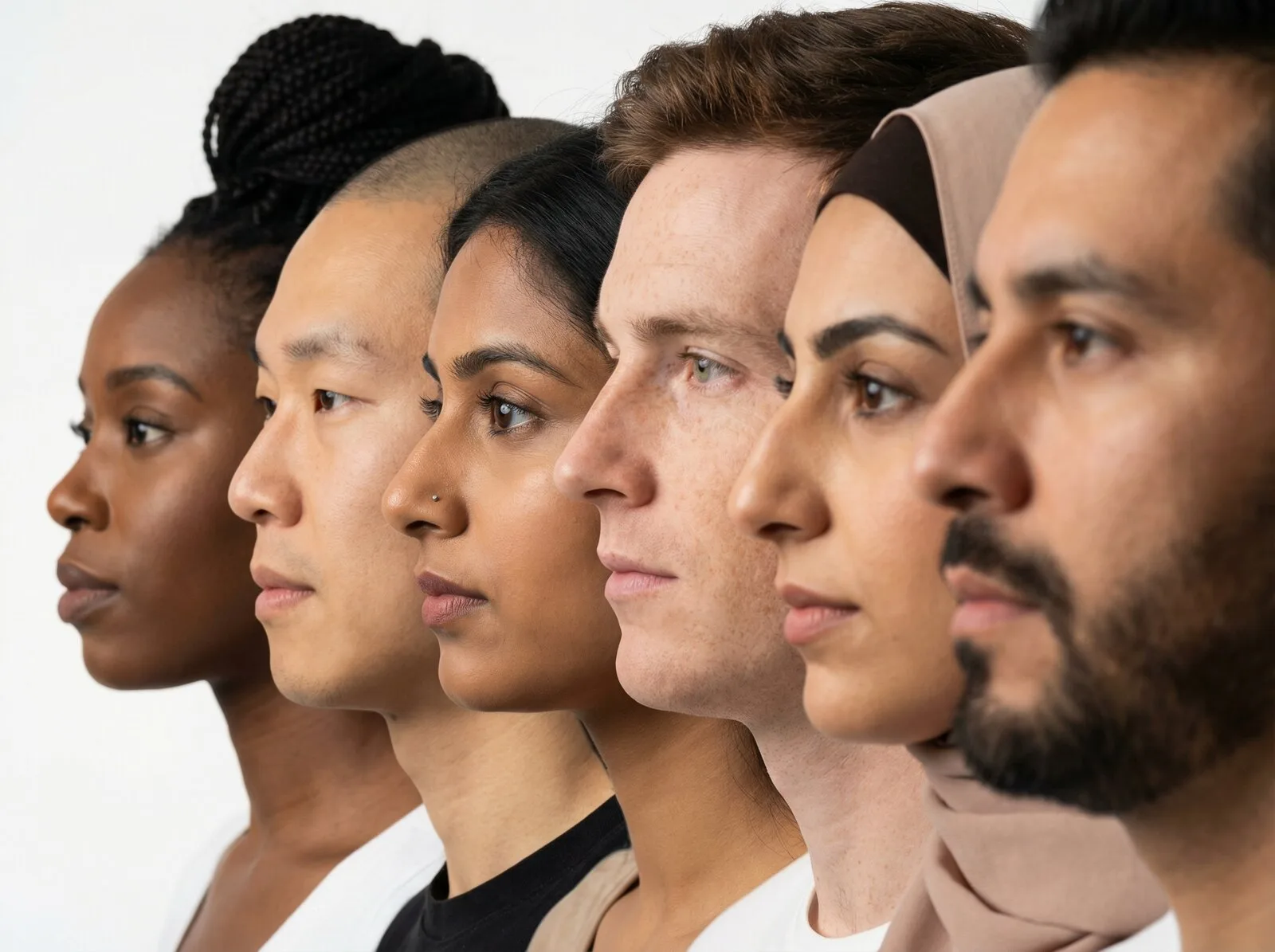
At a glance: Ethnic rhinoplasty is a way of planning that considers both the features a person wants to change and the ones they want to keep. There is no single technique for each ancestry: the skin, bridge, tip, nasal base, and breathing all have to be examined individually. Surgery may involve reduction, augmentation, or reinforcing support. In patients with thick skin, planning and expectations call for specific care; an extremely thin, sharp tip should not be treated as a required goal.
About my current practice: I, Dr. Walter Zamarian Jr., no longer perform rhinoplasty, either on its own or combined with other procedures. This article remains available as educational content only and is not an offer to evaluate or schedule rhinoplasty.
In Brazil, this conversation matters especially. During the years I performed rhinoplasty in Londrina, I saw patients from very different family backgrounds, often blending African, Indigenous, Asian, European, Arab, and Latin American ancestry. In practice, that means there is no single “ethnic nose.” There is an individual anatomy that has to be analyzed with respect.
Ethnic rhinoplasty is not a single technique
Rhinoplasty is called ethnic when the plan takes into account features of ancestry, skin thickness, the shape of the nasal base, the height of the bridge (dorsum), tip projection, and facial proportions, without trying to standardize the result. Depending on the case, it may involve refinement, support, augmentation, or reduction techniques.
For some people, the focus is on improving definition of the nasal tip. For others, it may be necessary to raise the bridge slightly, narrow the alar base (the base of the nostrils) with restraint, correct asymmetry, or address breathing at the same time. The decision does not come from a formula but from combining the patient’s concern, the physical examination, and anatomical limits.
Preserving identity and facial harmony
Preserving identity is the central point. A nose that has been operated on should still belong to the face. When surgery erases too much of a person’s natural features, the result can look artificial, out of place, or emotionally foreign to the patient.
That is why two questions are essential during the evaluation: what bothers you, and what should be preserved? The second question matters as much as the first. Many people want to refine the tip, soften the width of the base, or improve the profile, but do not want to lose family or cultural features. That boundary has to be heard and respected.
My article on the ideal nose and facial harmony explores this idea further: the ideal nose is not universal; it is proportionate to the face, functional, and consistent with the person’s identity.
Anatomical features that change the plan
In ethnic rhinoplasty, certain features come up often and require specific planning. They should not be treated as a rule for every patient, but as clinical variables that can influence the technique.
- Thick skin: can limit how much tip definition shows through and prolong postoperative swelling. In these cases, building internal structure is usually more important than simply removing tissue.
- A low or broad bridge: may call for dorsal augmentation with cartilage grafts, especially when the goal is to improve the profile without overly narrowing the face.
- A tip with little projection: may require support with grafts and sutures to improve projection and definition.
- A wide alar base: may be treated with alarplasty (alar base reduction) in selected cases, always avoiding excessive narrowing or an artificial change in nostril shape.
- Thin or flexible cartilages: may need reinforcement to support the tip and reduce the risk of losing definition.
The 2023 systematic review on rhinoplasty in thick-skinned noses reinforces that the thickness of the skin envelope influences both planning and the perceived result. Refinement therefore has to be explained with realistic expectations, especially when the skin limits very fine tip detail. The same clinical reasoning lies behind evaluating a so-called bulbous nasal tip, where skin, cartilage, and structure have to be analyzed together.
Why many cases need structure
In classic reduction rhinoplasty, many patients want to make the bridge, tip, or width of the nose smaller. In ethnic rhinoplasty, surgery is often a structural operation as well. Instead of only removing tissue, it is frequently necessary to build support.
Structural rhinoplasty works with septal cartilage, ear cartilage, or, in more complex cases, rib cartilage. The choice depends on the anatomy, any previous surgery, the amount of material available, and how much support is needed.
The purpose of cartilage grafts is not to make the nose stiff but to create a stable foundation for the bridge, the nasal tip, and the nasal valve. When well indicated, structure helps preserve shape and function. When overdone, it can cause stiffness, irregularities, or an artificial look. That is why the indication has to be individualized.
Alar base and nostrils: beware of overcorrection
The alar base is one of the most delicate areas. Reducing the nostrils can improve frontal proportions in selected patients, but excessive alarplasty can leave visible scars, asymmetry, nostrils that are too narrow, or difficulty breathing.
For that reason, the evaluation looks at the alar base with the patient at rest and smiling, from the front and from below. The surgeon also checks whether the width of the base is really the main source of disharmony, or whether the impression of width comes from a low bridge, a tip with little projection, or a lack of support. In many cases, structuring the tip and bridge already improves how the base reads, without the need for aggressive reduction.
Breathing is part of ethnic rhinoplasty too
Preserving identity does not mean looking only at appearance. Breathing has to be analyzed with the same rigor. A deviated septum, enlarged turbinates, nasal valve collapse, rhinitis, and previous injuries can all affect the plan.
When there is nasal obstruction, surgery may require septoplasty, treatment of the nasal valve, or other functional measures. Clinical practice guidance from otolaryngology on rhinoplasty underscores the importance of evaluating both form and function, and of counseling patients about benefits, risks, and limitations before the procedure.
Darker skin, healing, and keloids
Patients whose skin is more prone to hyperpigmentation, hypertrophic scarring, or keloids deserve closer follow-up. This is especially relevant when there is a columellar incision (across the strip of skin between the nostrils) or alar base reduction. The technique should aim for delicate closure, low tension, careful placement of incisions, and attentive postoperative monitoring.
It is also important to advise sun protection and gentle handling of the skin, and to return early if a scar becomes raised, darker, or thicker. No scar should be taken lightly, even when it sits in an inconspicuous area.
Realistic expectations for ethnic refinement
Ethnic rhinoplasty should not promise a radical change of identity. It should offer proportionate refinement. With thick skin, definition may be more subtle. With fragile cartilages, support may require grafts. With a wide alar base, reducing too much can be worse than accepting some natural width. In noses that have had previous surgery, predictability decreases.
This conversation is part of safety. The patient needs to understand what is technically possible, what would be unwise, and which changes best preserve facial identity. In revision cases, this care matters even more.
Differences between men, women, and mixed-heritage faces
Sex, gender, skin thickness, bone structure, and facial proportions also shape the analysis. Some patients want to keep a stronger bridge; others prefer a subtle softening. Some are bothered by a rounded tip; others value that feature as part of who they are.
That is why, even within the same ancestry group, two rhinoplasties can be completely different. The topic connects to the broader discussion of how male and female rhinoplasty differ: there are useful reference points, but no rule should replace the real face in front of the surgeon.
How the technique is chosen in each case
Planning starts with listening. The surgeon then evaluates the skin, bridge, tip, base, septum, breathing, asymmetry, healing tendencies, family history, and expectations. Photographs from different angles and, when helpful, simulation can serve as communication tools, never as an exact prediction.
I am Dr. Walter Zamarian Jr., a plastic surgeon in Londrina, Brazil (medical license CRM-PR 17.388; plastic surgery specialty registration RQE 15.688), a member of the Brazilian Society of Plastic Surgery (SBCP) and of the American Society of Plastic Surgeons (ASPS), with more than 8,000 operations over two decades. Today, by deliberate choice, I perform three facelifts a week, about 150 a year. This article is educational and draws on my previous experience with rhinoplasty. In ethnic rhinoplasty, a surgeon’s experience has to be applied with technical skill and cultural responsibility.
Frequently asked questions about ethnic rhinoplasty
What is ethnic rhinoplasty?
It is rhinoplasty planned to refine the nose while preserving facial identity, ancestry, breathing, and harmony with the patient’s natural features. It does not seek to standardize the face or erase individual characteristics.
Does ethnic rhinoplasty always require cartilage grafts?
Not always, but cartilage grafts are common when the bridge needs to be raised, the tip needs more projection, fragile cartilages need reinforcement, or the nasal valve needs better support. The cartilage can come from the septum, the ear, or the rib, depending on what is needed.
Can the alar base be reduced without losing a natural look?
Yes, in well-selected cases. Alarplasty can reduce the alar base, but it has to be conservative to avoid overly narrow nostrils, a noticeable scar, asymmetry, or a loss of naturalness.
Does thick skin rule out a good result?
Thick skin does not rule out a good result, but it changes expectations. It can limit very fine tip detail and prolong swelling, so surgery usually prioritizes structure, support, and proportionate refinement.
Technical references
- AAO-HNS Clinical Practice Guideline: Improving Nasal Form and Function after Rhinoplasty.
- Rhinoplasty for Thick-Skinned Noses: A Systematic Review.
- Dorsal Augmentation: A Review of Current Graft Options.
- Rhinoplasty: The African American Patient.
To judge whether a recommendation is well founded, notice whether the surgeon explains the technique, breathing, the limits set by skin and cartilage, the risks, and the alternatives. That is one of the central points of my guide on how to choose a rhinoplasty surgeon.
Read Also
This page in other languages: Português (BR)

Dr. Walter Zamarian Jr.
Plastic surgeon in Londrina, Brazil (CRM-PR 17.388 | RQE 15.688), full member of SBCP and ASPS. He has worked in plastic surgery for more than 20 years, with a focus on individualized planning, patient safety, Deep Plane facelift, eyelid surgery, facial fat grafting, and female intimate surgery.
Follow this blog on Google
Want to find more articles from this blog on Google? Add Dr. Walter Zamarian Jr. to your preferred sources.
Leave a comment