By Dr. Walter Zamarian Jr. — CRM-PR 17,388 | RQE 15,688
One of the most common questions I receive from patients — both in my office in Londrina, Brazil, and from international patients reaching out online — is: “What’s the difference between a Deep Plane facelift and a SMAS facelift?” It’s an important question, because the surgical technique directly impacts the naturalness, longevity, and overall quality of your facial rejuvenation.
In this article, I’ll explain the technical differences between these two approaches clearly, drawing from my experience of over 20 years and more than 8,000 surgeries, including hands-on Deep Plane training in the United States.
What is SMAS?
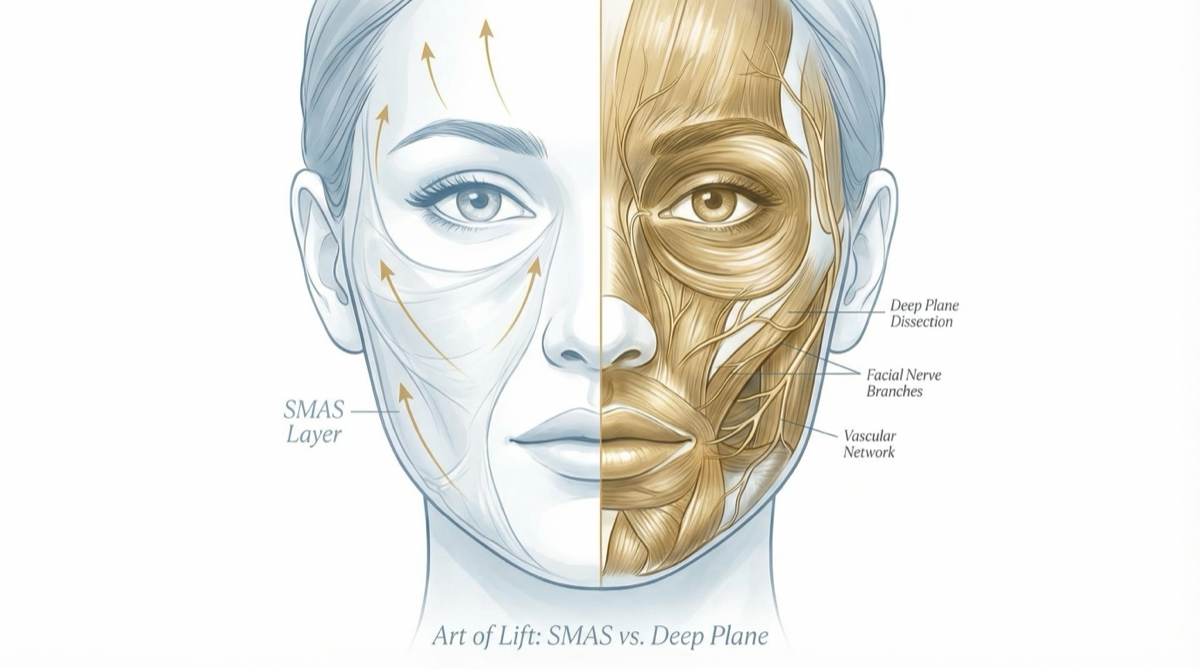
SMAS — Superficial Musculoaponeurotic System — is a layer of fibrous tissue located between the skin and the deeper facial muscles. Discovered in the 1970s, it revolutionized facelift surgery because it allowed surgeons to do more than just “pull the skin.”
In a traditional SMAS facelift, the surgeon plicates (folds) or implicates (removes a strip of) this layer, tightening it to reposition sagging facial tissues. The skin is then redraped over the repositioned SMAS.
It’s a safe and effective technique practiced by the majority of plastic surgeons worldwide. However, it has important limitations.
What is a Deep Plane Facelift?
The Deep Plane facelift goes beyond the SMAS. In this technique, the surgeon enters a deeper plane — below the SMAS — and releases the facial retaining ligaments (such as the zygomatic and masseteric ligaments). This allows the entire soft tissue structure to be repositioned as a single unit, without excessive tension on the skin.
I learned this technique directly from Dr. Tim Marten in San Francisco, widely regarded as the world’s foremost expert in Deep Plane facelift, and from Dr. Andrew Jacono in New York. This training enables me to deliver results that very few surgeons in Brazil can achieve.
Deep Plane vs SMAS: Side-by-Side Comparison
| Feature | Traditional SMAS | Deep Plane |
|---|---|---|
| Surgical plane | Superficial to SMAS | Below SMAS (sub-SMAS) |
| Retaining ligaments | Not released | Released (zygomatic, masseteric) |
| Skin tension | Moderate to high | Minimal (tension on deep tissues) |
| Natural appearance | Good, but can look “pulled” | Excellent — natural result |
| Result longevity | 5-7 years average | 10-15 years |
| Midface rejuvenation | Limited | Significant (nasolabial fold) |
| Surgery duration | 2-3 hours | 3-5 hours |
| Technical complexity | Moderate | High (requires specific training) |
| Recovery | 10-14 days | 10-14 days (similar) |
Why Does the Deep Plane Last Longer?
The primary reason Deep Plane results last significantly longer than traditional SMAS is where the tension is applied. In SMAS, some tension falls on the skin, which stretches over time, causing the result to fade. In Deep Plane, all tension is placed on the deep tissues — which are far more resilient — while the skin is simply redraped without traction.
Published studies confirm that Deep Plane patients maintain superior long-term results, with satisfaction rates exceeding 92%.
The Midface: Where Deep Plane Truly Excels
One of the greatest limitations of traditional SMAS is its inability to effectively treat the midface — the cheek area and nasolabial fold (the crease running from the nose to the corner of the mouth). SMAS primarily addresses the neck and jawline.
Deep Plane, by releasing the zygomatic ligaments, allows the midface to be elevated as a complete unit, smoothing the nasolabial fold and restoring cheek volume naturally. This is why my patients often hear: “You look rested,” rather than “Did you have something done?”
Regenerative Deep Plane: My Evolution of the Technique
In my practice, I go beyond traditional Deep Plane. I combine the facelift with facial fat grafting (lipofilling), creating what I call Regenerative Deep Plane. The transplanted fat not only restores volume but carries stem cells that actively regenerate skin quality, improving texture, luminosity, and elasticity.
This combination delivers rejuvenation that no single technique can achieve alone.
Who Is a Good Candidate for Deep Plane?
- Moderate to severe facial and neck laxity
- Pronounced nasolabial folds
- Loss of jawline definition (jowls)
- Midface descent
- Desire for natural, long-lasting results
- Generally ages 45-70 (but indication is individualized)
For patients with early signs of aging, a mini-facelift may be more appropriate. An in-person evaluation is essential to determine the best approach.
Is Recovery Different?
Many patients assume that because Deep Plane goes deeper, recovery must be harder. In practice, recovery is very similar to traditional SMAS. Swelling peaks between days 2-3 and subsides quickly. Most patients are presentable for social activities within 10-14 days.
An interesting detail: because Deep Plane doesn’t pull on the skin, healing tends to be even better, with more discrete scars. I detail the full recovery process on my Deep Plane facelift page.
Frequently Asked Questions
Is SMAS a bad technique?
Not at all. SMAS is a proven technique and remains the right choice for many patients. The difference is that Deep Plane offers specific advantages — especially for patients with moderate to severe laxity who seek longer-lasting results.
Can every surgeon perform Deep Plane?
Legally, any board-certified plastic surgeon can perform it. However, Deep Plane requires specific hands-on training, ideally with surgeons who have mastered the technique. The learning curve is significant. Ask your surgeon where they trained in this technique and how many they’ve performed.
Does Deep Plane cost more than SMAS?
Generally yes, because it’s a longer and more technically complex procedure. Pricing is discussed after an in-person evaluation, as it depends on the extent of the procedure and combinations with other surgeries (such as blepharoplasty or fat grafting).
Why choose a surgeon in Brazil for Deep Plane?
Brazil is the world’s second-largest market for plastic surgery, with surgeons who train intensively for years. My training at the Pitanguy Institute — one of the most prestigious plastic surgery schools in history — combined with Deep Plane specialization in the US, offers international patients world-class results at a fraction of US pricing. Learn more about my qualifications and background.
My Recommendation
After over 20 years of operating and having trained in both SMAS and Deep Plane with the best in the world, I can say with confidence: for most patients seeking comprehensive facial rejuvenation, Deep Plane is the best option available today. The naturalness, longevity, and ability to treat the midface are differentiators that make a real difference in my patients’ lives.
If you’re considering a facelift and want to understand which technique is right for you, schedule a consultation. In-person or telemedicine evaluation is the first step toward a personalized plan.
Dr. Walter Zamarian Jr.
CRM-PR 17,388 | RQE 15,688
Member SBCP | ASPS
Learn more about my training and background

drwalterzamarianjr
Dr. Walter Zamarian Jr. é cirurgião plástico em Londrina-PR (CRM-PR 17.388 | RQE 15.688), membro titular da SBCP e da ASPS. Formado em Medicina pela UEL, com especialização no Instituto Ivo Pitanguy (38a Enfermaria da Santa Casa do Rio de Janeiro) e treinamento nos EUA em lifting facial Deep Plane, rinoplastia estruturada e cirurgia íntima feminina. Com mais de 20 anos de experiência e 8.000+ cirurgias realizadas, é referência em rejuvenescimento facial e cirurgia genital feminina.
Deixe um comentário