By Dr. Walter Zamarian Jr. — CRM-PR 17,388 | RQE 15,688
Rhinoplasty has evolved dramatically over recent decades. Today, two surgical philosophies dominate the conversation among specialists: structural rhinoplasty and preservation rhinoplasty. But which is better? The answer, as often in surgery, is: it depends.
In this article, I’ll explain the differences between these approaches based on my 20+ years of experience in rhinoplasty and thousands of noses operated.
What Is Structural Rhinoplasty?
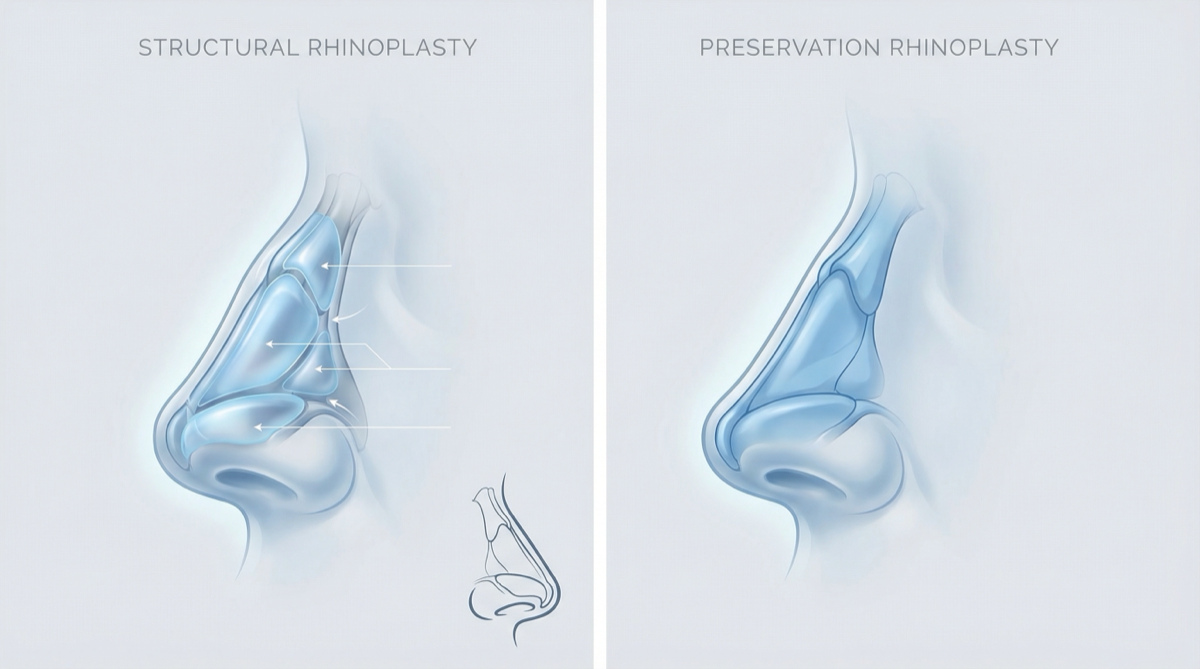
Structural rhinoplasty was introduced in 1989 by Drs. Johnson and Toriumi. The core principle: use cartilage grafts to reconstruct and reinforce the nose’s structure, rather than simply removing tissue.
In practice, we use the patient’s own cartilage — usually from the nasal septum, and when needed from the ear or rib — to create grafts that provide shape, support, and projection.
Key features:
- Usually open approach (columellar incision)
- Dorsal reduction by rasping or controlled removal
- Reconstruction with cartilage grafts (spreader grafts, columellar strut, tip grafts)
- Precise control of nasal tip shape
- Osteotomies to narrow the nasal bones
- Predictable, long-term stable results
This is the technique I use most frequently. It gives me extraordinary control over every detail of the final nasal shape — especially in complex cases like revision rhinoplasty, deviated noses, or ethnic noses.
What Is Preservation Rhinoplasty?
Preservation rhinoplasty is a more recent approach that has gained popularity in recent years. Its principle: preserve as much of the natural nasal anatomy as possible, rather than deconstructing and rebuilding.
Key features:
- Usually closed approach (no external incision)
- Dorsal reduction by “push down” or “let down” (lowering without rasping)
- Preservation of dorsal cartilage in continuity
- Less tissue dissection
- May have faster recovery (less edema)
- Maintains natural dorsal aesthetic lines
Structural vs Preservation: Comparison
| Feature | Structural | Preservation |
|---|---|---|
| Philosophy | Deconstruct and rebuild | Preserve and modify |
| Access | Open (most common) | Closed (most common) |
| Dorsum | Rasping + grafts | Push down / let down |
| Graft use | Extensive | Minimal |
| Tip control | Precise | Conservative modifications |
| Post-op swelling | Moderate (6-12 months) | Less (may resolve faster) |
| Complex cases | Excellent | Limitations in severe cases |
| Revision rhinoplasty | Gold standard | Not always applicable |
| Predictability | High | Good, but less versatile |
When I Choose Structural Rhinoplasty
In my practice, structural rhinoplasty is the technique of choice for most cases, especially:
- Significant septal deviations requiring functional and aesthetic correction
- Poorly defined nasal tips — the technique allows precise sculpting
- Previously operated noses (revision rhinoplasty) — often need reconstruction
- Significant asymmetries — grafts enable precise correction
- Ethnic noses needing augmented projection or definition
- Patients desiring significant changes in nasal shape
When Preservation May Be Appropriate
- The patient has an aesthetically pleasing dorsal shape but wants to reduce a dorsal hump
- The nasal tip is well-defined and needs minimal changes
- The case is relatively straightforward and symmetric
- There is no significant septal deviation
My Philosophy as a Surgeon
I’m not dogmatic about techniques. I believe the best surgeon is one who masters multiple approaches and selects the most appropriate for each patient. In most of my cases, structural technique offers greater versatility and predictability — especially in challenging cases.
What matters is not the technique itself, but the result: a nose that breathes well, looks natural, harmonizes with the patient’s face, and stands the test of time.
Recent scientific publications, including a 2025 meta-analysis, confirm that both techniques can achieve excellent aesthetic outcomes when properly executed. The choice should be individualized.
Why Consider Rhinoplasty in Brazil?
Brazil is the world’s second-largest market for plastic surgery, with rhinoplasty being one of the most performed procedures. My training at the Pitanguy Institute — combined with two decades of experience — allows me to offer international patients world-class structural rhinoplasty at competitive pricing. Londrina has direct flights from São Paulo, and my team assists with all travel logistics.
Frequently Asked Questions
Is preservation rhinoplasty better because it’s “more modern”?
Not necessarily. “Newer” doesn’t automatically mean “better.” Preservation is a valid philosophy with specific indications, but it doesn’t replace structural technique in all cases. Structural rhinoplasty remains the worldwide reference for complex cases.
Is the open rhinoplasty scar visible?
In the vast majority of cases, the small columellar incision heals to become virtually invisible within a few months. This incision provides direct visualization that results in greater surgical precision.
Can rhinoplasty be combined with other procedures?
Yes. It’s common to combine rhinoplasty with chin augmentation (mentoplasty) to improve the overall facial profile. It can also be combined with blepharoplasty or facelift as appropriate.
Schedule Your Evaluation
If you’re considering rhinoplasty, the first step is a detailed evaluation. During the consultation, I analyze your nose, discuss your expectations, and recommend the most suitable technique — whether structural, preservation, or a hybrid approach.
Schedule your consultation — in-person in Londrina, Brazil, or via telemedicine.
Dr. Walter Zamarian Jr.
CRM-PR 17,388 | RQE 15,688
Member SBCP | ASPS
Learn about my training and background

drwalterzamarianjr
Dr. Walter Zamarian Jr. é cirurgião plástico em Londrina-PR (CRM-PR 17.388 | RQE 15.688), membro titular da SBCP e da ASPS. Formado em Medicina pela UEL, com especialização no Instituto Ivo Pitanguy (38a Enfermaria da Santa Casa do Rio de Janeiro) e treinamento nos EUA em lifting facial Deep Plane, rinoplastia estruturada e cirurgia íntima feminina. Com mais de 20 anos de experiência e 8.000+ cirurgias realizadas, é referência em rejuvenescimento facial e cirurgia genital feminina.
Deixe um comentário