Plication
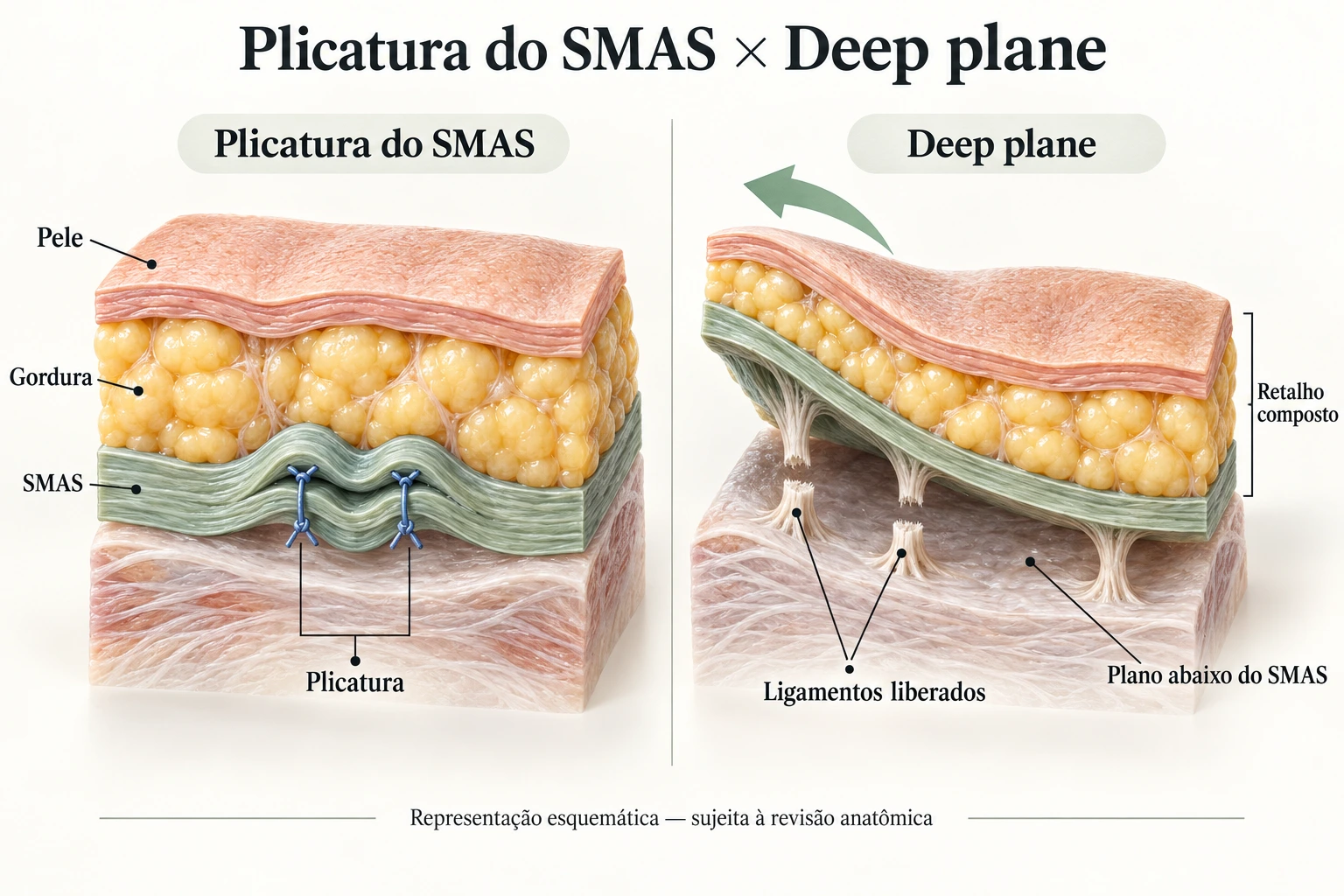
Uses stitches to fold and tighten the SMAS, without the kind of release used in a deep plane facelift.
Understand the differences so you can talk about your surgery with more clarity.
Explore my options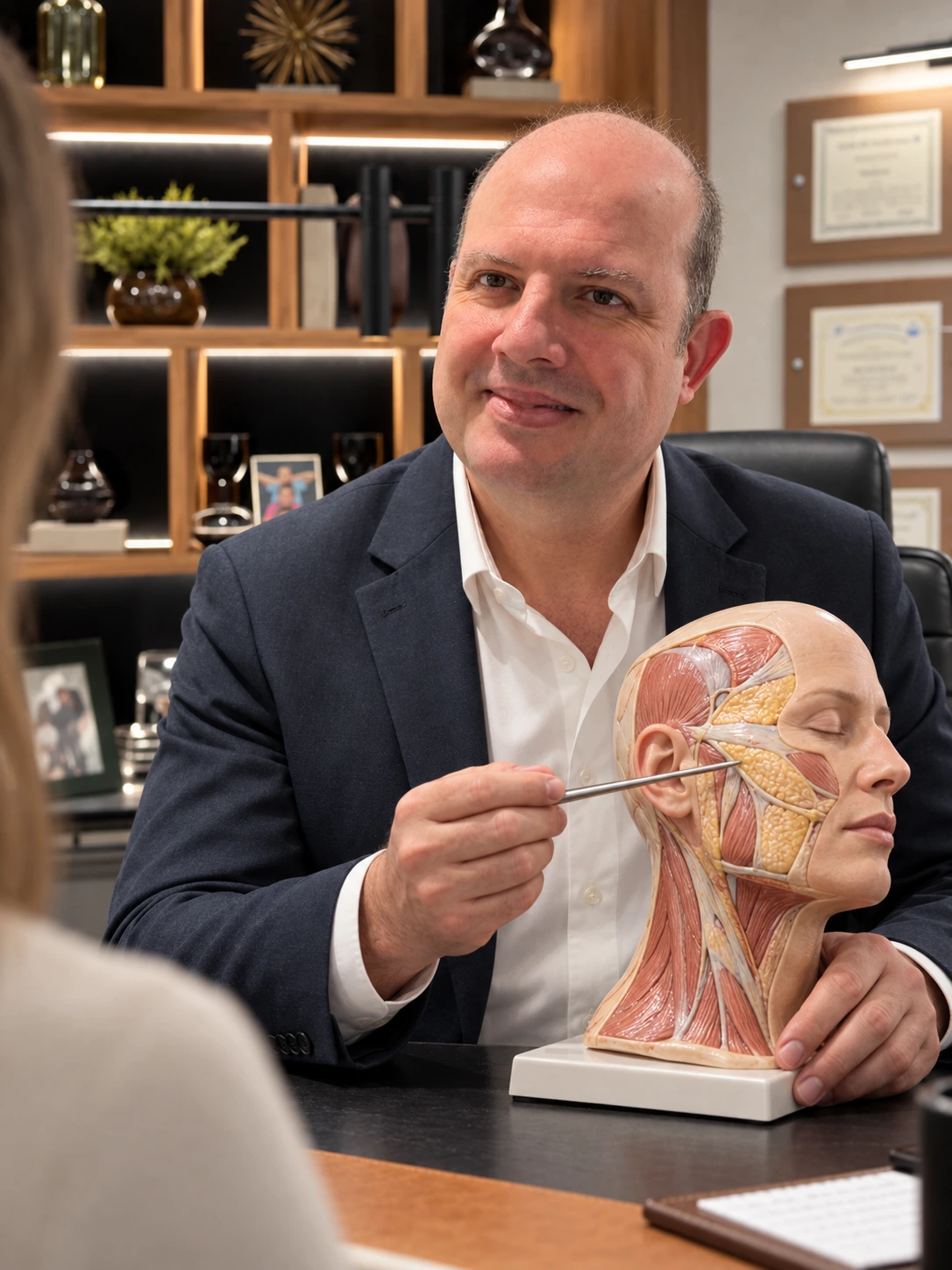
At a glance
The SMAS is the support layer of the face, and it can be treated by plication, resection, or flaps. A deep plane facelift mobilizes the tissues beneath it and releases retaining ligaments to address the cheeks, the nasolabial folds, and the jawline. Studies do not show one technique to be better for everyone. When I plan surgery, I favor the deep plane approach, but I don’t treat that preference as a guarantee.
Choosing
You may have seen results you liked, each presented under a different name, and been left wondering which one makes sense for you. I want this page to help you weigh the explanations you are given, without turning a personal decision into an anatomy exam.
I start by asking what has changed in your face. Does the area along your jawline bother you? Has your neck lost definition? Does your expression look heavy in photos? Your answers guide the exam. Only then do I match each treatment option to what your anatomy allows.
If you have already been given another proposal, feel free to bring it. Comparing complete plans usually tells you more than comparing two names.
SMAS
SMAS stands for superficial musculoaponeurotic system. This tissue layer is part of how the skin and fat connect to deeper structures. In surgery, depending on the approach, it can be folded and stitched, partially removed, or mobilized by lifting it free from the tissues around it.
Uses stitches to fold and tighten the SMAS, without the kind of release used in a deep plane facelift.
Removes a strip of this layer and stitches the edges together. How much is adjusted, and in which direction, varies.
Involve different degrees of dissection and ways of mobilizing the tissue. Not every SMAS facelift is superficial or limited.
That is why I avoid the idea that every technique other than deep plane just pulls the skin. That oversimplification doesn’t help you understand the surgery you are being offered.
Deep plane
In a deep plane facelift, working beneath the SMAS and releasing selected ligaments makes it possible to reposition tissues that have descended. How far the release goes, how the tissues are secured, and how the neck is treated together make up the surgical plan.
Retaining ligaments act as anchor points between the skin and the deeper structures. In their extended version of the technique, Jacono and Bryant describe releasing the zygomatic-cutaneous, masseteric-cutaneous, mandibular-cutaneous, and cervical ligaments to reposition the midface, the jawline, and the neck. Description of the extended technique. Which ligaments are released varies from surgeon to surgeon and from face to face.
In my practice, this reasoning has become central to how I approach facelift surgery. I aim to work on support and on how the regions of the face relate to each other, while preserving the features that make you feel like yourself. It is a technical preference I have built over my career; I don’t present it as proof that any deep plane facelift will turn out better than any other operation.
The full explanation of the approach is in the deep plane facelift guide. Here, the focus is on helping you compare the options.
Bring your questions about the techniques. I will examine your face and explain how each choice relates to the result we are working toward.
Comparison
SMAS approaches: may involve folding with stitches, resection, or dissection, depending on the technique.
Deep plane: mobilizes tissue beneath the SMAS and releases selected ligaments. The SMAS is part of the tissue that is moved, so deep plane and SMAS are not opposing structures.
With both: anatomy, extent, execution, and follow-up all matter. The name of the technique alone cannot guarantee a natural look, how long results last, or a shorter recovery.
I use this table to organize our conversation. It doesn’t lump every SMAS operation into one category, and it doesn’t turn my preference for deep plane into universal superiority.
Questions
Ask the surgeon which areas will be treated and what will be left out. The same word can cover very different plans.
A facial technique does not, by itself, tell you how the skin, the platysma, and the fullness under the chin will be treated.
Repositioning tissue and adding fat are separate decisions. Whether you need a graft can’t be inferred from the name of the facelift.
Find out who will check on your progress, how to report a complication, and how follow-up visits will be scheduled.
Evidence
A 2025 review by Vayalapra and colleagues pooled 47 studies and 10,766 patients. It found good outcomes with both SMAS and deep-layer approaches, but limitations in comparing aesthetic results. Studies with different techniques, patients, and assessment methods do not establish a universal winner. Read the review.
Another 2025 review, by Khoury and colleagues, looked at satisfaction and complications. It pooled 21 studies and 2,896 patients: satisfaction was 94.4% with deep plane and 87.8% with SMAS, and complications totaled 17.2% and 10.3%, respectively. It used a single-arm meta-analysis, combining results from case series rather than randomly assigning comparable patients to the two operations. For that reason, the numerical differences between the groups do not show that the technique alone caused the outcome. Read the study and its methods.
In 2026, Neel and colleagues prospectively followed 166 patients of a single surgeon, 45 with deep plane and 121 with SMAS plication. There was no significant difference in satisfaction, rated rejuvenation, recovery time (median of 25.5 and 30 days), or complications, including temporary facial nerve weakness (11.1% and 12.4%). Median follow-up was three months, too short to answer the question of longevity. 2026 prospective study.
On longevity, a 2026 systematic review by Schultz and colleagues analyzed 17 articles and concluded that SMAS techniques can deliver good results and that more medial deep plane approaches did not show significant midface improvement or greater longevity. Review of SMAS techniques.
I use this evidence to keep the conversation honest: the literature informs my choices, but it doesn’t replace your exam or an assessment of the surgeon’s experience.
A natural look
A face that looks overly pulled can’t be explained by the name of the technique alone. Where the tissues end up, the tension on the skin, any volume added, and whether proportions are preserved are all part of the result.
When I show cases, I explain which procedures were combined and at what stage of recovery the photos were taken. A result that includes eyelid surgery, neck treatment, and fat grafting shouldn’t be used to show what the facelift alone does.
You can tell me what you like and what you wouldn’t want to change. Photos of yourself from other times in your life help with that conversation, but they are not a promise that you will look exactly that way again.
Candidates
No particular age calls for deep plane or for SMAS. I look at how far the cheeks have descended, how deep the nasolabial folds are, the jawline contour, the neck, skin quality, and volume loss. Previous surgery and how much recovery time you can set aside also factor in.
An older study that is still useful here illustrates the point. In 2004, Becker and Bassichis asked four surgeons, blinded to the technique used, to rate photos of 20 patients who had a deep plane facelift and 20 who had SMAS plication. Under age 70, deep plane did not show a better result; in the 70-to-80 group, it scored slightly higher. The small sample and short follow-up limit the conclusion. Blinded assessment study.
In general, good candidates are healthy enough to heal well, don’t smoke, and have realistic expectations. ASPS candidate criteria.
Uncontrolled medical conditions, nicotine use, weight that is still changing, or expectations that surgery can’t meet call for a different time or a different path.
Early changes can be discussed alongside other options, such as a mini facelift, or nonsurgical treatments.
Risks
Hematoma, changes in sensation, nerve injury, healing problems, asymmetry, and the need for revision are risks that must be covered in informed consent. Reviews record these events in different ways, so I don’t carry a rate from one case series over to your case as if it were a personal prediction.
To give a sense of scale: a 2026 meta-analysis by Koroma and colleagues pooled 45 studies and 10,784 patients who had deep plane facelifts. The overall complication rate was 6.6%, with temporary facial nerve weakness in 1.2%, hematoma in 1.8%, and hypertrophic scarring in 2.8%; no permanent facial nerve injury was recorded in these series. The authors call for randomized studies and longer follow-up. Meta-analysis of deep plane complications. These are averages from published series, not a prediction for your case.
I also don’t use “deep” to mean more dangerous or safer. The extent of surgery, your health, medications, smoking, previous procedures, and care before and after the operation all affect the assessment.
The signs that mean you should contact us right away are the same with any technique: rapid swelling of the face or neck, severe pain on one side only, persistent bleeding, fever, discharge, or a change in skin color. Pain or swelling in the calf needs urgent evaluation. Shortness of breath, chest pain, or a sudden change in speech, strength, or vision is an emergency; don’t wait for a reply on WhatsApp. The full list is in the postoperative instructions.
When the facelift includes other areas, recovery has to be planned around the whole procedure. I routinely discuss a return to social activities at around two weeks, with individual variation; the tissues keep settling after that. Look through the patient journey before choosing travel dates or commitments.
Recovery
The chosen surgical plane mainly changes what is done beneath the skin. Facelift incisions usually start in the hairline at the temple, run around the ear, and end in the scalp behind it; the neck may require a small incision under the chin. Steps and incisions, ASPS. Scars do exist, and they mature over the following months.
I routinely operate at Hospital do Coração Bela Suíça in Londrina under total intravenous anesthesia (TIVA), and discharge usually takes place the next morning, after I examine you. In my hands, a facelift takes about three hours; when I add a deep neck, it takes about 50 minutes more. Stitches come out at 7, 10, and 14 days. I clear you for light exercise at one month and for any physical activity, including contact sports, at two months. I advise not driving for ten days; you can usually return to social activities after about two weeks, possibly with some swelling still present.
These timelines describe the facelift I perform, not a comparison between techniques. In the Neel study cited above, recovery time was similar for deep plane and plication. Each stage is covered in detail in the deep plane facelift guide and the patient journey.
Decision
At the consultation, I want you to leave knowing what I propose to treat, why I chose that approach, and what limitations remain. You don’t need to agree to surgery to get something out of that conversation.
My preference for deep plane becomes meaningful when I can relate it to your face and your priorities. If the indication isn’t clear, we can talk about waiting or looking at another kind of care. A good decision starts with an explanation you understand.
The cost is also set after the assessment. It depends on the areas treated, any combined procedures, operating time, the hospital, and anesthesia, not on the name of the technique. I explain how I handle this step on the pricing page.
Questions
A deep plane facelift is directly tied to the SMAS and works beneath it. The useful distinction is between ways of mobilizing and releasing tissue, not between using that structure or not.
No individual timeframe can be guaranteed, and there is not enough evidence to claim universally superior longevity. Aging, anatomy, technique, and lifestyle all play a part in how results hold up.
No. There are several SMAS techniques, and natural results are possible with different approaches. I evaluate the plan and how it is carried out, rather than blaming an acronym for an artificial look.
No. The 2026 systematic review by Schultz and colleagues concluded that SMAS techniques can deliver good results. What matters is whether the proposed technique fits your anatomy and the degree of correction you need.
Revision surgery can be considered, but scars and changes from earlier surgery need a specific exam. Bring information about your previous operation; whether it is possible shouldn’t be confirmed from photos alone.
Check the areas treated, combined procedures, hospital, anesthesia, and follow-up. Different plans can go by the same name and can’t be compared on price alone.
In published series, temporary facial nerve weakness after deep plane facelifts was around 1.2%, and no permanent injury was recorded in the 2026 meta-analysis. A prospective study found no difference between deep plane and SMAS plication. It is a risk I discuss during informed consent, without promising it won’t happen.
Not necessarily. In a 2026 study, median recovery was 25.5 days with deep plane and 30 days with plication, with no significant difference. I routinely see patients return to social activities after about two weeks, with individual variation.
At the consultation, we can turn the comparison between techniques into a plan that makes sense for the anatomy of your face.
References
The sources below support the general information on this page. When I describe how I care for patients, I am describing my team’s routine; the guidance for your surgery will be individual.
This page in other languages: Português (BR) | Español | Français | Italiano