Every week, patients sit across from me and ask the same question: “Doctor, should I get fat grafting or fillers?” After performing over 8,000 surgeries in more than 20 years of practice, I can tell you this — the answer is never one-size-fits-all. Both fat grafting and dermal fillers restore facial volume, but they do so in fundamentally different ways, with different trade-offs that matter enormously depending on your goals, your anatomy, and your stage of life.
In this article, I’ll share my honest perspective as a surgeon who performs both procedures regularly. No marketing spin — just the clinical reality I see every day in my operating room and office in Londrina, Brazil.
How Fat Grafting Works
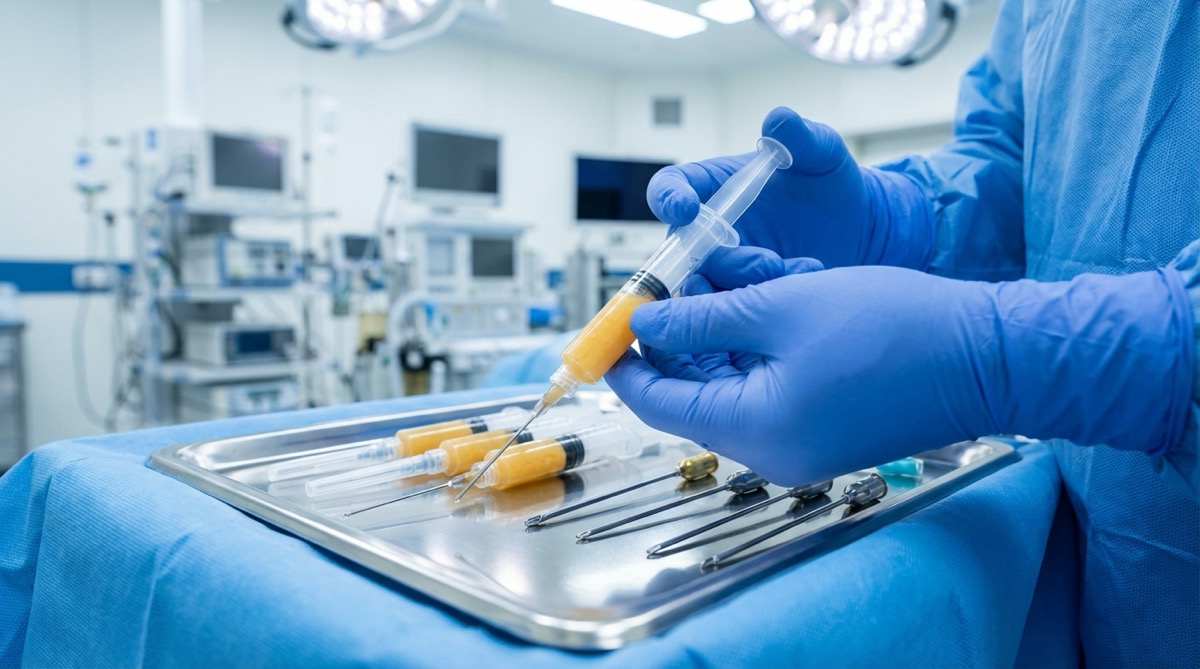
Fat grafting — also called fat transfer or lipofilling — is a surgical procedure where I harvest fat from one area of your body (usually the abdomen or thighs), process it carefully, and reinject it into the face. The technique I use is part of my Regenerative Deep Plane approach, where fat grafting plays a central role in facial rejuvenation.
What makes fat grafting unique is that it’s not just a filler — it’s a biological transplant. The transferred fat contains adipose-derived stem cells (ADSCs) that stimulate collagen production, improve skin quality, and promote tissue regeneration. This is why patients often notice their skin looks healthier and more luminous in the months following the procedure, even in areas that weren’t directly injected.
The fat is processed using centrifugation or decantation to separate viable fat cells from oil, blood, and tumescent fluid. The purified fat is then micro-injected in small parcels across multiple tissue planes, maximizing survival rates. In experienced hands, 60–80% of the transferred fat integrates permanently into the facial tissues.
Recovery typically involves 7–14 days of noticeable swelling, with final results visible at 3–6 months once the fat has fully integrated.
How Dermal Fillers Work
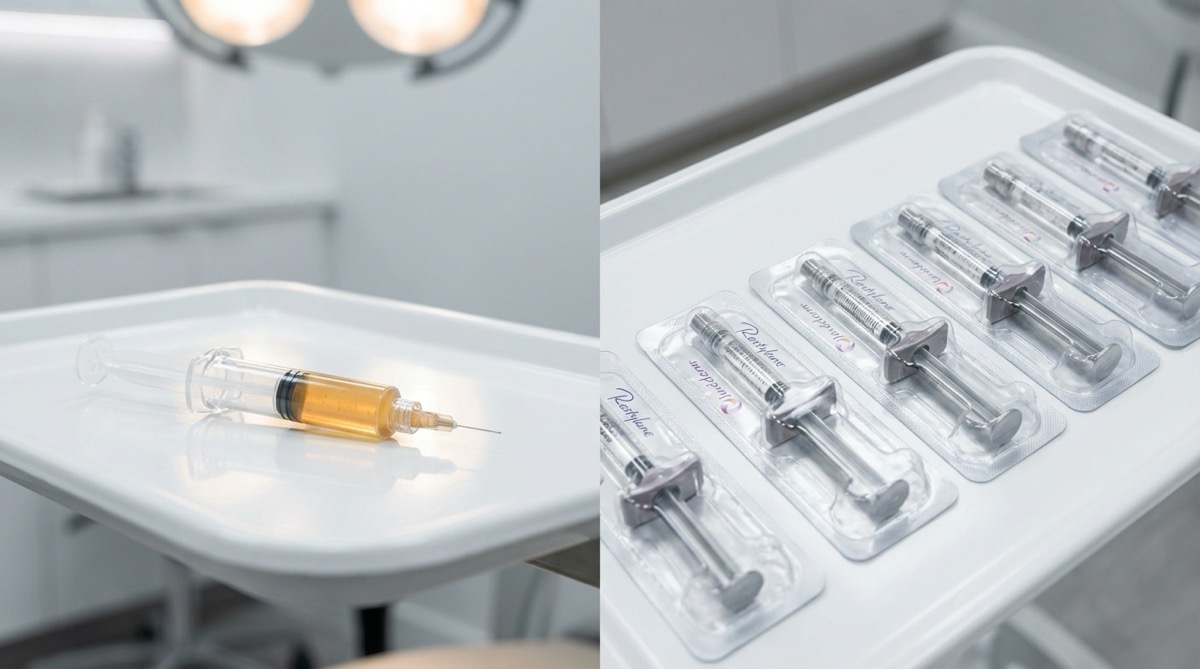
Dermal fillers — primarily hyaluronic acid (HA) products like Juvederm and Restylane — are gel-like substances injected directly into facial tissues to restore volume, smooth wrinkles, or enhance contours. The procedure takes 15–45 minutes, requires no general anesthesia, and patients can return to normal activities almost immediately.
Hyaluronic acid is a naturally occurring molecule in your skin that attracts and retains water, creating a plumping effect. Different formulations have varying levels of cross-linking, which determines their thickness, lifting capacity, and longevity. Thicker products work well for cheek augmentation and jawline definition, while thinner ones are better suited for lips and fine lines.
Results are immediate but temporary, typically lasting 6–18 months depending on the product, the area treated, and your metabolism. The body gradually breaks down the hyaluronic acid, and the effect fades. One significant advantage: HA fillers can be dissolved with hyaluronidase if the result is unsatisfactory or if a complication arises.
Fat Grafting vs Dermal Fillers: A Detailed Comparison
Here’s how the two approaches compare across the factors that matter most to my patients:
| Factor | Fat Grafting | Dermal Fillers |
|---|---|---|
| Longevity | Permanent (surviving fat lasts a lifetime) | Temporary (6–18 months) |
| Naturalness | Extremely natural — it’s your own tissue | Very good with modern products, but can look “puffy” if overdone |
| Cost Over 10 Years | Lower (one-time investment, occasional touch-up) | Higher (repeated sessions every 6–18 months) |
| Recovery | 7–14 days of visible swelling | 0–3 days of mild swelling |
| Anesthesia | Local + sedation or general | Topical or local only |
| Stem Cell Benefit | Yes — regenerative effect on skin quality | No |
| Reversibility | Not easily reversible | Reversible with hyaluronidase |
| Risk of Vascular Occlusion | Very low | Low but documented, especially near the nose and glabella |
| Best Areas | Cheeks, temples, periorbital, jawline, full face | Lips, nasolabial folds, marionette lines, targeted touch-ups |
| Volume Capacity | Large volumes (20–60 mL per session) | Limited (typically 1–4 mL per session) |
When I Recommend Fat Grafting
Fat grafting is my first recommendation when patients present with significant facial volume loss — the kind that makes the face look gaunt, hollow, or prematurely aged. Specifically, I recommend it for:
- Patients over 45 with global volume deflation — sunken cheeks, hollow temples, deep under-eye circles. These patients need substantial volume restoration that fillers simply cannot deliver cost-effectively.
- Patients combining procedures — if you’re already undergoing a facelift or eyelid surgery, adding fat grafting during the same operative session is highly efficient. One recovery, multiple benefits.
- Patients who want a permanent solution — those tired of returning every 12 months for filler maintenance.
- Patients seeking skin quality improvement — the stem cell component of fat grafting genuinely improves skin texture, thickness, and luminosity in ways fillers cannot.
- Under-eye hollows and tear troughs — in many cases, fat grafting provides a more natural, longer-lasting correction than filler in this delicate area.
When I Recommend Fillers
Fillers are the better choice in several specific scenarios:
- Younger patients (30s–early 40s) with mild volume loss — a syringe or two of filler can restore subtle volume without surgery.
- Patients who want zero downtime — professionals, public figures, or anyone who simply cannot take time off.
- Very targeted corrections — lip enhancement, a specific nasolabial fold, a small chin projection adjustment.
- “Test drive” before surgery — some patients want to see what more volume looks like before committing to a permanent procedure. Fillers serve as an excellent preview.
- Patients with insufficient body fat — very thin patients may not have enough donor fat for an effective transfer.
The Hybrid Approach: Combining Fat Grafting and Fillers
In my practice, I’ve found that the most sophisticated rejuvenation plans often combine both techniques. Here’s a scenario I see frequently:
A 52-year-old patient undergoes a deep plane facelift with fat grafting for global volume restoration — cheeks, temples, periorbital area, jawline. Six months later, once everything has settled, she returns for a small touch-up with filler: perhaps 1 mL in the lips for definition, or a subtle correction in the nasolabial folds.
This hybrid approach leverages the permanent, regenerative power of fat for the heavy lifting, while using fillers for precision finishing touches. It’s the best of both worlds.
The goal is never to choose between fat grafting and fillers — it’s to understand which tool serves which purpose in your specific rejuvenation plan.
Frequently Asked Questions
Is fat grafting more painful than fillers?
Fat grafting is a surgical procedure performed under anesthesia, so you feel nothing during the operation. Post-operative discomfort is mild and manageable with oral medication. Fillers involve needle pricks that can be uncomfortable but are typically well-tolerated with topical anesthetic. Overall, the recovery experience differs more than the pain itself — fat grafting requires downtime, while fillers do not.
How much does fat grafting cost compared to fillers?
Fat grafting has a higher upfront cost since it’s a surgical procedure. However, when you calculate the cumulative cost of filler maintenance over 5–10 years (repeated sessions every 6–18 months), fat grafting almost always becomes the more economical option. I always encourage patients to think in terms of total investment over time, not just the initial price tag.
Can fat grafting go wrong? What if too much fat survives?
In experienced hands, overcorrection is rare. I use a conservative, multi-layered injection technique and slightly overcorrect initially (by about 20–30%) because some fat is naturally reabsorbed. If the result is slightly fuller than desired, the face typically settles into a natural look within 3–6 months. Unlike fillers, excess fat cannot be “dissolved,” which is precisely why surgical precision and experience matter enormously.
Are there any risks specific to facial fillers I should know about?
The most serious risk with facial fillers is vascular occlusion — when filler is inadvertently injected into or compresses a blood vessel. This can lead to skin necrosis or, in extremely rare cases, vision problems. The nose and glabella (between the eyebrows) are particularly high-risk zones. This is why I always emphasize choosing an experienced physician and why I’m selective about which areas I treat with fillers.
Can I get fat grafting if I’m very thin?
It depends on how thin. Even slender patients usually have enough fat in the lower abdomen, inner thighs, or flanks for facial fat grafting — we typically need only 30–60 mL of raw fat. However, if you have an extremely low body fat percentage (such as competitive athletes), the harvest may be insufficient. In those cases, fillers or a combination of a small fat harvest plus fillers may be the better approach.
Ready for an honest assessment? During your consultation, I’ll evaluate your facial anatomy, volume loss pattern, skin quality, and goals to recommend the approach — or combination of approaches — that will give you the most natural, lasting result. Learn more about my Regenerative Deep Plane technique or explore facelift options.