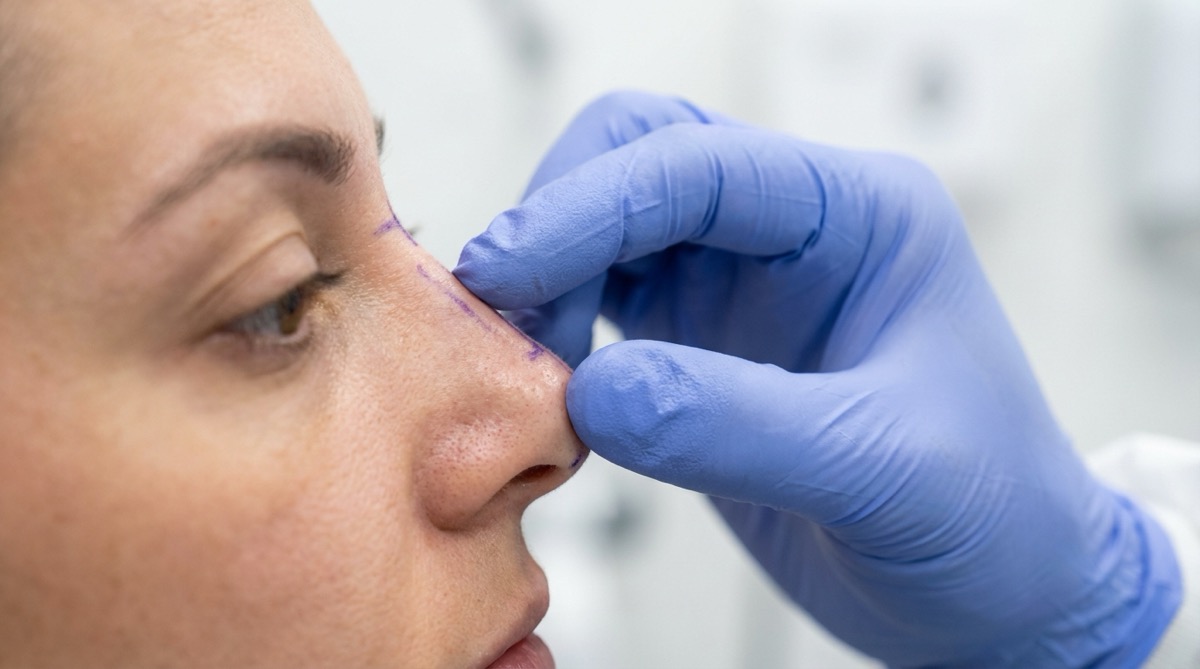
Over the course of more than 20 years and over 8,000 surgeries, one of the most common situations I encounter in my practice in Londrina, Brazil, is patients who come to me dissatisfied with the results of a rhinoplasty performed by another surgeon. These are individuals who had legitimate expectations for their procedure and, for various reasons, did not achieve the desired outcome — whether aesthetic, functional, or both.
Revision rhinoplasty — also known as secondary rhinoplasty — now represents a significant portion of my surgical practice. I can say with confidence: it is one of the most complex and challenging surgeries in all of facial plastic surgery. It is not simply about “fixing” something that did not turn out well. It involves reconstructing structures in an anatomical field that has already been modified, where internal scarring exists, cartilage has been removed or altered, and tissues behave unpredictably.
In this article, I want to explain transparently when it makes sense to consider a revision, what makes this procedure different from a primary surgery, and how my approach using structural rhinoplasty technique aims to deliver lasting and predictable results — even in the most difficult cases.
What Is Revision Rhinoplasty
Revision rhinoplasty is any surgical procedure performed on the nose after a primary rhinoplasty. Its goal may be to correct aesthetic problems, functional issues, or both that arose — or persisted — after the first surgery.
It is important to understand that not every dissatisfaction after a rhinoplasty means something went wrong technically. Sometimes the result is within what was surgically expected, but it does not match the patient’s expectations. That is why, before recommending a revision, I conduct a thorough evaluation to distinguish between:
- A real problem that can be surgically corrected
- Misaligned expectations that require an honest conversation about limitations
- A result still in evolution that needs more time to mature
This distinction is critical. Operating on a nose that does not need revision can worsen the result, and this is a responsibility I take very seriously.
When It Is Time to Consider a Revision
Throughout my experience, I have identified the most common scenarios that lead patients to seek me out for a redo nose job:
Signs that a revision may be necessary:
- Breathing difficulties that appeared or worsened after the first surgery — frequently caused by nasal valve collapse, residual septal deviation, or synechiae (internal adhesions)
- Visible asymmetries that do not improve over time — a crooked tip, irregular dorsum, or uneven nostrils
- An obviously “operated” appearance — an overly upturned tip, excessively narrow nostrils, an overly lowered dorsum, or the so-called “inverted-V deformity”
- Progressive deformities — when the nose changes shape over months or years, usually due to inadequate structural support in the first surgery
- Alar retraction — when the nostril rim rides up excessively, exposing the interior of the nose from the front view
It is crucial to respect the minimum waiting period. I recommend waiting at least 12 to 18 months after the primary rhinoplasty before considering a revision. This period is necessary for the edema (swelling) to resolve completely and for the tissues to reach their definitive shape. Operating before this time frame risks correcting something that would have resolved on its own.
Why Revision Is More Difficult Than the First Surgery
This is a question I hear frequently: “Doctor, if it was done once before, why would it be harder to do again?” The answer involves several factors:
1. Internal scarring: Every surgery generates scar tissue. The second time around, the surgeon works in a field where normal anatomical planes have been altered by fibrosis. The tissues are stiffer, less predictable, and more prone to bleeding.
2. Missing or modified cartilage: In primary rhinoplasty, many surgeons remove cartilage — from the septum, upper laterals, or alar cartilages. In a revision, that cartilage simply is no longer available. It is like trying to rebuild a house when some of the original materials have been discarded.
3. Compromised structural support: If the first surgery weakened the nose’s support without adequately rebuilding it, the revision needs to not only correct the shape but also reconstruct the foundation upon which the entire nose rests.
4. Unpredictable tissue behavior: The skin and soft tissues of a previously operated nose respond differently. Their capacity for retraction and accommodation is reduced, and the final result may take longer to stabilize.
Statistically, while the revision rate after a well-executed primary rhinoplasty ranges from 10% to 15%, with the structural technique I use, this rate drops to 3% to 5%. This is because the structural technique preserves and rebuilds nasal support, significantly reducing the chance of progressive deformities.
My Approach to Revision Rhinoplasty
Over the years, I have developed a rigorous protocol for patients who seek me for secondary rhinoplasty. Each case is unique, but certain principles guide my practice:
Detailed evaluation: Before anything else, I need to understand exactly what was done in the first surgery. I request operative reports when available, perform a thorough physical examination, and in many cases order a CT scan to assess the condition of the septum and internal structures.
Three-dimensional planning: Revision rhinoplasty leaves no room for improvisation. Every surgical maneuver must be planned in advance, taking into account the limitations imposed by the previous surgery.
Structural technique with grafts: My philosophy is to always rebuild support before refining shape. I use strategically placed cartilage grafts to restore nasal architecture. The most common grafts include:
- Residual septal graft — when septal cartilage is still available (not always the case in revisions)
- Auricular cartilage graft — from the ear, useful for minor refinements
- Costal cartilage graft — from the rib, reserved for more complex cases where there is significant material deficiency
Open approach (external approach): In the vast majority of revisions, I choose the open rhinoplasty approach. It provides direct visualization of all structures, allowing me to identify and correct problems that would be invisible through a closed approach.
Honesty about limitations: It is not always possible to achieve the “dream nose” in a revision. The previous surgery imposes real constraints. I prefer to be transparent about what I can and cannot do rather than create false expectations.
Rib Cartilage Graft — When It Is Necessary
The costal cartilage graft is one of the most powerful tools in revision rhinoplasty, yet also one of the most feared by patients. Let me demystify this topic.
When I recommend a rib graft:
- When the nasal septum has already been used or is insufficient
- When major reconstructions are needed (dorsum, tip, and sidewalls simultaneously)
- When the nose has undergone multiple previous surgeries and requires abundant material for reconstruction
- When significant structural collapse is compromising the airway
How the harvest is performed: The cartilage is harvested through an incision of approximately 3 cm in the inframammary region (below the breast or pectoral area), resulting in a discreet scar. I remove only the cartilaginous portion of the rib, without compromising the periosteum or the bony structure. Pain at the donor site is generally moderate and well controlled with standard analgesics.
Advantages of rib cartilage:
- Abundance of material — enables extensive reconstructions
- Firm, resilient cartilage — ideal for structural support
- Can be precisely sculpted for different purposes
- Long-lasting, durable results
A critical consideration is cartilage warping. I employ sculpting techniques that minimize this risk, such as balanced strip cutting and proper graft fixation.
What to Expect During Recovery
Recovery from revision rhinoplasty is generally similar to that of primary rhinoplasty, with a few notable differences:
First 7 to 10 days: Nasal splint in place, possible periorbital bruising (“black eyes”), and moderate to significant swelling. This is the period of greatest discomfort, especially if a rib graft was harvested.
2 to 4 weeks: Gradual return to daily activities. The most visible swelling has already decreased significantly, but the nose is still far from its final shape.
3 to 6 months: Progressive resolution of edema. The nasal tip is always the last area to lose its swelling. During this period, the patient can already get a good sense of the result, although subtle refinements continue.
12 to 18 months: The result is considered definitive. In revisions, swelling tends to be more prolonged than after a first surgery, because the tissues already carry scars and respond differently.
Special care after revision:
- Avoid intense physical activity for 6 weeks
- Strict sun protection on scars for 6 months
- Do not wear glasses resting on the nasal dorsum for at least 8 weeks
- Patience — the final result takes longer to consolidate than after a primary surgery
Frequently Asked Questions
How many times can a rhinoplasty be redone?
Technically, there is no absolute limit, but each additional surgery increases complexity and reduces the predictability of the result. In my experience, most patients achieve a satisfactory outcome after one well-planned revision. In rare cases, a third procedure may be necessary, but this should be the exception, not the rule.
Is revision rhinoplasty more painful than the first?
The discomfort is comparable. If a rib graft is involved, the patient will have an additional area of soreness (the chest region), but this is well managed with medication. The nasal discomfort itself is similar to that of the first surgery.
How long do I need to wait before having a revision?
I recommend a minimum of 12 to 18 months after the previous surgery. The nose needs to be fully healed and free of swelling so that I can accurately assess what truly needs correction and so the tissues are in optimal condition for a new procedure.
Can a revision make things worse?
Like any surgery, revision carries risks. However, when performed by an experienced surgeon with proper planning and structural technique, the chances of improvement are significantly greater than those of worsening. My commitment is to always be honest: if I assess that surgery carries more risk of worsening than improving, I will not recommend the procedure.
What is the success rate of revision rhinoplasty?
Success rates vary depending on the complexity of the case and the definition of “success.” In the literature, patient satisfaction after revision rhinoplasty performed by experienced surgeons ranges from 75% to 90%. In my practice, using structural technique with cartilage grafts and meticulous planning, I achieve high satisfaction rates. The key is honest preoperative communication about realistic goals.
If you are considering revision rhinoplasty, the first step is a thorough evaluation. During a consultation at my clinic in Londrina, Brazil, I examine your nose, analyze what was previously done, and with complete transparency, explain what can realistically be achieved. I welcome patients from around the world seeking expert revision rhinoplasty care. Learn more about my rhinoplasty practice.

drwalterzamarianjr
Dr. Walter Zamarian Jr. é cirurgião plástico em Londrina-PR (CRM-PR 17.388 | RQE 15.688), membro titular da SBCP e da ASPS. Formado em Medicina pela UEL, com especialização no Instituto Ivo Pitanguy (38a Enfermaria da Santa Casa do Rio de Janeiro) e treinamento nos EUA em lifting facial Deep Plane, rinoplastia estruturada e cirurgia íntima feminina. Com mais de 20 anos de experiência e 8.000+ cirurgias realizadas, é referência em rejuvenescimento facial e cirurgia genital feminina.
Deixe um comentário