More coverage over deeper structures
The transferred volume can soften the look of very prominent tendons and veins without removing them.
Your hands can also be part of the care you have chosen for yourself.
Explore my options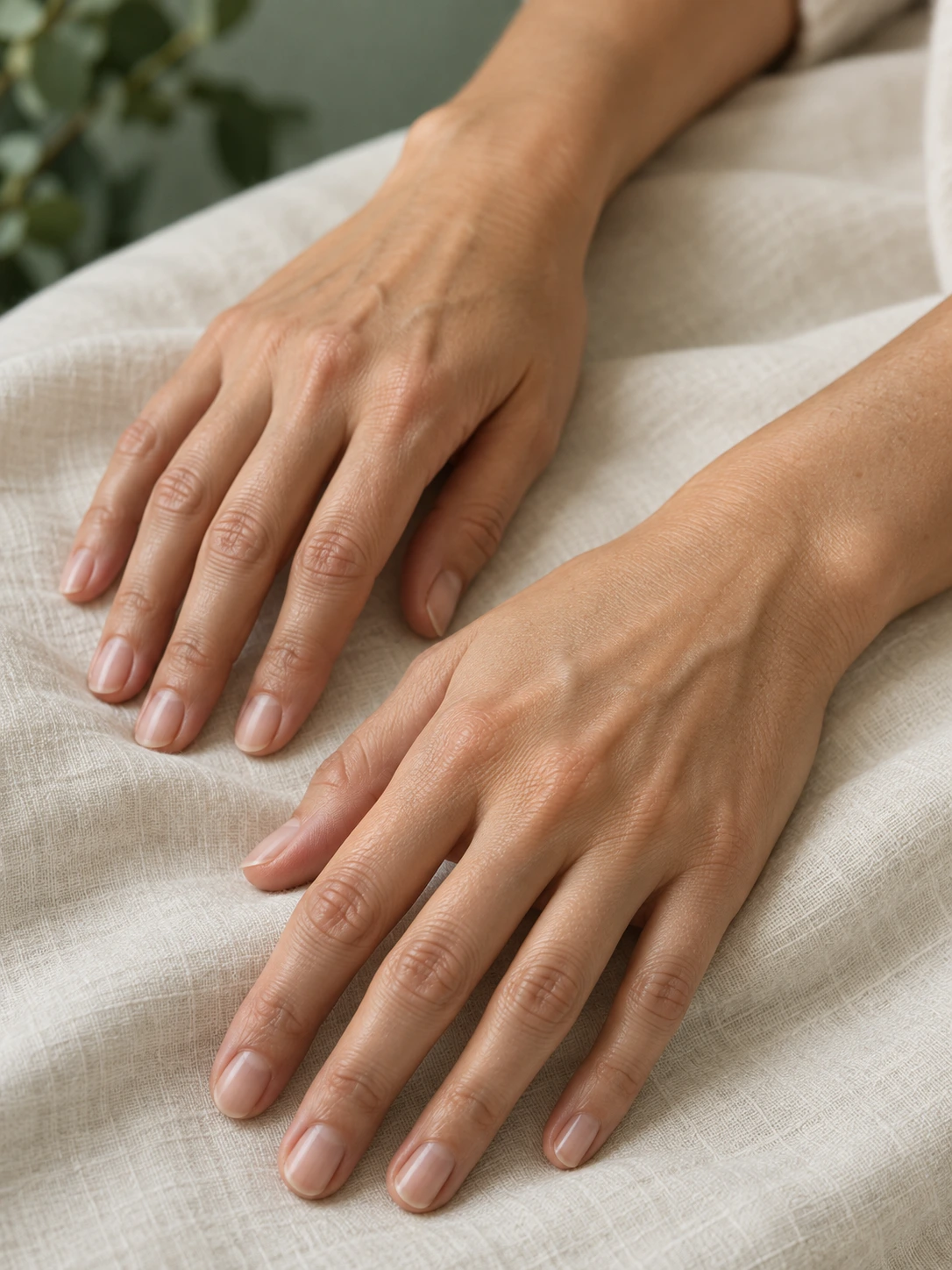
At a glance
Hand fat grafting, also called fat transfer to the back of the hands, moves your own fat to restore lost volume and make tendons and veins less visible. I only perform it during a facelift, never as a stand-alone procedure. It does not remove veins, treat dark spots, or improve strength or mobility.
What you notice
You may notice that your tendons stand out more, your veins look more prominent, or your hands no longer seem to match your face. Rather than putting it all down to aging skin, I want to know which of these bothers you most.
Volume, dark spots, and texture each call for a different evaluation. A hand with little tissue covering the deeper structures may benefit from restoring volume; a new spot, or one that has changed in appearance, needs a proper evaluation first. Trying to hide it with a graft is not the right approach.
I also consider how you use your hands day to day. Manual work, handling tools or instruments, exercise, and having to care for someone else all help us plan your recovery. The plan has to fit your life, not just look good in a photo.
Benefits
The transferred volume can soften the look of very prominent tendons and veins without removing them.
The fat is distributed to reduce hollows on the back of the hand, avoiding excess and respecting the natural shape of the hand.
I only perform hand fat grafting during a facelift. If you want your hands treated, I will evaluate whether to add it; it is an additional choice, not a requirement.
I don't promise wrinkle-free hands, invisible veins, or better strength and mobility. The goal of this approach is cosmetic: restoring volume. Joint pain, changes in sensation, or loss of function should be evaluated to identify the cause.
I also explain that fat used for volume and preparations studied for their biological effects are not interchangeable terms. The fact that the tissue contains cells does not justify promising skin regeneration.
Planning
I look at the skin, how much the underlying structures show, and the differences between your two hands. I ask about medical conditions, medications, surgeries, previous fillers, and recent weight changes. This information can affect both whether the procedure is right for you and the area we will take the fat from.
Because some of the fat is absorbed, I place more fat in the hands than the final volume we are aiming for, allowing for that absorption. That is why the backs of your hands may look fuller in the first few weeks than they will end up. This approach means a revision of the graft is rarely needed.
Because hand fat transfer is done during a facelift, the team will plan care for your hands, your face, and the donor area. Combining procedures only makes sense when you will have the support and peace of mind to get through recovery.
Tell me what bothers you most. I'll separate volume loss from skin changes and explain what fat grafting can realistically achieve.
Technique
The fat is removed by liposuction from a selected area, prepared, and placed through small incisions. This is a transfer of living tissue: part of it has to survive where it is placed. That is why the volume placed should not be equated with the final volume. The general principles of harvesting, preparation, and reabsorption are the same as in the face and are covered on the facial fat grafting page.
On the back of the hand, I distribute the fat with a cannula, in a fan pattern, just under the skin. In the review by McGuire and colleagues, which included 31 studies, fanning with a cannula from the wrist toward the fingers was associated with a lower risk of complications. Review of hand rejuvenation techniques.
The anatomy of the hand calls for close attention to blood vessels, nerves, and tendons. The layer the fat goes into and how it is distributed are technical decisions. You don't need to memorize these details, but you should know that the procedure involves more than simply filling an empty area.
The donor area may be sore, bruised, and uneven. Even when only a small amount is removed, it has to be part of the conversation about recovery and scars. Hand surgery should not be presented as a simple injection with no other step involved.
I only treat the hands together with a facelift, never on their own: the fat transfer is done during the same operation and under the same total intravenous anesthesia (TIVA), which I use in almost all my surgeries. The incisions on the back of the hand and in the donor area are tiny entry points for the cannula.
Evidence
In 2022, Vermeersch and colleagues published a review of ten studies including 320 patients who had fat grafted to the back of the hands. The results were promising, with high satisfaction; swelling occurred in nearly all patients. The authors called for more objective volume measurements, validated questionnaires, and longer follow-up. Review focused on hand rejuvenation.
These limitations matter: a report of satisfaction doesn't tell you how much fat each person retained, nor does it rule out the risk of irregularities. At the consultation, I explain the difference between a well-supported possibility and an exact prediction for your hands.
Studies of fat grafting for hand diseases have different goals. Their findings should not be used to claim that a cosmetic procedure will treat osteoarthritis, pain, or any loss of function. The purpose here is to improve the volume and appearance of the back of the hand, based on its own indication.
A more recent review by Abu Alqam and colleagues, published in 2025, included 11 studies and 303 patients, with follow-up ranging from five to 38 months. Satisfaction rates were again favorable, but the authors stressed the need to standardize volume measurements and acknowledged that further sessions may be needed because fat is absorbed. 2025 review.
Recovery
Swelling and bruising can make tasks that usually seem minor harder, such as getting dressed, cooking, or carrying things. Before surgery, talk with the team about your work and who will be able to help. Because the hands are treated together with a facelift, this planning matters even more.
You will receive instructions on dressings, hand position, and returning to your activities. Don't press, massage, or exercise your hands on your own to try to shape the graft. When you are cleared depends on how the tissues heal and on what each task demands: you can usually return to light tasks before strenuous effort, extended typing, or heavy manual work. Light exercise is allowed after one month; any physical activity, including contact sports, after two months.
One hand may lose its swelling at a different pace from the other. Follow-up visits make it possible to tell expected variation from something that needs treatment. Don't judge the final result while swelling still dominates how your hands look.
On the Journey page, we show how the consultation, discharge, and follow-up fit together. Let Isanna know if you are traveling in for surgery and whether you will be on your own: arranging support is as practical a step as choosing your dates.
Risks
Infection, hematomas, changes in sensation, asymmetry, lumps, oil cysts, irregularities, or more absorption than desired can occur. A correction may be needed, and the donor area carries its own risks. Using fat from your own body does not make the procedure free of complications.
In the review by Vermeersch and colleagues, covering 320 patients, bruising was reported in 7%, temporary changes in sensation in 5.3%, cysts or irregularities in 1.3%, and infection in 0.67%, with no major complications. These figures come from studies with different methods and are not a prediction for your case. Complications in the 2022 review.
Severe or worsening pain, a marked change in color, cold fingers, loss of sensation, fever, or discharge need prompt evaluation. Don't wait for your scheduled visit to report a change that is getting worse.
Over the long term, volume can change with weight and aging. I monitor how things evolve at follow-up visits. If, once the fat has settled, more was absorbed than expected, I can perform a revision of the hand graft, which is rare. I don't promise that a single treatment will meet every need.
Alternatives
Aging of the back of the hand combines thinning skin, bulging veins, and more visible tendons and bones. In their 2016 review, Hoang and colleagues list microdermabrasion, chemical peels, and fillers as alternatives to fat. Review of fat grafting for hand rejuvenation.
Among fillers, calcium hydroxylapatite is the most studied on the back of the hand: in the review by McGuire and colleagues, both it and fat were the most frequently evaluated treatments, each in 32.2% of studies. Fillers don't require a donor area, but they come with their own risks and management. I don't perform filler injections in my practice; I mention these options so the comparison is complete.
Addressing dark spots, skin texture, and sun damage calls for a proper evaluation, skin care, and sun protection. A lesion that has changed in appearance needs to be examined before any cosmetic procedure.
The cost of treating the hands is part of planning your facelift and depends on the donor area, the hospital, and anesthesia. The factors are explained on the pricing page.
Questions
No. The idea is to add tissue coverage so some structures are less noticeable. Veins and tendons stay in place and serve important functions.
It is not a treatment for dark spots. A skin evaluation may point to other treatments, and a suspicious lesion should be investigated before any cosmetic procedure.
The fat that takes can last a long time, but retention is not the same for everyone. Weight, aging, and how your tissues respond affect how your hands will look in the future.
Yes, and that is the only way I do it: hand fat grafting is done during the facelift, when it is indicated. I evaluate the overall plan and your recovery, including the help you may need with tasks that use your hands.
No. I only perform hand fat grafting during a facelift, in the same operation and under the same anesthesia. If you only want your hands treated, I can evaluate them and explain what I see, but I don't perform the procedure on its own. The exception is a revision of a previous graft, when needed, which is rare.
The principle of transferring tissue is similar, but the anatomy, tissue layers, and goals are specific to the hands. Results from facial studies should not be automatically applied to this area.
Whether there is enough donor fat is assessed during the exam. Being thin does not, in itself, rule you out, but it doesn't guarantee there is enough volume for the intended goal either.
Show me what you notice in your hands. We can evaluate volume loss, skin quality, and the limits of each treatment.
References
The sources below support the general information on this page. When I describe how I care for patients, I am describing my team's routine; the guidance for your surgery will be individual.
This page in other languages: Português (BR) | Español | Français | Italiano